
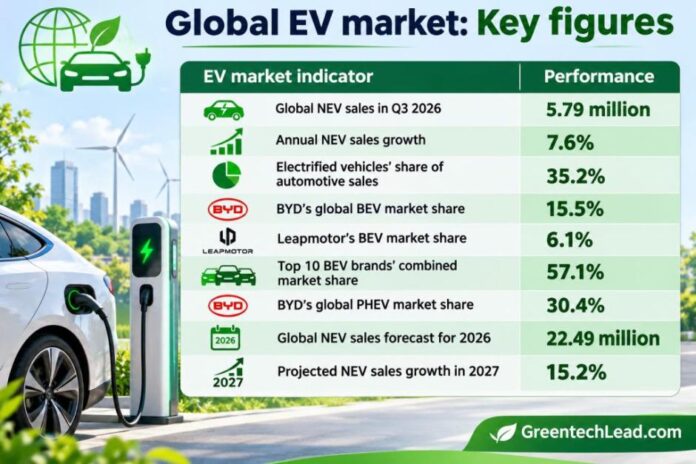
Global new energy vehicle (NEV) sales increased 7.6 percent year-on-year to 5.79 million units in the third quarter of 2026, driven by demand for battery electric vehicles (BEVs), despite weakening sales of plug-in hybrid electric vehicles (PHEVs), according to the latest research from TrendForce.
Battery electric vehicles, plug-in hybrid electric vehicles, fuel cell vehicles (FCVs) and hybrid electric vehicles (HEVs) collectively accounted for a record 35.2 percent of global automotive sales during Q3 2026, highlighting the accelerating transition away from conventional petrol and diesel vehicles.
Higher fuel prices, improvements in battery technology, longer driving ranges and government incentives targeting fully electric vehicles supported BEV adoption. Meanwhile, weakening consumer demand for plug-in hybrids in China contributed to changes in the global electric vehicle market.
BYD, Tesla and Leapmotor dominate global BEV market
Chinese electric vehicle manufacturer BYD maintained its leadership in the global battery electric vehicle market with a 15.5 percent share during Q3 2026, followed by Tesla.
Leapmotor secured third position with a 6.1 percent market share, benefiting from new vehicle launches, portfolio expansion and growing international demand.
Xpeng returned to eighth position for the first time since Q4 2025, supported by new model introductions. MG secured ninth position, benefiting from overseas sales growth and improved performance in China. Toyota, GAC Aion and Xiaomi dropped out of the global top 10 BEV brands.
The combined market share of the world’s 10 largest BEV brands increased from 52.5 percent in Q2 2026 to 57.1 percent in Q3 2026, representing an increase of 4.6 percentage points.
Growing market concentration could intensify pressure on smaller electric vehicle manufacturers struggling with production costs, pricing competition, distribution network expansion and profitability.
Affordable electric vehicles drive consumer demand
The International Energy Agency’s Global EV Outlook 2026 forecasts global electric car sales of 23 million units in 2026, representing approximately 28 percent of new car sales worldwide.
Electric vehicle affordability remains a major competitive advantage for Chinese automakers. According to the IEA’s research on electric car pricing trends, average BEV prices declined by more than 10 percent in China, approximately 6 percent in Germany and nearly 2 percent in the United States during 2025.
Approximately 30 percent of BEV models available in China in 2025 had starting prices below $20,000.
Declining battery costs, competitive pricing strategies and the growing availability of affordable electric cars are strengthening the business case for fully electric vehicles in both developed and emerging economies.
BYD leads PHEV market as European luxury brands struggle
BYD retained its leadership in the global plug-in hybrid electric vehicle market with a 30.4 percent share during Q3 2026. Chinese automakers occupied the first four positions, demonstrating their competitive advantage across both fully electric and hybrid powertrain technologies.
Toyota climbed to fifth position following stronger plug-in hybrid vehicle sales in the United States and Europe.
Li Auto secured eighth position as its sales shifted towards range-extended electric vehicles (REEVs), which combine electric propulsion with an onboard engine that generates electricity to extend driving range.
European luxury car manufacturers Mercedes-Benz, BMW and Volvo dropped out of the global top 10 PHEV brands, with all three recording year-on-year sales declines.
Chinese EV manufacturers accelerate European expansion
Chinese electric vehicle manufacturers are increasing their focus on European production to reduce exposure to trade restrictions, transportation costs and potential import volume limits.
TrendForce expects changes in EU-China EV trade arrangements to increase the strategic importance of localized manufacturing, particularly if import quotas replace existing tariff-related restrictions.
BYD’s manufacturing expansion in Hungary and Leapmotor’s partnership with Stellantis illustrate how Chinese automakers are pursuing international growth through local manufacturing and established distribution networks.
According to the IEA’s global EV market research, China accounted for nearly 75 percent of worldwide electric car production in 2025, while Chinese electric car exports doubled to more than 2.5 million units.
China also accounted for more than 80 percent of global battery cell production, giving its automotive industry significant supply chain and manufacturing cost advantages.
Global EV market growth varies across regions
Data from the IEA’s Global EV Outlook highlights considerable differences in electric vehicle adoption across major automotive markets.
| EV market | Electric car sales share in 2025 |
| China | Nearly 55% |
| Europe | 28% |
| Global | 25% |
| Southeast Asia | Nearly 20% |
| United States | Below 10% |
European electric vehicle sales increased by more than 30 percent to 4.2 million units in 2025, supported by emissions regulations, purchase incentives and affordable model launches.
Emerging markets are also becoming important for EV manufacturers. Electric car sales more than doubled in Southeast Asia during 2025, while Latin America recorded 75 percent growth.
Global EV sales forecast for 2026 and 2027
TrendForce forecasts global NEV sales to reach 22.49 million units in 2026, representing annual growth of 9.5 percent.
Global NEV sales growth is expected to accelerate to 15.2 percent in 2027, potentially taking annual sales to approximately 25.91 million units.
The anticipated acceleration in EV demand during 2027 will be supported by the final year of China’s 50 percent vehicle purchase tax reduction, a relatively weak comparison base in the United States and continued vehicle electrification initiatives across Western Europe.
Competition for semiconductor manufacturing capacity from AI infrastructure developers and data center equipment manufacturers could also increase procurement challenges for automotive companies.
EV manufacturers with competitive battery sourcing strategies, affordable vehicle portfolios, localized production capabilities and strong international distribution networks are likely to be better positioned to capitalize on the next phase of global electric vehicle market growth.
BABURAJAN KIZHAKEDATH
