Artificial intelligence is emerging as a major investment opportunity in the global electricity sector, helping utilities reduce operating expenses, improve power grid reliability, forecast renewable energy generation and optimise transmission infrastructure.
Utilities and technology companies including RTE, National Energy System Operator (NESO), China Southern Power Grid, California ISO, C3 AI, Siemens, Schneider Electric, GE Vernova, Hitachi Energy and ABB are deploying or developing AI-based grid solutions.
According to the International Energy Agency (IEA), more than 2,500 GW of renewable energy, storage and large electricity-consuming projects are waiting in global grid connection queues.
Annual electricity grid investment is approximately $400 billion and needs to increase by around 50 percent by 2030.
The IEA report on modernising electricity grids identifies AI, digitalisation and advanced grid technologies as important tools for improving electricity network performance and managing growing power demand.
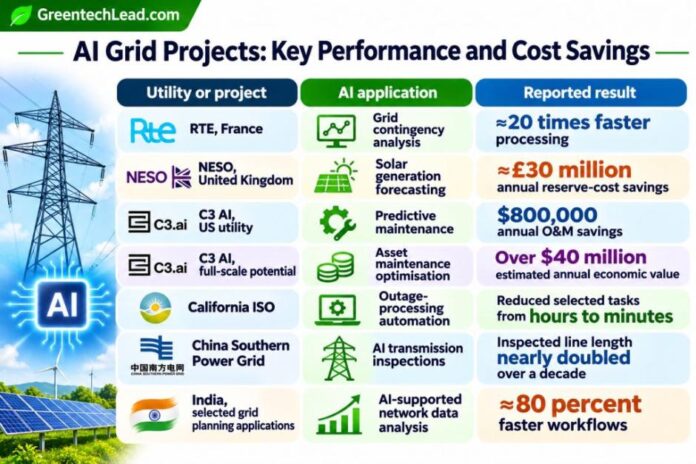
These results cover different applications and measurement methods. Some are utility-reported outcomes, while others are vendor estimates or potential savings rather than independently audited financial results.
RTE France Uses AI to Accelerate Grid Security Analysis
France’s electricity transmission operator RTE has applied AI-supported contingency analysis to improve assessment of network operating conditions.
The IEA reports that the technology can process relevant security assessments approximately 20 times faster than manual approaches.
Faster analysis allows grid operators to examine more operating scenarios, identify potential network constraints and support decisions about electricity flows.
Such systems can improve the utilisation of existing transmission assets, although AI does not replace essential grid protection and operational controls.
NESO UK Targets £30 Million Annual Savings with AI Solar Forecasting
Britain’s National Energy System Operator introduced Quartz Solar, an AI-based solar forecasting system developed with Open Climate Fix.
The technology uses weather information and electricity generation data to improve predictions of photovoltaic output.
The IEA reports estimated annual reserve-cost savings of approximately £30 million from the application.
Better forecasting can reduce the amount of backup electricity and balancing services that grid operators need to procure.
The IEA analysis of AI-enhanced grid solutions highlights renewable forecasting as an important opportunity for reducing system operating costs.
C3 AI Reports $40 Million Potential Annual Value from Predictive Maintenance
C3 AI deployed predictive maintenance technology for a US electricity utility serving more than seven million customers.
The platform analysed ten years of operating information from 12 data sources, covering approximately 10,000 transformers and 22,000 circuit breakers.
C3 AI reported 98 percent accuracy in detecting future equipment failure events and estimated annual operations and maintenance savings of $800,000.
The company also estimated potential annual economic value exceeding $40 million if the application were expanded across the utility’s operations.
These are vendor-reported estimates. The $40 million figure represents potential economic value at scale rather than verified annual cash savings.
The C3 AI electric grid predictive maintenance case study describes the deployment and reported performance.
China Southern Power Grid and California ISO Improve Operations
China Southern Power Grid has expanded the use of visual intelligence and digital inspection tools to monitor transmission infrastructure.
The IEA reports that inspected transmission-line length nearly doubled over a decade, while inspection staffing increased from approximately 60 to 80 employees.
AI-assisted image analysis can help utilities identify damaged components, vegetation risks and equipment deterioration.
California ISO has also applied digital automation to outage-processing workflows, reducing selected activities from several hours to a few minutes.
These examples demonstrate how AI and automation can reduce administrative workloads and improve operational responsiveness.
Additional AI Grid Technology Vendors and Projects
Several major technology suppliers are developing AI-based electricity network solutions.
Siemens provides Gridscale X software for grid planning, network management and digital operations. Its grid software portfolio supports utilities seeking improved network visibility and operational efficiency.
Schneider Electric offers EcoStruxure Grid solutions for distribution management, outage management and network analytics.
GE Vernova supplies GridOS software and grid management technologies for electricity network operations, renewable integration and asset optimisation.
Hitachi Energy provides Lumada-based digital technologies, asset performance management and advanced grid automation solutions.
ABB develops distribution automation, monitoring and asset-management technologies that can support predictive maintenance and electricity network reliability.
Itron supplies smart metering, grid-edge intelligence and distributed energy resource management technologies.
AutoGrid, part of Schneider Electric, provides flexibility management and virtual power plant technologies for distributed energy resources.
Camus Energy develops grid orchestration software for utilities managing distributed generation and flexible electricity demand.
These companies offer different combinations of AI, analytics, automation and conventional grid management technology. Their products should not all be classified as independently verified AI deployments.
AI Forecasting Can Reduce Electricity Balancing Costs
AI-based forecasting combines historical electricity consumption, weather patterns, renewable generation and real-time grid information.
Consider an illustrative utility managing 10,000 MWh of daily electricity demand.
If forecasting error declines from 5 percent to 2 percent, the corresponding deviation volume falls from 500 MWh to 200 MWh.
At an assumed incremental balancing cost of $30/MWh, potential avoided expenditure would reach $9,000 daily, equivalent to approximately $3.29 million annually.
This is a hypothetical financial model rather than a reported utility result.
Actual savings depend on balancing market prices, forecast accuracy, electricity procurement arrangements and operational decisions.
India AI Grid Investment Opportunity: ₹2.83 Lakh Crore in Distribution Projects
India is expanding investment in smart meters, electricity distribution infrastructure and network digitalisation.
Under the Revamped Distribution Sector Scheme, projects worth approximately ₹2.83 lakh crore have been sanctioned for distribution infrastructure and smart metering.
National aggregate technical and commercial losses declined from 21.91 percent in FY2020–21 to 15.04 percent in FY2024–25.
The improvement reflects several distribution reforms and investments and cannot be attributed exclusively to AI.
The Ministry of Power’s distribution-sector update provides the official programme and performance figures.
Potential beneficiaries include Tata Power, Adani Energy Solutions, IntelliSmart, Genus Power, HPL Electric & Power, Schneider Electric, Siemens and Hitachi Energy, through their respective activities in power distribution, smart metering, grid software and electrical infrastructure.
AI applications could support demand forecasting, electricity theft detection, transformer monitoring, feeder management and renewable energy integration.
AI Can Unlock Additional Renewable Grid Capacity
The IEA estimates that selected grid technology upgrades could enable connections for approximately 450–700 GW of projects already at advanced stages in global connection queues.
These improvements include dynamic line ratings, advanced power-flow control and other grid-enhancing technologies.
The estimate should not be attributed to AI alone, since conventional engineering upgrades and grid automation also contribute.
AI can improve the effectiveness of these technologies through forecasting, congestion analysis and operational recommendations.
AI Electricity Grid Investment Outlook
The growing use of AI in electricity networks creates opportunities for software developers, cloud providers, sensor manufacturers, smart meter suppliers, grid engineering companies and utilities.
However, investment returns depend on measurable reductions in operating costs, outage duration, equipment failures, renewable curtailment and unnecessary capital expenditure.
Utilities must also address cybersecurity, data quality, system integration and the reliability of AI recommendations.
For investors, the most attractive AI grid applications are those with verified financial benefits, repeatable deployment models and long-term utility contracts.
AI will not eliminate the need for new transmission lines, substations and storage facilities, but it can help utilities improve the performance and economics of existing electricity infrastructure.
SHAFANA FAZAL