Global geothermal energy investment is accelerating as electricity demand from AI data centres, industrial facilities and utilities increases interest in reliable, around-the-clock clean power.
Fervo Energy, Eavor, Ormat Technologies, Quaise Energy and other geothermal developers are expanding projects using enhanced geothermal systems (EGS), closed-loop technology and conventional geothermal resources.
According to the International Energy Agency (IEA), financing for next-generation geothermal reached nearly $2.2 billion in 2025, increasing 80 percent year over year. Conventional geothermal power attracted almost $5 billion, while geothermal heating received more than $11.5 billion.
The IEA’s geothermal investment analysis identifies growing electricity demand, long-term power purchase agreements and advances in drilling technology as important drivers of investment.
However, high drilling costs, geological uncertainty, financing expenses and construction delays remain major barriers to commercial expansion.
Geothermal Energy Project Costs and Investment Requirements
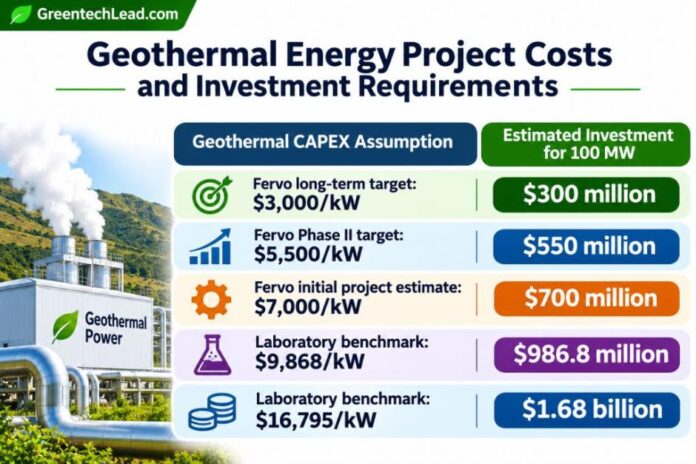
The US National Laboratory of the Rockies’ 2025 Annual Technology Baseline provides modelled overnight capital costs for deep enhanced geothermal systems ranging from approximately $9,868 to $16,795 per kilowatt, depending on resource conditions.
Fervo Energy has cited approximately $7,000 per kilowatt for its initial Cape Station development, a $5,500 per kilowatt target for its second phase and a longer-term target of $3,000 per kilowatt.
These figures represent different project assumptions and technology maturity levels rather than directly comparable construction quotations.
The 2025 geothermal technology cost model provides assumptions covering drilling, reservoir characteristics and power generation economics.
Actual project costs also depend on transmission infrastructure, financing, drilling success and construction schedules.
Fervo Energy: $2.2 Billion IPO and 500 MW Cape Station Project
Fervo Energy is among the leading developers commercialising enhanced geothermal systems in the United States.
The company raised approximately $2.2 billion in gross proceeds through its May 2026 initial public offering and secured $421 million in non-recourse financing for Cape Station Phase I.
Fervo’s Cape Station project in Utah is designed for 500 MW, comprising a 100 MW first phase and a 400 MW second phase targeted for 2028.
On October 1, 2026, Fervo declared its first 33 MW GeoBlock commercially operational and generating revenue under a power purchase agreement.
The remaining planned capacity should not be counted as operational until commissioning is completed.
Fervo has also secured a 396 MW, 15-year power purchase agreement associated with Google, demonstrating demand from technology companies seeking dependable low-carbon electricity.
The Cape Station commercial operation announcement represents an important milestone for engineered geothermal reservoirs.
Eavor, Quaise and Ormat Expand Geothermal Investments
Eavor – Germany: Canadian geothermal developer Eavor is advancing its Geretsried closed-loop geothermal project, designed for 8.2 MW of electricity generation and 64 MW of thermal capacity.
The project uses sealed underground circulation loops rather than the stimulated reservoirs associated with conventional EGS. Partial operations have begun, although design capacity should not be confused with actual electricity output.
Quaise Energy – United States: Quaise raised $180 million in Series B financing to advance millimetre-wave drilling technology and Project Obsidian.
The project targets more than 25 MW of gross generation, with initial electricity production planned for 2030. Quaise has also been selected for up to $25 million in US Department of Energy support.
Ormat Technologies – Global: Ormat reported approximately 1,031 MW of consolidated geothermal generating capacity in February 2026.
Unlike earlier-stage EGS developers, Ormat has an established operating portfolio and participates in geothermal power plant development, equipment supply and energy storage.
Additional Geothermal Projects and Vendors
Several other companies are expanding geothermal development and equipment markets.
Sage Geosystems – United States: Sage is developing geopressured geothermal systems and subsurface energy storage, including projects intended to provide firm electricity for data-centre customers.
XGS Energy – United States: XGS is developing closed-loop geothermal technology designed to extract heat from hot rock without relying on naturally permeable geothermal reservoirs.
GreenFire Energy – United States: GreenFire is developing closed-loop geothermal systems that can potentially use existing geothermal wells and infrastructure.
CeraPhi Energy – United Kingdom: CeraPhi focuses on closed-loop geothermal solutions for heating applications and the repurposing of existing wells.
SLB and Baker Hughes – Global: These oilfield technology companies supply drilling, subsurface evaluation, well construction and reservoir-management capabilities relevant to geothermal development.
Turboden – Italy: Turboden supplies Organic Rankine Cycle power generation systems that can convert geothermal heat into electricity.
These vendors operate at different stages of commercial maturity, and their project announcements do not necessarily represent commissioned generation capacity.
Geothermal Project Revenue, Payback and Investment Returns
Consider an illustrative 100 MW geothermal plant with $700 million CAPEX, a 90 percent capacity factor and annual fixed operating costs of $10 million.
| Financial indicator | Illustrative estimate |
| Installed capacity | 100 MW |
| Annual electricity generation | 788,400 MWh |
| Electricity selling price | $100/MWh |
| Annual electricity revenue | $78.84 million |
| Annual fixed operating costs | $10 million |
| Revenue after fixed O&M | $68.84 million |
| Simple payback | 10.2 years |
At an 80 percent capacity factor, the estimated payback extends to approximately 11.7 years.
At a 90 percent capacity factor and electricity price of $70/MWh, payback increases to approximately 15.5 years.
A downside scenario combining a 20 percent CAPEX overrun, 80 percent capacity factor and $70/MWh electricity price extends simple payback to approximately 21.5 years.
These calculations exclude financing, taxes, insurance, variable operating costs, replacement wells and construction delays. They are illustrative rather than project forecasts, and simple payback is not equivalent to internal rate of return.
India Geothermal Energy Investment Opportunities
India has an estimated theoretical geothermal potential of approximately 10,600 MW, although commercially recoverable capacity remains uncertain.
The government’s September 2025 National Policy on Geothermal Energy provides a framework for exploration and development.
At Puga Valley in Ladakh, ONGC Energy Centre commissioned two 1,000-metre exploratory wells in July 2026 to evaluate resources for a proposed 1 MW demonstration project.
The Government of India’s geothermal energy update outlines the policy and exploration initiatives.
Potential opportunities include industrial heating, agricultural drying, aquaculture, geothermal heat pumps and electricity generation where resources are commercially viable.
Geothermal Investment Outlook for 2027–2030
Geothermal power offers a potential source of continuous low-carbon electricity for data centres, industrial customers and utilities.
However, geothermal investment returns depend heavily on drilling productivity, resource temperature, reservoir performance, financing costs and long-term electricity contracts.
Fervo Energy, Eavor, Quaise Energy, Ormat Technologies, Sage Geosystems and XGS Energy represent different approaches to reducing geothermal development costs.
Investors should prioritise commissioned capacity, verified electricity output, drilling costs per successful well, CAPEX per kilowatt, contracted electricity prices and project cash flow.
The next stage of geothermal investment growth will depend on whether developers can repeatedly deliver commercially viable projects rather than relying on announced capacity, technology targets and financing commitments alone.
SHAFANA FAZAL