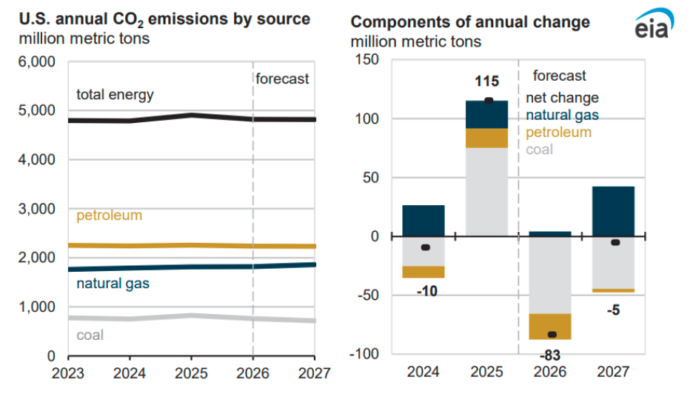
The U.S. electricity market is heading toward another significant reduction in coal use as rapid growth in solar and wind generation, combined with higher natural gas generation, reshapes the power mix. The U.S. Energy Information Administration (EIA) expects coal-fired electricity generation to fall 8 percent in 2026 and another 6 percent in 2027, contributing to a decline in U.S. energy-related carbon dioxide emissions.
EIA’s September 2026 Short-Term Energy Outlook (STEO) indicates U.S. energy-related CO2 emissions will decrease 1.7 percent in 2026 from 2025 levels, followed by a smaller 0.1 percent decline in 2027. Lower coal consumption is expected to be the biggest contributor to the emissions reduction in 2026.
The decline is occurring even as U.S. electricity consumption reaches record levels, highlighting a continuing shift in the sources used to meet incremental power demand.
Coal Share of U.S. Power Generation Falls to 14% by 2027
Coal’s share of U.S. electricity generation is forecast to decline from 17 percent in 2025 to 16 percent in 2026 and 14 percent in 2027.
Natural gas, in contrast, is expected to maintain a 40 percent share in all three years. Wind increases from 11 percent in 2025 and 2026 to 12 percent in 2027, while solar rises from 7 percent in 2025 to 8 percent in 2026 and 9 percent in 2027. Nuclear remains stable at 18 percent.
This changing generation mix is important because U.S. power demand itself is not falling. Electricity sales are forecast to reach 4,135 billion kilowatthours (BkWh) in 2026, almost 2 percent higher than 2025, before increasing nearly another 2 percent to 4,211 BkWh in 2027.
Commercial electricity sales are expected to rise 3.3 percent in 2026 and 2.7 percent in 2027, driven partly by data centers, while industrial sales increase 1.6 percent and 2.6 percent, respectively.
U.S. Coal Production to Drop to 497 Million Short Tons
Weakening demand from power generators is feeding directly into U.S. coal production.
EIA forecasts coal output will fall from 528 million short tons (MMst) in 2025 to 516 MMst in 2026, a decline of about 12 MMst. Production is expected to drop by another 19 MMst to 497 MMst in 2027. That represents an overall reduction of about 31 MMst, or nearly 6 percent, between 2025 and 2027.
The Western region, responsible for about half of U.S. coal supply, is expected to lead the contraction. Western production is forecast to fall about 4 percent in 2026 and another 5 percent in 2027, reaching 260 MMst.
Appalachian coal production is expected to remain relatively flat in 2026 before declining around 2 percent in 2027. Interior production is also projected to remain close to 2025 levels this year before falling approximately 5 percent to 79 MMst in 2027.
Coal Demand From Power Plants Falls 8%
The main pressure on the coal industry comes from electricity generation.
EIA expects domestic coal demand from the electric power sector to decline 8 percent in 2026 and another 6 percent in 2027, despite coal exports increasing from 2025 levels. Rising natural gas and renewable electricity generation, particularly in the Northwest and MISO regions, is reducing coal requirements.
Coal-fired electricity generation follows almost exactly the same trajectory, dropping 8 percent in 2026 and 6 percent in 2027.
Renewables are moving in the opposite direction. EIA forecasts solar electricity generation to jump 21 percent in 2026 and another 18 percent in 2027. Wind generation is projected to grow 7 percent in 2026 and 5 percent in 2027.
Natural gas generation is also forecast to increase 2 percent in 2026 and 1 percent in 2027.
The figures indicate that coal is losing generation share not because U.S. electricity demand is contracting, but because solar, wind and natural gas are supplying a growing proportion of an expanding electricity market.
CO2 Emissions Fall Despite Record Electricity Demand
The emissions impact is substantial. EIA estimates U.S. energy-related CO2 emissions at approximately 4.9 billion metric tons in 2025, declining to around 4.8 billion metric tons in both 2026 and 2027. The rounded annual figures mask the more precise forecast decline of 1.7 percent in 2026 and 0.1 percent in 2027.
EIA says the 2026 reduction is primarily attributable to lower coal consumption, with declining consumption of petroleum products — particularly motor gasoline and distillate fuel oil — providing additional reductions.
The emissions picture becomes more complicated in 2027. Coal- and petroleum-related CO2 emissions are expected to continue falling, but those reductions will be largely offset by higher natural gas-related emissions, especially from gas-fired electricity generation. As a result, total energy-related CO2 emissions decline only 0.1 percent next year.
Coal Decline Becomes Key Driver of U.S. Emissions Reduction
The September 2026 EIA outlook shows an important structural trend in the U.S. energy market: electricity consumption can grow while coal generation and energy-related CO2 emissions decline simultaneously.
Between 2025 and 2027, electricity sales are forecast to rise to 4,211 BkWh, coal’s generation share falls from 17 percent to 14 percent, coal production drops from 528 MMst to 497 MMst, and solar’s generation share climbs from 7 percent to 9 percent.
For 2026 in particular, coal is central to the emissions story. An 8 percent reduction in coal-fired generation, combined with 21 percent solar growth and 7 percent wind growth, helps push U.S. energy-related CO2 emissions down 1.7 percent even as electricity demand expands.
The challenge becomes greater in 2027. Continued coal displacement lowers emissions, but additional natural gas generation offsets much of that benefit, leaving the EIA forecasting only a marginal 0.1 percent reduction in total U.S. energy-related CO2 emissions.
SHAFANA FAZAL