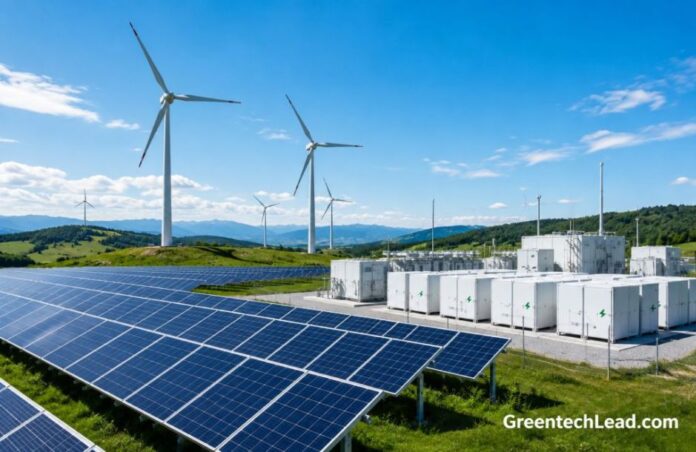
Global renewable-energy investment is entering a new phase in 2026. Solar remains the biggest destination for generation capital, wind is gaining importance in hybrid power projects, and battery energy storage systems (BESS) are emerging as critical infrastructure for delivering renewable electricity when customers actually need it.
The International Energy Agency (IEA) expects total global energy investment to reach about $3.4 trillion in 2026, including around $665 billion for renewable power. Solar alone is expected to attract approximately $365 billion, making it the largest renewable investment category.
The bigger investment opportunity, however, is increasingly shifting toward integrated platforms combining solar + wind + BESS + grids rather than standalone renewable projects.
Solar Leads with $365 Billion Investment
Solar remains the largest renewable-energy investment opportunity because projects can be developed quickly and scaled from rooftop systems to multi-gigawatt renewable parks.
The IEA World Energy Investment 2026 report indicates that around $365 billion is expected to flow into solar during 2026.
India represents one of the biggest growth opportunities. The country’s solar capacity reached approximately 150 GW by March 2026, supporting investment across power generation, manufacturing, transmission and storage.
Adani Green Energy illustrates the scale of expansion. It added 5,051 MW during FY2025-26, comprising:
3,409 MW solar
686 MW wind
956 MW wind-solar hybrid
These additions lifted operational renewable capacity to 19.3 GW.
Expansion continued in FY2026-27. After commissioning another 139 MW solar project at Khavda, Adani Green’s operational portfolio reached 20.28 GW.
The company also has 3,551 MWh of operational BESS and is targeting 50 GW of renewable capacity and 50,000 MWh — or 50 GWh — of battery storage by 2030.
ReNew, JSW Energy, NTPC and Tata Power are also expanding diversified renewable portfolios as India moves from standalone solar projects toward larger hybrid and storage-backed power platforms.
Wind Investment Shifts Toward Hybrid Renewable Projects
Wind cannot match solar’s investment scale, but its strategic value is increasing because wind generation can occur during different hours and seasons.
That makes wind particularly valuable when combined with solar. A diversified portfolio can produce renewable electricity across a wider portion of the day, while batteries can store excess generation for later use.
Suzlon is positioning itself around this opportunity. Its FY2031 ambitions include 10 GW of annual renewable-energy sales, a 15 GW order book and 70 GW of renewable assets under management.
Its strategy is moving beyond conventional wind turbines toward a broader renewable platform encompassing wind, solar, BESS and energy management.
Inox Wind is another beneficiary of India’s wind expansion, while developers including ReNew and JSW Energy can use combinations of solar and wind to offer customers more balanced renewable generation.
For investors, this explains wind’s changing role: solar provides massive low-cost capacity, while wind improves the generation profile of the overall renewable portfolio.
Battery Storage Emerges as the High-Growth Opportunity
Battery storage may represent the biggest structural change in renewable-energy investment.
As solar and wind penetration rises, electricity systems need technologies capable of storing excess generation and releasing it during periods of higher demand.
The IEA’s energy investment analysis highlights the growing importance of battery storage as capital moves toward renewable integration, peak-hour electricity supply and grid flexibility.
The scale of the leading battery companies shows how quickly this market is developing.
CATL shipped 121 GWh of energy-storage batteries in 2025, while BYD continues securing multi-GWh international storage contracts. Tesla is expanding Megapack manufacturing, while Fluence has developed a substantial deployment and contracted pipeline.
By June 2026, Fluence had deployed approximately 7.4 GW / 19.3 GWh of storage.
Its contracted backlog reached 12.6 GW, while its broader pipeline stood at 45.6 GW / 163.7 GWh.
Those figures demonstrate that BESS is moving from an add-on to solar and wind projects into a major infrastructure industry of its own.
India BESS Market Moves Toward Multi-GWh Scale
India could become one of the biggest beneficiaries of the storage investment cycle.
Adani Green already has 3,551 MWh of operational storage and is targeting more than 10,000 MWh by FY2026-27 before scaling to 50,000 MWh by 2030.
Policy could accelerate investment further. India has proposed mandatory battery storage for new government-backed solar and wind projects from July 2027, potentially strengthening demand for solar-plus-storage and wind-plus-storage projects.
This is important because storage changes the commercial value of renewable electricity. Instead of selling solar power only when the sun is shining, developers can store electricity and deliver it during evening peaks or other high-demand periods.
AI Data Centers Create New Renewable Investment Opportunity
AI and data-center expansion are adding another powerful driver for renewable investment.
Hyperscale facilities need enormous quantities of electricity around the clock. That requirement favors portfolios combining multiple renewable technologies and storage rather than intermittent solar generation alone.
Serentica Renewables, for example, is targeting ₹15,000-18,000 crore of investment over four to five years in infrastructure capable of supporting up to 1 GW of data-center capacity.
The company already has contracts covering approximately 9 GW of renewable power.
For developers, AI data centers therefore represent an opportunity to sell firm renewable power through long-term commercial agreements rather than simply selling electricity from individual solar or wind farms.
Grid Investment Must Rise 50% by 2030
The renewable boom is also creating a parallel investment opportunity in electricity grids.
Solar and wind projects are often built far from large electricity-consuming centers, making transmission networks, substations, transformers and grid-management technology essential.
According to the IEA, annual grid investment needs to increase by approximately 50 percent by 2030 from today’s level of around $400 billion to keep pace with rising electricity demand and clean-energy deployment.
India’s states are already pursuing this opportunity.
Madhya Pradesh has partnered with the Asian Development Bank to structure clean-energy projects designed to attract up to $1 billion of private investment, including solar-plus-storage development in Shajapur.
Bihar has announced a much larger ₹1.38 lakh crore five-year clean-energy investment plan, targeting 24 GW of renewable capacity and 6 GWh of energy storage by 2030.
Solar vs Wind vs BESS: Where Should Investors Watch?
The 2026 investment landscape shows three distinct opportunities.
Solar is the scale leader. Around $365 billion of investment expected in 2026 makes it the biggest renewable-generation opportunity. Large developers including Adani Green, ReNew, JSW Energy, Tata Power and NTPC are positioned to benefit from continued capacity additions.
Wind provides generation diversity. Its value increases when paired with solar because the two technologies can generate electricity at different times. This strengthens opportunities for Suzlon, Inox Wind and diversified renewable developers.
Battery storage offers the strongest structural growth opportunity. CATL’s 121 GWh of storage-battery shipments and Fluence’s 163.7 GWh pipeline demonstrate the scale at which the industry is developing.
But the most important investment trend is the convergence of all three.
Solar + Wind + BESS Is Becoming the Winning Model
The renewable investment race is therefore no longer simply solar versus wind versus battery storage.
Solar remains the scale engine, attracting approximately $365 billion in 2026. Wind provides complementary generation, while BESS adds the flexibility required to shift electricity between periods of supply and demand.
Grids represent the fourth component, with annual investment needing to rise about 50 percent from today’s $400 billion level by 2030.
Companies capable of integrating solar, wind, BESS, transmission infrastructure and long-term electricity contracts are consequently better positioned to capture growing demand from AI data centers, manufacturing, electric mobility and industrial electrification.
For investors, the biggest long-term opportunity may therefore be not choosing between solar, wind and batteries, but identifying the companies that can combine all three into reliable, scalable and commercially attractive power platforms.
SHAFANA FAZAL