
China’s energy transition is moving beyond simply adding renewable energy capacity. Clean electricity is beginning to replace functions traditionally performed by coal and oil, creating major investment opportunities across solar, wind, battery storage, grids, electric vehicles and industrial electrification.
The China Energy Transition Review 2026 from Ember describes this as a shift from “building before breaking” to “building while breaking” — expanding the clean-energy system while fossil-fuel use starts flattening or declining.
Here are 10 key investment, capacity and growth trends shaping China’s energy market.
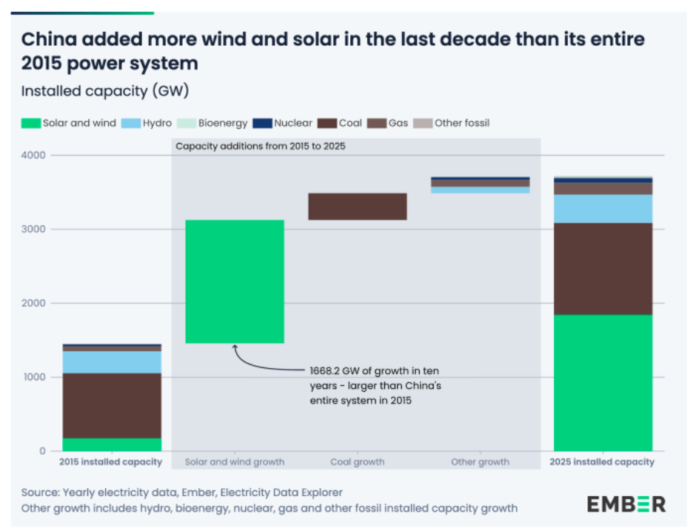
1. China Added Nearly 1,700 GW of Wind and Solar in a Decade
The sheer scale of China’s renewable investment remains the foundation of its energy transition.
China had around 1,450 GW of total power-generation capacity in 2015. During the following decade, it added almost 1,700 GW of wind and solar capacity alone — more capacity than its entire electricity system had in 2015.
The investment story is now changing, however. Renewable developers are moving from a model driven primarily by rapid capacity additions toward one where project location, electricity prices, grid availability, storage and utilisation increasingly determine returns.
That change could direct future capital toward higher-value renewable projects rather than simply maximising installed gigawatts.
2. Clean Power Meets 100% of Incremental Electricity Demand
China reached an important milestone in 2025 when clean electricity supplied all of the country’s additional electricity demand.
Electricity consumption increased 5%, yet thermal generation — predominantly coal — declined 0.7%. It was the first thermal-generation decline in a decade.
In 2015, the previous year when thermal generation declined, electricity demand had grown only 0.5%. The 2025 numbers therefore indicate that clean generation is becoming large enough to simultaneously support economic growth and displace some fossil generation.
For renewable investors, this represents a fundamental shift: new wind and solar capacity is increasingly competing directly with coal generation rather than merely satisfying incremental electricity consumption.
3. Battery Storage Capacity Jumps 84% as China Takes 60% of Global Additions
Energy storage is emerging as one of China’s most important clean-energy investment markets.
Battery storage surpassed pumped hydro in installed capacity by the end of 2024 and then expanded another 84% in 2025, nearly doubling within one year.
China accounted for approximately 60% of global battery-storage capacity additions in 2025, making it the world’s largest storage market.
Storage utilisation is improving as well. Standalone batteries increased from 146 equivalent full cycles in 2022 to 299 in 2025, while renewable co-located batteries rose from 80 to 199 cycles.
This combination of rapidly growing capacity and higher utilisation strengthens the investment case for batteries as China integrates increasingly large quantities of variable renewable power.
4. Long-Duration Storage Opens Another Investment Market
China’s storage expansion is no longer limited to lithium-ion batteries.
Between 2023 and 2025, compressed-air energy storage capacity expanded more than sixfold, flow batteries grew more than tenfold, and molten-salt thermal storage capacity almost tripled.
China’s first 100 MW advanced compressed-air energy storage project was connected in 2022. By early 2026, the technology had scaled to a 600 MW / 2.4 GWh facility, described by Ember as the world’s largest project of its kind.
A 1,000 MWh molten-salt thermal storage project also entered operation in Anhui during 2025.
These developments create opportunities beyond conventional battery manufacturing, including long-duration storage equipment, engineering, grid integration and energy-management technologies.
5. Electricity Demand Could Add 2,600 TWh by 2030
Despite the slowdown in some parts of China’s economy, electricity represents a major long-term growth market.
China consumed around 10.4 trillion kWh in 2025, becoming the first country to cross the 10-trillion-kWh threshold and consuming more than twice as much electricity as the United States.
Electricity demand has almost doubled during the past decade.
The IEA expects Chinese electricity consumption to increase at an average 4.9% annually through 2030, adding around 2,600 TWh of demand — approximately equivalent to the European Union’s current total electricity consumption.
This growth creates continuing requirements for investment in renewables, transmission, distribution, storage and grid flexibility.
6. China Shifts Renewable Investment From Capacity to Value
A major policy change is transforming renewable-project economics.
China’s Document No. 136, introduced in February 2025, moved newly commissioned renewable projects away from guaranteed benchmark tariffs toward greater participation in electricity markets.
Developers therefore face greater exposure to market prices, project location, grid congestion and curtailment.
China is simultaneously supporting grid expansion, storage and a CfD-type mechanism designed to stabilise revenues.
The policy change could favour projects combining solar or wind with storage and better grid access. For investors, quality of capacity may increasingly matter more than sheer capacity expansion.
7. Industrial Electrification Creates a Huge New Clean-Power Market
Renewable investment is increasingly linked to China’s industrial transformation.
Electricity’s share of China’s final energy consumption reached 28.8% in 2024, rising from 22.3% in 2015. That compares with around 23% in Europe and 21% in the US.
Electricity already supplies approximately 75% of final energy in industries including machinery, electrical equipment, electronics, textiles and transport equipment.
Even harder-to-electrify industries are beginning to change. Electricity’s share in metals smelting and processing increased from just over 10% in 2000 to 20% in 2023, while fossil-fuel extraction and non-metallic minerals reached around 17%.
Heavy industry alone accounts for an enormous potential market: extractive industries, petrochemicals, metals and non-metallic minerals represent roughly 40% of China’s final energy consumption.
8. EV Growth Expands From Passenger Cars to Trucks
Transport electrification is creating another powerful source of electricity demand and clean-energy investment.
Passenger EVs represented 67.2% of new vehicle sales in June 2026, after accounting for less than 10% as recently as 2020.
More significantly, electric trucks are beginning to scale. Sales more than doubled in 2024 and more than doubled again in 2025. China accounted for nine out of every 10 electric trucks sold worldwide in 2025.
By June 2026, electric trucks had reached almost 45% of China’s new truck sales.
Truck electrification could drive investment in high-capacity charging networks, batteries, renewable electricity and grid infrastructure while accelerating the reduction in diesel consumption.
9. Clean-Tech Exports Exceed $220 Billion
China’s investment in clean-energy manufacturing is increasingly generating export revenue.
Clean-technology exports covering batteries, EVs, solar PV, wind equipment and grid infrastructure exceeded $140 billion during the first half of 2026 alone, more than twice the amount exported during the whole of 2020.
Clean technology represented 6.6% of China’s total exports in H1 2026, compared with only 2.7% in 2020.
For full-year 2025, clean-tech exports had already surpassed $220 billion.
This makes clean energy not simply a decarbonisation strategy but an increasingly important industrial and export-growth strategy.
10. China’s Clean-Energy Economy Reaches $2.1 Trillion
Perhaps the most important investment figure in Ember’s report is the estimated economic scale of China’s clean-energy ecosystem.
Clean-energy sectors generated approximately CNY15.4 trillion ($2.1 trillion) of economic activity in 2025, covering investment, manufacturing and associated supply chains.
That was greater than the combined value added of China’s three largest coal-producing provinces — Shanxi, Shaanxi and Inner Mongolia. Ember cautions that its clean-energy number is a reconstructed estimate rather than an official national-accounts sector, but it nevertheless demonstrates the extraordinary scale the industry has reached.
Clean energy is therefore increasingly becoming an economic growth engine in its own right.
China Energy Investment Is Entering a New Phase
The next stage of China’s transition will be less about breaking installation records and increasingly about making existing and new clean-energy assets productive.
China added nearly 1,700 GW of wind and solar in a decade, battery storage expanded 84% in 2025, and the country captured around 60% of worldwide battery-storage additions. Electricity demand could meanwhile increase another 2,600 TWh by 2030.
At the same time, EVs have reached 67.2% of passenger-car sales, clean-tech exports exceeded $220 billion, and China’s clean-energy economy generated an estimated $2.1 trillion in economic activity in 2025.
The investment opportunity is consequently widening from solar and wind farms into battery and long-duration storage, transmission grids, industrial electrification, EV charging and technologies that improve the utilisation and commercial value of renewable electricity.
The most important change is that this investment is starting to affect China’s fossil-fuel system. Coal generation has flattened in 17 of the 26 provincial regions tracked by Ember, representing more than half of national thermal capacity, while fossil-fuel consumption has fallen 26% to 71% from previous peaks across eight industrial sectors. For investors and clean-energy companies, China’s energy transition is shifting from a capacity-building story into a much larger electricity, storage, infrastructure and industrial-transformation story through 2030.
BABURAJAN KIZHAKEDATH
