India’s renewable energy market is accelerating in 2026, driven by record solar installations, rapid battery storage deployment, wind expansion, transmission investment and multibillion-dollar commitments from leading energy companies.
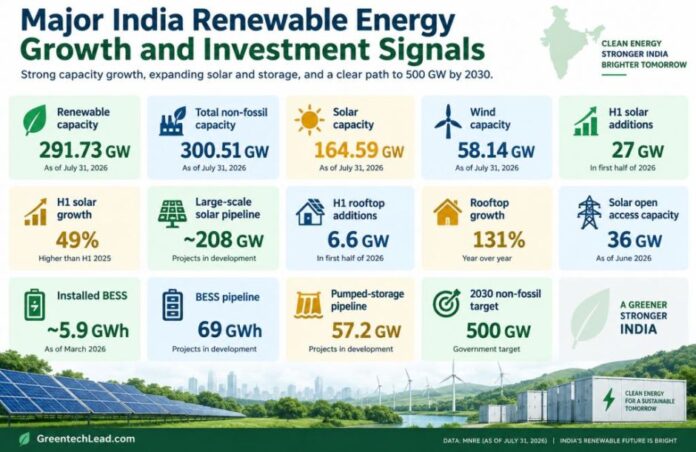
India had 291.73 GW of installed renewable energy capacity as of July 31, 2026, while total non-fossil power capacity reached 300.51 GW, according to MNRE renewable energy capacity data.
Solar accounted for 164.59 GW and wind for 58.14 GW. India added another 17.04 GW of renewable capacity between April and July 2026, keeping the country on the path toward its target of 500 GW of non-fossil capacity by 2030.
India Adds Record 27 GW of Solar in H1 2026
Solar remains the biggest engine of India’s renewable energy expansion.
India installed a record 27 GW of solar capacity during the first half of 2026, an increase of 49 percent from 18 GW during H1 2025.
Solar represented approximately 76 percent of the 36 GW of new power capacity installed during the period. Cumulative solar capacity reached about 164.8 GW by June, while India’s large-scale solar project pipeline expanded to approximately 208 GW.
The pipeline indicates that solar will remain India’s largest renewable growth segment through the second half of the decade. However, investment is increasingly moving beyond conventional utility-scale solar toward projects integrating wind and battery storage to supply more reliable power.
Rooftop Solar Jumps 131% to 6.6 GW
India’s distributed solar market is also expanding rapidly.
Rooftop solar installations reached 6.6 GW in H1 2026, representing 131 percent year-over-year growth.
Residential systems accounted for 84 percent of rooftop installations during the second quarter.
Nearly 4.5 million households had installed rooftop solar under the PM Surya Ghar programme by June 2026, reaching approximately 45 percent of the government’s 10 million-household target.
The rapid expansion of India’s rooftop solar market is broadening renewable investment beyond large developers and utilities toward residential consumers and distributed-energy providers.
Solar Open Access Capacity Reaches 36 GW
Corporate renewable electricity demand is becoming another major growth driver.
India added nearly 6 GW of solar open access capacity during H1 2026, increasing 42 percent year over year.
Cumulative solar open access capacity consequently reached approximately 36 GW by June.
Growth is being supported by industrial companies, commercial businesses, manufacturing facilities and other large electricity consumers seeking lower-cost renewable power through open-access arrangements, captive projects and power purchase agreements.
Corporate procurement could become even more important as electricity-intensive sectors expand and companies seek long-term access to renewable energy.
Wind Capacity Reaches 58.14 GW
Wind energy is regaining momentum as India attempts to create a more balanced renewable generation mix.
Installed wind capacity reached 58.14 GW by July 2026. Developers are increasingly combining wind with solar and storage rather than developing individual generation technologies separately.
Hybrid projects can produce electricity across a wider portion of the day and improve utilization of transmission infrastructure.
The trend is shifting India’s renewable market from competition based largely on the lowest solar tariff toward competition based on the ability to supply reliable and dispatchable renewable electricity.
India BESS Capacity Hits 5.9 GWh, Pipeline Reaches 69 GWh
Battery energy storage is emerging as one of the fastest-growing segments of India’s clean-energy market.
India had approximately 5.9 GWh of installed BESS capacity by March 2026, following the addition of around 4.6 GWh during Q1 alone.
More importantly, the battery project pipeline reached approximately 69 GWh.
Standalone storage already represented 73 percent of cumulative battery capacity, indicating that BESS is increasingly being developed as an independent grid asset rather than only as an addition to solar and wind projects.
The India energy storage market outlook also identifies a further 57.2 GW pumped-storage pipeline, providing another potentially important source of long-duration grid flexibility.
India has also proposed requiring new government solar and wind projects to include battery storage from July 2027, potentially accelerating the transition toward renewable projects designed around dispatchability.
Transmission Investment Becomes Critical
India’s renewable ambitions will depend increasingly on whether transmission infrastructure can keep pace with solar and wind construction.
Renewable generation is concentrated in resource-rich markets such as Rajasthan and Gujarat, while large electricity demand centers can be hundreds or thousands of kilometers away.
India is therefore planning transmission infrastructure capable of integrating more than 500 GW of renewable energy by 2030 and over 600 GW by 2032.
The expansion creates opportunities for transmission developers and manufacturers of transformers, substations, switchgear, transmission lines and grid-management technologies.
Grid availability is also becoming an important investment criterion for renewable developers because transmission delays and congestion can affect commissioning schedules, revenue and project economics.
Adani Green Targets 50 GW Renewable Capacity
India’s leading renewable developers are responding to the market opportunity with aggressive capacity expansion.
Adani Green Energy has crossed 20 GW of operational renewable generation capacity and reported 3,551 MWh of operational battery storage.
Its flagship Khavda development is becoming a major integrated renewable and storage hub. Adani Green is targeting 50 GW of renewable capacity by 2030, alongside substantial expansion of its battery storage portfolio.
ReNew Expands Generation and Manufacturing
ReNew commissioned approximately 2.4 GW during FY2026 and had around 20 GW of gross renewable assets by March 2026.
Its strategy increasingly combines renewable electricity generation with domestic solar module and cell manufacturing.
This vertical integration could become more important as India’s domestic-content requirements encourage developers to secure locally manufactured equipment.
Tata Power Renewable Invests ₹5,750 Crore in Andhra Pradesh
Tata Power Renewable Energy is expanding its utility-scale renewable portfolio through a major hybrid project in Andhra Pradesh.
The company broke ground in July 2026 on an 800 MW renewable project, comprising 400 MW of solar and 400 MW of wind capacity.
The development represents investment of approximately ₹5,750 crore and is expected to create around 4,000 jobs.
Hybrid developments of this scale demonstrate how India’s renewable market is evolving beyond standalone solar projects.
JSW, NTPC Green, Avaada and Suzlon Plan Major Expansion
Several other major renewable companies are preparing substantial investments and capacity additions through 2030.
JSW Energy is targeting 30 GW of generation capacity and 40 GWh of storage by 2030.
NTPC Green Energy is pursuing a renewable portfolio target of 60 GW.
Avaada plans investment of approximately ₹1 lakh crore over five years as it works toward a 30 GW clean-energy portfolio by 2030.
Wind turbine manufacturer Suzlon is benefiting from India’s wind revival and has announced plans associated with approximately ₹10,500 crore of investment and 1,325 MW of wind projects in Andhra Pradesh.
Domestic Manufacturing Emerges as Next Investment Opportunity
India’s renewable expansion is creating investment opportunities beyond power generation.
Domestic solar module, cell and battery manufacturing is becoming strategically important as the government seeks to reduce import dependence.
The Approved List of Models and Manufacturers framework and domestic-content requirements are encouraging localization across the solar supply chain.
Battery manufacturing could follow a similar trajectory as the 69 GWh BESS pipeline creates demand for cells, battery packs, containerized storage systems, power conversion equipment, thermal management and energy-management software.
The combination of generation and manufacturing investment could allow Indian renewable companies to capture a larger share of the clean-energy value chain rather than depending heavily on imported equipment.
India Renewable Energy Outlook 2026-2030
India’s renewable market is shifting from a race to install solar and wind capacity toward a more complex investment cycle built around generation, storage, transmission and domestic manufacturing.
Solar remains the largest opportunity, with 164.59 GW installed and a roughly 208 GW large-scale pipeline. Wind has reached 58.14 GW, while the BESS pipeline has surged to 69 GWh.
At the corporate level, Adani Green is targeting 50 GW, NTPC Green 60 GW, JSW Energy 30 GW of generation plus 40 GWh of storage, and Avaada 30 GW backed by approximately ₹1 lakh crore of planned investment.
The Ministry of New and Renewable Energy’s 500 GW non-fossil capacity target now represents more than a capacity-expansion challenge. India must ensure that rapidly expanding renewable generation is grid-connected, stored when necessary and available when electricity demand peaks.
That transition makes battery storage, hybrid renewable projects, transmission infrastructure and domestic equipment manufacturing some of the most important investment opportunities in India’s renewable energy market through 2030.
SHAFANA FAZAL