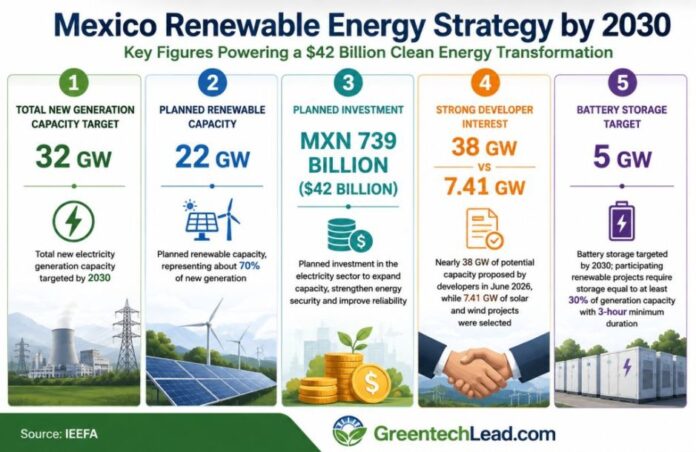
Mexico is preparing for a major electricity investment cycle, targeting about 32 GW of additional generation capacity by 2030, including approximately 22 GW of renewable energy. The plan involves MXN 739 billion, or roughly $42 billion, in investment, with renewables representing about 70 percent of planned capacity additions.
IEEFA separately frames Mexico’s ambition as approximately 20 GW of new renewable generation and 5 GW of battery storage by 2030.
Investor appetite is already substantial. Developers proposed nearly 38 GW during Mexico’s June 2026 utility-scale allocation process, while approximately 7.41 GW of solar and wind capacity was selected.
Solar and Wind Lead Mexico’s Renewable Pipeline
Mexico aims to generate at least 38 percent of electricity from renewable sources by 2030, while maintaining a 61 percent state share of total electricity generation.
Solar capacity in Mexico is targeted to increase 140 percent, geothermal 90 percent, wind 70 percent and hydropower 18 percent, primarily through upgrades to existing facilities.
The planned pipeline includes 50 solar PV plants totaling approximately 7.85 GW and 17 wind projects representing about 4.7 GW, with another 2.16 GW scheduled for allocation.
Of the 7.41 GW selected in June 2026, solar accounted for approximately 6.7 GW, or 90 percent, while wind represented around 700 MW.
The new investment cycle follows years of slower renewable expansion. Wind and solar increased their combined share of Mexican electricity generation from 3.2 percent in 2017 to nearly 12 percent in 2021, after which growth largely stalled.
Battery Storage Becomes Mandatory
Mexico is linking renewable expansion directly with energy storage. Participating renewable projects must incorporate battery systems equivalent to at least 30 percent of generation capacity, with a minimum three-hour discharge duration.
The policy could create significant demand for batteries, inverters, power-conversion equipment, energy-management systems and grid technologies while allowing solar and wind projects to deliver electricity during higher-demand periods.
The importance of diversification is clear from Mexico’s existing generation mix. Fossil fuels accounted for nearly 80 percent of electricity generation between 2000 and 2024.
Oil-fired generation declined from approximately 45 percent in 2000 to 7 percent in 2024, but natural gas increased from 22 percent to about 62 percent.
For comparison, wind and utility-scale solar increased from 8 percent of New Mexico’s generation in 2001 to 52 percent in 2025. In Texas, wind and solar supplied more than 34 percent of generation in 2025.
Cubico and CFE Plan Nearly $1 Billion Investment
Public-private investment is emerging as a central component of Mexico’s strategy, with CFE using mixed-investment agreements to attract private capital while preserving a strong state role.
Cubico Sustainable Investments and CFE have formed a 25-year partnership covering five renewable projects totaling 578 MWac, combined with 175.7 MW of three-hour battery storage, equivalent to 500 MWh.
The projects across Tamaulipas, Nuevo León, Campeche and the Yucatán Peninsula represent close to $1 billion of investment.
Construction of the 78 MW Altamira Solar project in Tamaulipas is scheduled to start in December 2026, with the remaining projects expected to begin construction in Q2 2027.
Cubico already operates approximately 600 MW of renewable capacity in Mexico and has a development pipeline of around 1.5 GW.
Elawan and El Chorro Combine Renewables With Storage
Elawan Energy’s 98.2 MW San Pedro solar project in Querétaro, developed through a joint investment agreement with CFE, will include a 72 MWh battery system and is expected to generate approximately 280 GWh annually.
The 705 MW El Chorro wind project in Tamaulipas goes further, incorporating a 317 MW battery energy storage system, demonstrating that large-scale storage is expanding beyond solar projects into wind generation.
Puerto Peñasco Targets 1 GW Solar Capacity
CFE’s Puerto Peñasco development in Sonora illustrates the scale of Mexico’s solar ambitions.
Its first two phases provide 420 MW of solar and 72 MW of storage, while the third phase adds 300 MW of solar and 103 MW of storage.
After completion of the planned phases, Puerto Peñasco is expected to reach approximately 1 GW of solar capacity and 246 MW of battery storage, backed by more than $1.4 billion of investment.
Existing Renewable Players Add Market Depth
Mexico already has a substantial operating renewable base. Enel Green Power México and ENGIE México have established renewable portfolios, while Zuma Energía operates approximately 1.33 GW, including six solar plants totaling 856 MW and two wind farms totaling 474 MW.
These assets should be distinguished from new projects associated with the 2026 investment cycle.
Similarly, ACCIONA Energía’s transaction involving the 183 MW El Cortijo and 138 MW Santa Cruz wind farms in Tamaulipas represents asset rotation rather than new generation capacity.
Grid Investment Will Determine Mexico’s Renewable Growth
Transmission and interconnection could become major constraints as renewable construction accelerates. Strong solar resources in northern and western Mexico and wind resources in Tamaulipas and Oaxaca are often distant from major demand centers.
Baja California and the Yucatán Peninsula face additional challenges because of relatively isolated electricity systems. Battery storage can move electricity across time, but it cannot replace transmission infrastructure.
Mexico therefore needs generation, batteries, substations, transmission lines and interconnection capacity to expand together.
The opportunity nevertheless extends across the electricity value chain, from solar modules, wind turbines and batteries to transformers, switchgear, substations, power-conversion systems, grid software, engineering and construction.
Mexico’s $42 billion electricity investment program has attracted nearly 38 GW of proposed capacity, demonstrating strong developer interest. The critical test will be converting those proposals into financed and operating assets.
If Mexico delivers its targeted 32 GW of new capacity by 2030, including approximately 22 GW of renewables, while developing around 5 GW of battery storage, the country could substantially diversify an electricity system where natural gas currently accounts for approximately 62 percent of generation.
The next phase of Mexico’s renewable-energy transition will therefore be determined not by capacity announcements alone, but by financing, construction, storage deployment, transmission expansion and successful grid connection.
SHAFANA FAZAL