
Pakistan has emerged as one of the world’s fastest-growing distributed solar markets, with a remarkable rooftop solar boom reshaping the country’s energy economy in two years.
According to a new report, The Solarisation of Pakistan’s Energy Economy, released by Ember and Renewables First, distributed solar has transformed electricity consumption, strengthened energy security, reduced fossil fuel imports, and pushed Pakistan’s electrification rate close to the global average.
The Ember report revises Pakistan’s official energy statistics by incorporating distributed solar generation, which has largely been excluded from conventional energy accounting. The updated analysis reveals that rooftop and distributed solar have become the country’s largest driver of electricity demand growth.
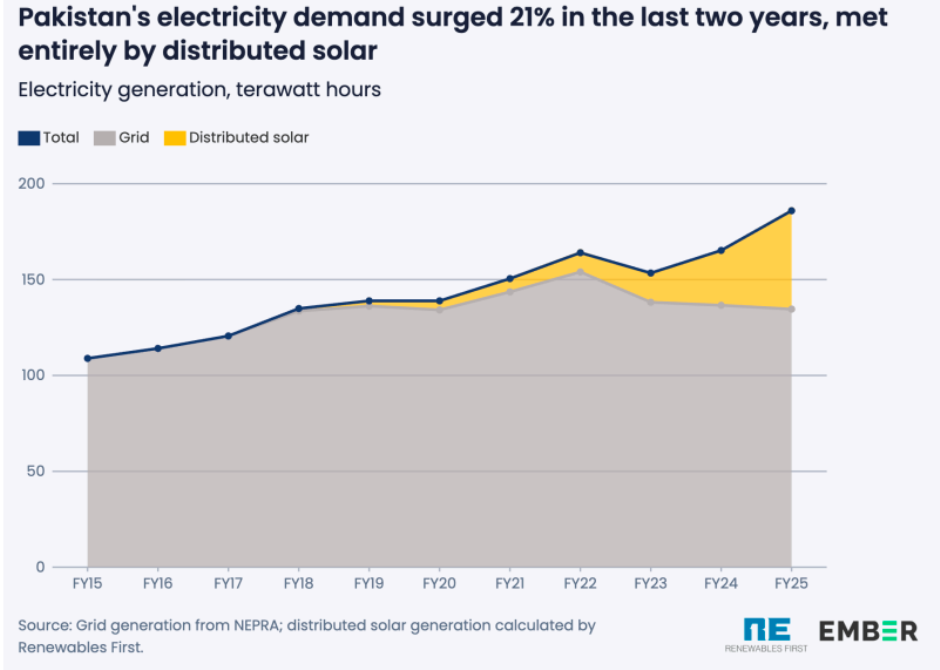
Pakistan’s electricity demand increased by 21 percent between FY23 and FY25, adding 33 TWh of new electricity consumption. During the same period, distributed solar generation expanded from 15 TWh to 51 TWh, an increase of 36 TWh, fully supplying the country’s additional electricity demand while conventional grid generation declined by 3 percent. Distributed solar’s share of electricity generation nearly tripled from 10 percent to 28 percent over the two-year period. When transmission and distribution losses are considered, distributed solar now supplies 32 percent of Pakistan’s electricity.
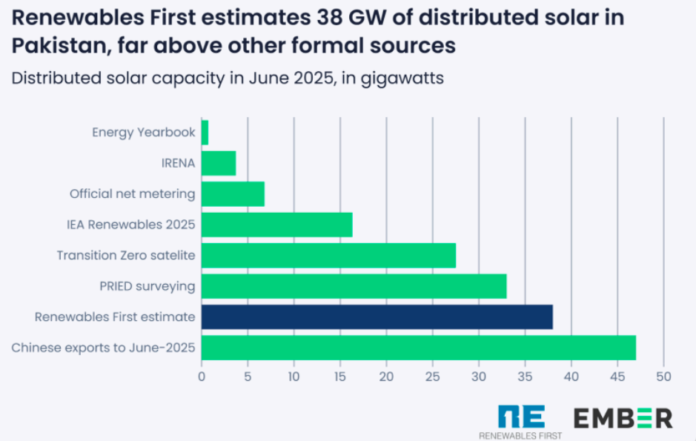
The report — prepared by Nabiya Imran, Muhammad Mustafa Amjad, Sohaib Malik, Dave Jones — estimates Pakistan deployed 38 GW of distributed solar capacity by June 2025 across residential, industrial, agricultural and commercial sectors, making it one of the fastest consumer-driven solar expansions globally. Of this capacity, 27 GW was installed in only two years, matching the combined operating capacity of every coal, natural gas and oil-fired power plant ever built in Pakistan.
“Pakistan’s distributed solar boom provides experience to show how fast clean energy growth can happen, and the benefits that this brings,” Dave Jones Chief Analyst, Ember, said.
“Distributed solar is providing millions of Pakistani homes, farms and businesses with affordable, reliable electricity. Empowered by the widespread adoption of solar PV tech, consumers are playing a central role in Pakistan’s electrification and energy transition,” Nabiya Imran Associate – Energy Insights, Renewables First, said.
Rapid solar adoption has significantly accelerated electrification across the economy. Electricity now accounts for 21.7 percent of Pakistan’s final energy demand in FY25, compared with the global average of 22.0 percent. Pakistan gained almost five percentage points in electrification within two years, while the global average increased by only 0.8 percentage points. During the same period, electricity demand grew by 21 percent, whereas non-electric energy consumption increased by only 2 percent, confirming that distributed solar met almost all of the country’s overall energy demand growth.
The report highlights that solar adoption has transformed every major sector of the economy. Agriculture has experienced one of the biggest changes, with distributed solar capacity reaching 8.1 GW. Solar-powered tubewells increased from almost zero to 61 percent of all tubewells between 2022 and 2025, while diesel-powered systems declined from 79 percent to 28 percent. This transition avoids approximately 1.9 billion litres of diesel consumption annually, lowers irrigation costs and enables greater agricultural productivity.
Industrial users have embraced solar as an alternative to increasingly expensive captive gas and coal generation. Commercial businesses have expanded electricity consumption while reducing exposure to rising grid tariffs. Residential consumers have benefited from reliable daytime electricity, allowing greater use of cooling appliances and reducing dependence on costly diesel generators during power outages.
The residential solar market has expanded rapidly, with approximately seven million households now owning rooftop solar systems. These installations represent around 18 percent of Pakistan’s 40 million households and account for 16.9 GW of installed capacity. The average rooftop system size is 2.4 kW, providing sufficient daytime electricity for many household needs.
The economics of rooftop solar have played a major role in driving adoption. Residential solar systems equipped with medium-sized battery storage generate electricity at around PKR 20 per kWh, approximately half the PKR 40 per kWh cost of grid electricity. Diesel-based electricity generation costs around PKR 120 per kWh, making distributed solar roughly six times cheaper than diesel power.
The report also highlights significant macroeconomic benefits. Pakistan has already avoided more than USD 12 billion in oil and gas imports by February 2026 because of distributed solar deployment. The report projects an additional USD 6.3 billion in avoided fossil fuel imports by the end of the year. Pakistan’s fossil fuel import bill reached PKR 4.3 trillion, equivalent to USD 15.5 billion, in FY25, making distributed solar an increasingly important contributor to national energy security and foreign exchange savings.
Distributed solar has also improved electricity reliability by virtually eliminating daytime load shedding in many regions, reducing carbon dioxide emissions, lowering air pollution and minimizing transmission and distribution losses by generating electricity close to where it is consumed.
The report shows that Pakistan’s distributed solar market is overwhelmingly driven by private investment rather than utility-scale deployment. Residential installations account for 44 percent of total distributed solar capacity, followed by industry at 26 percent, agriculture at 21 percent and commercial users at 9 percent.
The report concludes that Pakistan’s consumer-led solar revolution demonstrates how rapidly distributed renewable energy can transform emerging economies. By combining affordable electricity, improved energy security and reduced dependence on imported fossil fuels, Pakistan offers a compelling model for other developing countries seeking faster electrification and sustainable economic growth.
BABURAJAN KIZHAKEDATH
