
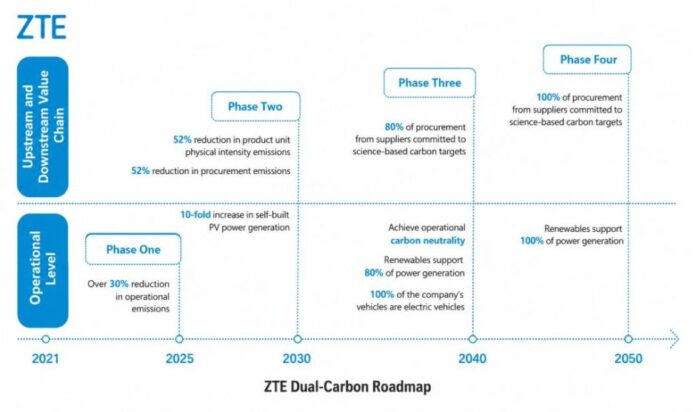
ZTE has reported significant progress in its sustainability strategy during 2025, achieving a 46 percent reduction in Scope 1 and Scope 2 greenhouse gas emissions compared with its 2021 baseline. The achievement underscores the company’s commitment to climate action through energy efficiency improvements, operational optimization, and increased adoption of renewable energy.
The company’s environmental progress extended beyond its direct operations. ZTE reduced physical emissions intensity during the product use and maintenance phase by 8.55 percent, supporting decarbonization efforts across the product lifecycle. These achievements align with the company’s science-based emissions reduction targets validated by the Science Based Targets initiative (SBTi) and support a 1.5°C climate pathway, according to ZTE Sustainability Report 2025.
ZTE reported total energy consumption of 910.58 million kWh in 2025 and invested more than CNY70 million in environmental governance and protection initiatives. The investment was directed toward energy-saving upgrades across R&D, manufacturing, and administrative operations, campus greening projects, treatment of exhaust gases, wastewater, hazardous and general waste, development of an energy management center, enhancement of the GPM system, and green and low-carbon testing and certification activities.
The company stated that it incurred no administrative penalties related to environmental issues during 2025, highlighting its compliance with environmental regulations and ongoing commitment to sustainable operations. The environmental spending supports ZTE’s strategy to improve energy efficiency, reduce environmental impact, and strengthen its green and low-carbon development capabilities.
ZTE CEO Xu Ziyang said: “Our efforts not only strengthen the security and resilience of the industry chain but also promote TCO optimization and low-carbon transformation across the industry.”
Since adopting its carbon reduction roadmap in 2021, ZTE has made substantial progress in energy conservation and emissions reduction. By the end of 2025, the company had reduced purchased electricity consumption by 16.3 percent compared with the 2021 baseline, achieving a compound annual reduction rate of 4.3 percent and generating nearly CNY100 million in cost savings.
ZTE also improved its comprehensive energy efficiency – measured as energy consumption per CNY100 million of revenue in tons of coal equivalent – by 28.39 percent over the same period. In addition, the company’s operational carbon emissions fell by 46 percent, representing a compound annual reduction rate of 14.3 percent. These achievements reflect the effectiveness of ZTE’s long-term sustainability strategy and ongoing investments in low-carbon operations.
ZTE COO Xie Junshi said: “We integrate climate action with our development strategy, and continue to build the Digital Green Path in four key dimensions: green corporate operations, green supply chain, green digital infrastructure, and green industry empowerment.”
Renewable energy remained a cornerstone of ZTE’s sustainability strategy. The company expanded photovoltaic installations across major operational sites, generating 39.22 million kWh of renewable electricity annually. To further increase clean energy consumption, ZTE purchased 33,700 Green Electricity Certificates, representing 33.69 million kWh of renewable power. The combined approach of on-site renewable generation and certified green electricity procurement has strengthened the company’s decarbonization efforts while reducing dependence on conventional energy sources.
Sustainable manufacturing continued to advance through the operation of three national-level green factories and one provincial-level green factory. These facilities focus on improving resource efficiency, reducing energy consumption, minimizing waste generation, and enhancing environmental performance throughout manufacturing operations.
ZTE also highlighted the broader environmental impact of its energy-efficient telecommunications technologies. The company estimates that its solutions help telecom operators worldwide save more than 10 billion kWh of electricity every year. Technologies including 5G-Advanced networks, 50G PON systems, and liquid-cooling solutions are enabling operators to reduce energy consumption while maintaining high network performance. As global digital infrastructure expands, these innovations are playing an increasingly important role in reducing emissions associated with telecommunications networks.
Supply chain sustainability remained a key priority. ZTE deployed AI-powered planning and management systems across a network of more than 20,000 global partners, helping improve operational efficiency, optimize resource utilization, reduce waste, and strengthen environmental performance throughout the value chain. The initiative demonstrates how artificial intelligence can support sustainability objectives while improving supply chain resilience.
The company’s digital solutions also delivered measurable social and operational benefits. At the Huatailong mine in Xizang, private network technologies reduced worker exposure to hazardous environments by 50 percent, improving workplace safety. In logistics operations, low-altitude drone networks increased delivery efficiency by more than 60 percent. Meanwhile, deployment of 50G PON technology at the Shanghai Mitsubishi factory improved production efficiency by 35 percent, highlighting the role of advanced connectivity in sustainable industrial transformation.
ZTE continued supporting digital inclusion through products designed for elderly users and underserved communities. Devices such as the ZTE Xiaoxian 60 Senior Edition smartphone and the TongTong care robot aim to improve accessibility and help bridge digital divides, enabling wider participation in the digital economy.
Governance and transparency remained central to the company’s ESG strategy. The 2025 report represents ZTE’s 18th consecutive sustainability disclosure. The company aligned reporting practices with international frameworks including the Corporate Sustainability Reporting Directive (CSRD) and the European Sustainability Reporting Standards (ESRS). ZTE maintained a Low ESG Risk rating from Sustainalytics for the fourth consecutive year and achieved an S&P Global ESG Score of 52, reflecting continued progress in sustainability management and governance practices.
ZTE’s 2025 Sustainability Report demonstrates measurable progress across climate action, renewable energy adoption, sustainable manufacturing, supply chain management, workplace safety, digital inclusion, and ESG governance. Key achievements include a 46 percent reduction in operational emissions, an 8.55 percent reduction in product-use emissions intensity, 39.22 million kWh of annual photovoltaic electricity generation, 33.69 million kWh of certified renewable electricity procurement, and more than 10 billion kWh in annual energy savings enabled through energy-efficient technologies. These results reinforce ZTE’s commitment to advancing sustainability while supporting global digital transformation.
SHAFANA FAZAL
