
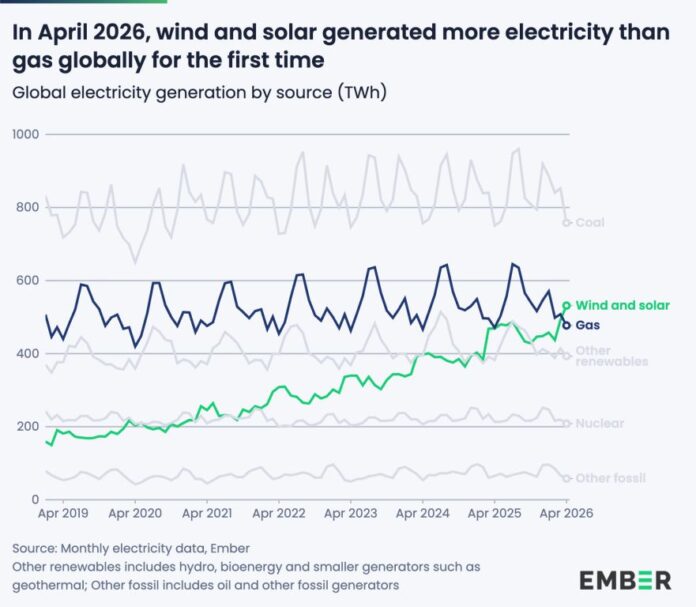
Wind and solar power generated more electricity than gas globally for the first time ever in April 2026, marking a major milestone in the global energy transition, according to new analysis from Ember.
Wind and solar together accounted for 22 percent of electricity generation in April 2026, surpassing gas, which contributed 20 percent. Combined wind and solar generation reached a record 531 terawatt-hours (TWh), exceeding gas-fired electricity generation of 477 TWh by 54 TWh.
The achievement in the renewable energy industry came during the first full month of the latest global energy crisis triggered by the conflict in the Middle East, highlighting the growing importance of renewable energy as countries seek secure, low-cost and domestically produced electricity sources.
Five years earlier, in April 2021, global gas generation stood at 476 TWh, nearly the same level as today, while wind and solar generation totaled just 245 TWh. The comparison underscores the rapid acceleration of renewable energy deployment worldwide.
Wind and Solar Growth Reshaping Global Power Markets
According to Ember, strong growth in wind and solar generation helped meet most of the increase in global electricity demand in April 2026, limiting the rise in gas generation despite geopolitical tensions and volatility in fossil fuel markets.
The analysis found no evidence of large-scale switching from gas to coal globally, despite ongoing energy security concerns.
Wind and solar electricity output increased across major economies during April 2026. China recorded 14 percent year-on-year growth in wind and solar generation, while the European Union achieved 13 percent growth. The United Kingdom posted a significant 35 percent increase, while the United States saw 8 percent growth.
Other notable increases included Australia at 17 percent, Chile at 24 percent and Brazil at 4 percent. Globally, wind and solar output is estimated to have risen 13 percent year-on-year during the month.
Renewable Energy Gains Momentum During Global Energy Crisis
The April milestone reflects a longer-term structural shift in global electricity markets rather than a temporary reaction to the latest energy crisis. Ember previously reported in its Global Electricity Review that wind and solar met all global electricity demand growth in 2025.
Kostantsa Rangelova said countries are increasingly turning to wind and solar because they are “cheap, homegrown and secure sources of electricity.”
She added that the current energy crisis has strengthened the economic and political case for renewable energy deployment, particularly for countries dependent on imported liquefied natural gas (LNG).
“For many importing countries, LNG-powered electricity is increasingly unable to compete with wind and solar,” Kostantsa Rangelova said.
Seasonal Factors Helped April 2026 Milestone
Ember noted that April was the most likely month for wind and solar to overtake gas because of favorable seasonal conditions in the northern hemisphere, where most global solar capacity is installed.
Spring conditions typically combine strong wind generation with rising solar output, while electricity demand tends to remain lower between winter heating and summer cooling seasons. This seasonal pattern usually reduces gas-fired power generation during April compared with other months of the year.
Although wind and solar surpassed gas for one month, they have not yet exceeded gas generation on an annual basis globally.
Governments Accelerate Renewable Energy Investments
Governments worldwide are expanding renewable energy targets and investment plans to reduce exposure to volatile fossil fuel prices and imported energy supplies.
Several countries recently announced major renewable energy initiatives tracked by the Global Renewables Alliance.
Indonesia unveiled plans to develop 100 gigawatts (GW) of solar-plus-storage capacity, while South Korea aims to triple its renewable energy capacity to 100 GW by 2030.
Countries including the Philippines, Thailand and the United Kingdom are also accelerating renewable energy project approvals and deployment to boost energy security and support long-term decarbonization goals.
The April 2026 milestone signals that wind and solar are rapidly becoming central pillars of the global electricity system, reshaping energy markets and reducing dependence on fossil fuels amid increasing geopolitical uncertainty.
BABURAJAN KIZHAKEDATH
