
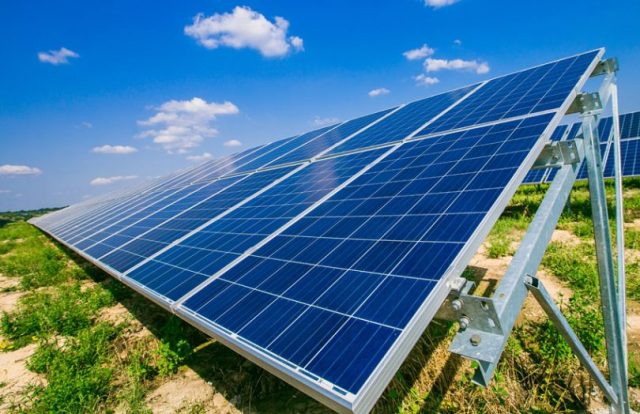
New projections from the U.S. Energy Information Administration show that utility-scale solar, wind, and battery storage will add more than 80 GW of new generating capacity in the United States by February 2027, while fossil fuel and nuclear capacity will decline by nearly 5 GW.
Renewable energy’s share of total utility-scale capacity is expected to rise from 33.4 percent in March 2026 to 36.6 percent by early 2027. Solar will lead the expansion with 42,628.6 MW of additions, increasing its share from 12.7 percent to 15.5 percent.
Wind capacity will grow by 14,507.4 MW, including 4,155 MW of offshore wind, raising its share to 13.6 percent. Other renewables such as hydropower, biomass, and geothermal will add 316.7 MW.
Total renewable capacity additions of 57,452.7 MW over the 12-month period are nearly 75 percent higher than the 32,988.9 MW added in the previous year.
Meanwhile, nuclear capacity will see no additions
Fossil fuels will decline by 4,903.2 MW.
Including small-scale solar could further accelerate the shift. With distributed solar capacity already at about 60,197.9 MW and growing by over 6,000 MW annually, renewables could reach 39.7 percent of total installed capacity by March 2027.
Solar alone could account for 19.7 percent, while natural gas is projected to fall from 40.0 percent to 38.3 percent.
Battery energy storage is also expanding rapidly, with capacity expected to increase from 44,630.7 MW to 67,549.6 MW, a rise of 51.4 percent. Combined, renewables and storage are set to deliver around 86,370 MW of new clean capacity.
This rapid capacity buildout is already boosting generation. In January and February 2026, renewable electricity output rose by 10.8 percent, accounting for 26.0 percent of total generation, up from 23.6 percent a year earlier.
Growth was led by utility-scale solar, which surged 23.2 percent, followed by hydropower at 22.9 percent and small-scale solar at 11.4 percent. Wind and geothermal generation also increased by 1.4 percent and 1.5 percent, respectively. Overall electricity generation grew by 3.6 percent, meaning renewables expanded at three times the overall rate.
Solar and wind combined continued to generate more electricity than either coal or nuclear power, underscoring the accelerating transition toward cleaner energy sources in the U.S.
“Notwithstanding policy obstacles in the past year, renewables raced ahead in 2025 and are now poised to accelerate further in 2026 and beyond,” said Ken Bossong.
BABURAJAN KIZHAKEDATH
