
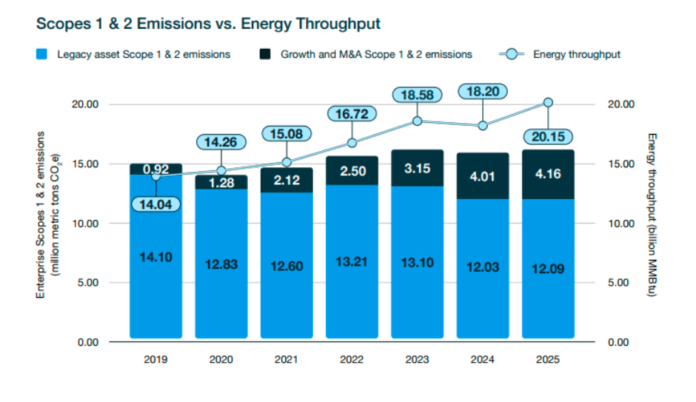
Williams is accelerating its sustainability strategy through significant greenhouse gas emissions reductions, advanced methane management, renewable energy, carbon capture, lower-carbon infrastructure investments and enhanced ESG reporting, according to its 2025 Sustainability Report. The company reported measurable progress across environmental, social and governance priorities while strengthening energy reliability and supporting the transition to a lower-carbon future.
Chief Executive Officer Chad J. Zamarin said rising energy demand requires affordable, reliable and practical lower-carbon solutions, with natural gas continuing to play a key role alongside investments in sustainable infrastructure. Williams is expanding critical energy infrastructure while investing in technologies that reduce emissions and improve long-term environmental performance.
Climate action remained a major focus during 2025. Williams achieved a 28 percent reduction in carbon intensity-based greenhouse gas emissions compared with its 2018 baseline while continuing to expand its operational footprint. The company reaffirmed its commitment to achieve net-zero carbon emissions by 2050 and maintained its interim target of reducing absolute greenhouse gas emissions by 56 percent by 2030 compared with its 2005 baseline, Williams Sustainability Report 2025 said.
The company also strengthened its greenhouse gas management by expanding Scope 3 emissions inventories, improving emissions accounting and deploying advanced technologies that enhance emissions measurement and operational efficiency. Improved emissions data and value chain reporting are helping Williams identify additional opportunities to reduce its environmental footprint.
Methane management continued to set industry benchmarks. Williams exceeded its annual methane reduction targets and earned OGMP 2.0 Gold Standard Pathway recognition for excellence in methane measurement, reporting and transparency. The company expanded the use of artificial intelligence-powered analytics, satellite monitoring and advanced leak detection technologies to improve emissions monitoring, accelerate response times and enhance asset integrity.
Williams also advanced several lower-carbon infrastructure projects during the year. The company continued development of a utility-scale solar and battery energy storage project in Lakeland, Florida, converting a former phosphate mine into renewable energy infrastructure. It also progressed engineering work on the Louisiana Energy Gateway carbon capture and sequestration project, designed to capture, transport and permanently store carbon dioxide to reduce industrial emissions.
To support growing electricity demand, Williams advanced more than $7 billion in behind-the-meter energy projects, representing approximately 2.6 gigawatts of onsite natural gas power generation for data centers, hyperscale facilities and other energy-intensive operations. The company highlighted the complementary role of natural gas in supporting grid reliability alongside renewable energy sources such as wind and solar.
Operational excellence remained a core strength throughout 2025. Williams maintained nearly 100 percent service reliability, demonstrating the resilience of its energy infrastructure. The company also inspected 4,216 miles of pipelines through its Integrity Program, improving asset reliability, reducing operational risks and enhancing the safe transportation of natural gas.
Workplace safety improved significantly during the reporting period. Williams reduced its employee Total Recordable Incident Rate by 23 percent compared with 2024 while continuing mandatory compliance and ethics training to strengthen corporate governance, risk management and organizational accountability.
The company continued aligning its sustainability disclosures with internationally recognized reporting frameworks, including GRI Standards 2021, GRI 11, SASB Oil and Gas – Midstream Standards, the Task Force on Climate-related Financial Disclosures (TCFD) and IFRS Foundation S2 Climate-related Disclosures. Independent limited assurance provided by ERM CVS further enhanced the credibility and transparency of Williams’ environmental data and ESG reporting.
With a 28 percent reduction in carbon intensity since 2018, a commitment to net-zero emissions by 2050, a 56 percent greenhouse gas reduction target by 2030 versus the 2005 baseline, more than $7 billion in lower-carbon energy investments, approximately 2.6 gigawatts of onsite power projects, nearly 100 percent service reliability, 4,216 miles of pipeline inspections and a 23 percent improvement in workplace safety, Williams continues to strengthen its sustainability leadership while delivering reliable energy and advancing practical climate solutions.
SHAFANA FAZAL
