
Vattenfall has released its Sustainability Report 2025, showcasing accelerated progress toward its goal of enabling fossil-free living within one generation.
The company reported an underlying operating profit of 30.9 billion SEK, reflecting strong financial performance driven by strategic price hedging and solid nuclear output. This momentum supports a major 165 billion SEK net investment plan for 2026-2030, with 56 percent of the capital earmarked for expanding fossil-free energy technologies.
In 2025, Vattenfall invested around 30 billion SEK, with 88 percent aligned with EU Taxonomy criteria for sustainable activities, while 85 percent of total investments during the year met EU sustainability classification standards.
Vattenfall, as part of its sustainability goals, achieved a major decarbonisation milestone in 2025, delivering a 56 percent absolute reduction in greenhouse gas emissions across its full value chain compared to its 2017 baseline. Emissions from its own operations declined by 53 percent over the same period, reinforcing its transition away from fossil fuels.
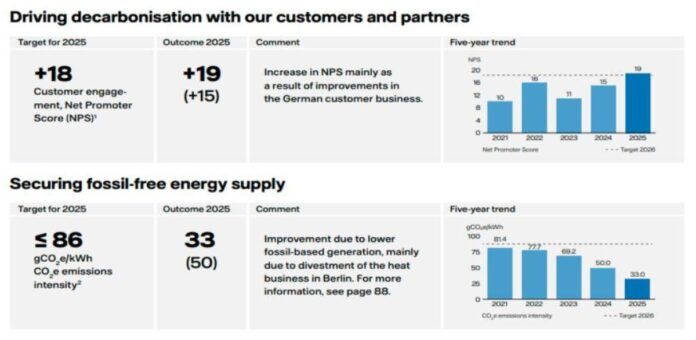
Vattenfall, under the leadership of CEO Anna Borg, significantly improved its generation carbon intensity, reducing it to 50 grams of CO2e per kWh, well below its original target of 86 grams. These results confirm alignment with the 1.5°C climate pathway, validated by the Science Based Targets initiative, as the company progresses toward its net-zero value chain ambition by 2040.
Operationally, Vattenfall generated approximately 102 TWh of electricity in 2025, with 99.6 TWh coming from fossil-free sources, meaning around 90 percent of its total generation is now fossil-free. Fossil-based power accounts for only about 7 percent of the energy mix, highlighting the company’s rapid shift toward wind, hydro, and nuclear energy. Continued investments in renewable infrastructure and electrification are further accelerating this transition.
Vattenfall is also advancing its strategic expansion into next-generation energy technologies. The company partnered with GE Vernova and Rolls-Royce SMR to develop small modular reactors, establishing Videberg Kraft AB to lead nuclear innovation in Sweden.
At the same time, it is scaling renewable capacity through offshore wind projects such as Nordlicht I and II in Germany and Clashindarroch II in the UK. In hydropower, a 1.3 billion SEK upgrade of the Harsprånget facility will strengthen grid reliability and long-term energy security in the Nordic region.
Beyond emissions reduction, Vattenfall is embedding circular economy principles into its operations. In 2025, it inaugurated Europe’s first car park built using recycled wind turbine blades and collaborated with SSAB to integrate fossil-free steel into dam infrastructure. Biodiversity investments reached a record 450 million SEK, supporting initiatives such as fish migration systems at hydropower plants and artificial reef development at offshore wind sites.
Workplace safety and diversity also remain key priorities. The Lost Time Injury Frequency rate improved to 1.46, with a target to reach 1.0, reflecting ongoing efforts to enhance safety standards. Female representation in leadership roles increased to 34 percent, progressing toward the company’s 40 percent target by 2028.
Looking ahead, Vattenfall continues to align its strategy with evolving European sustainability regulations, including compliance with the Corporate Sustainability Reporting Directive and ESRS frameworks. Its broader investment roadmap includes a previous 170 billion SEK plan for 2025-2029, with 61 percent allocated to growth and sustainability-focused initiatives, alongside the new 165 billion SEK plan for 2026-2030.
Overall, Vattenfall’s 2025 Sustainability Report highlights substantial progress in scaling fossil-free energy, achieving over 90 percent fossil-free electricity generation, reducing emissions by 56 percent across its value chain, and delivering 99.6 TWh of clean power. Supported by tens of billions of SEK in sustainable investments and clear long-term targets for net-zero by 2040, the company is strengthening its position as a key driver of Europe’s energy transition.
FASNA SHABEER
