
Torrent Pharmaceuticals has reported significant progress across climate action, renewable energy adoption, water stewardship, waste management, and community development in its FY 2025–26 Sustainability Report, highlighting its commitment to building a resilient and sustainable business through a comprehensive Environmental, Social, and Governance (ESG) strategy.
The company said sustainability remains a board-level priority under the supervision of its CSR and Sustainability Committee, with a long-term objective of decoupling business growth from carbon emissions, water consumption, and waste generation. Its sustainability disclosures align with Global Reporting Initiative (GRI), Sustainability Accounting Standards Board (SASB), United Nations Sustainable Development Goals (UN SDGs), SEBI’s Business Responsibility and Sustainability Reporting (BRSR) framework, and the National Guidelines on Responsible Business Conduct (NGRBC).
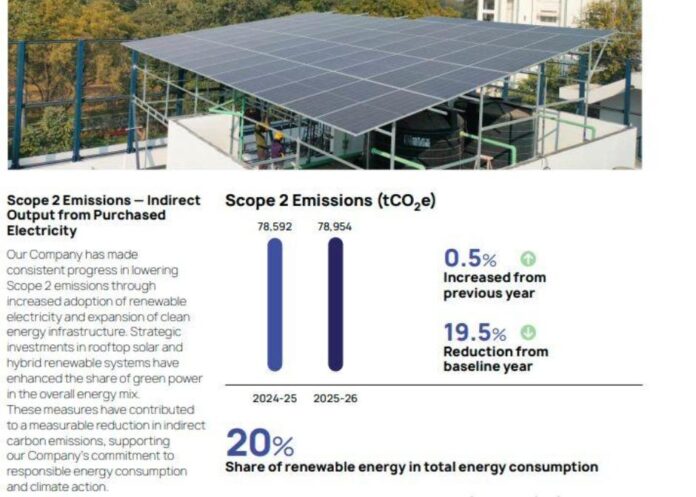
A major achievement during FY26 was a 32.4 percent reduction in combined Scope 1 and Scope 2 greenhouse gas emissions compared with the FY 2019–20 baseline. The reduction was supported by investments exceeding ₹4 crore in low-carbon utility upgrades, including high-efficiency centrifugal air compressors, advanced heat pumps, energy-efficient LED lighting systems, and the transition to R410A refrigerants with lower global warming potential, Torrent Pharmaceuticals Sustainability report 2025-26 indicated.
Torrent Pharmaceuticals also accelerated its renewable energy transition. The company’s captive renewable energy generation capacity reached 8.15 MW following investments of more than ₹85 crore in renewable infrastructure. A key project in Jamnagar combines a 5 MW AC solar power plant with two wind turbines of 2.7 MW each, supplying clean power to manufacturing facilities, operations, and research laboratories.
During the reporting year, Torrent Pharmaceuticals generated 27.07 million kWh of renewable electricity. Renewable energy now contributes more than 41.5 percent of the company’s total manufacturing energy consumption, reducing dependence on conventional energy sources and supporting its low-carbon growth strategy.
The company further strengthened thermal energy decarbonization through investments exceeding ₹35 crore in biomass briquette-fired boiler systems. A major initiative includes the installation of a 10 TPH biomass-fired boiler at the Indrad facility, complemented by additional biomass energy deployments at Dahej and Baddi manufacturing plants. These projects replace coal and lignite-based systems with renewable biomass derived from agricultural waste.
Water stewardship remained another focus area. Torrent Pharmaceuticals has completely eliminated deep borewell groundwater extraction at its principal manufacturing facilities. To enhance water security, the company operates 26 rainwater harvesting structures across its locations. At the Indrad facility, advanced Effluent Treatment Plant (ETP) and Reverse Osmosis (RO) systems maintained an average Chemical Oxygen Demand (COD) level of 46 ppm, significantly below the regulatory limit of 100 ppm, providing a 54 percent compliance buffer.
The company also advanced its circular economy goals. During FY26, 100 percent of industrial ETP sludge and incinerable hazardous waste from key manufacturing facilities were diverted for co-processing in cement kilns, eliminating landfill disposal while creating alternative fuel for cement production. Solvent recovery systems equipped with double-condenser technology further improved resource efficiency by enabling solvent reclamation and reuse in pharmaceutical manufacturing.
On the social front, Torrent Pharmaceuticals continued to invest in healthcare, hygiene, and education initiatives. Through its REACH Project, the company screened more than 18,000 rural children for anemia, vitamin deficiencies, and severe malnutrition, supporting early intervention and improved health outcomes.
The company also distributed more than 29,900 reusable and 100 percent biodegradable sanitary napkins to young women in rural communities, promoting menstrual hygiene while reducing plastic waste. Its Shiksha Setu program supported digital classrooms, STEM laboratories, educational infrastructure upgrades, and teacher training initiatives aimed at improving learning outcomes in government schools.
To enhance transparency and stakeholder confidence, Torrent Pharmaceuticals engaged Grant Thornton Bharat LLP for independent verification of sustainability data. The assurance process included Reasonable Assurance for key BRSR sustainability metrics and Limited Assurance covering all nine principles of the NGRBC framework.
Torrent Pharmaceuticals’ FY26 sustainability performance highlights measurable progress across ESG priorities, including a 32.4 percent reduction in Scope 1 and Scope 2 emissions, 8.15 MW renewable energy capacity, 27.07 million kWh renewable electricity generation, investments of more than ₹85 crore in renewable energy infrastructure, over ₹35 crore in biomass energy systems, 26 rainwater harvesting structures, 100 percent co-processing of industrial hazardous waste, screening of more than 18,000 rural children, and distribution of over 29,900 biodegradable sanitary napkins. These achievements reinforce the company’s commitment to sustainable, resource-efficient, and socially responsible growth.
SHAFANA FAZAL
