
Nasdaq has strengthened its sustainability leadership with progress in emissions reduction, renewable energy adoption, sustainable finance, and carbon removal, according to its 2025 Sustainability Report.
The company reduced its total market-based greenhouse gas (GHG) emissions by 17.1 percent to 72,188 metric tons of carbon dioxide equivalent (CO₂e) in 2025 from 87,088 metric tons in 2024, while maintaining operational carbon neutrality for the seventh consecutive year.
The report underscores Nasdaq’s commitment to achieving net-zero greenhouse gas emissions across its value chain by 2050 through science-based targets aligned with the Science Based Targets initiative (SBTi) 1.5°C pathway. The company plans to reduce absolute Scope 1 and Scope 2 emissions by 90 percent by 2032 from the 2023 baseline and cut Scope 3 emissions by 50 percent over the same period.
By 2050, Nasdaq aims to maintain at least a 90 percent reduction in Scope 1 and Scope 2 emissions while reducing Scope 3 emissions by 95 percent. The company also targets increasing suppliers with science-based emissions reduction targets to 70 percent of procurement spend by 2029, up from 50.8 percent in 2025 and 44.2 percent in 2024, Nasdaq sustainability report 2025 indicated.
Nasdaq achieved 100 percent renewable electricity procurement across its global offices and data centers during 2025, meeting its long-term renewable energy objective ahead of schedule. Renewable electricity was sourced through renewable electricity procurement and Renewable Energy Certificates (RECs), with certificates originating from projects less than five years old and connected to the same electricity grids as Nasdaq’s operations. The company has increased renewable electricity sourcing from 97 percent in 2023 to 100 percent in 2025.
Adena Friedman Chair and CEO of Nasdaq, said: “We continued our sustainability commitments by procuring 100% renewable electricity for our global office and data center portfolios in 2025.”
The company’s operational decarbonization efforts continued to deliver measurable results. Scope 1 and Scope 2 market-based emissions declined by 73 percent from the 2023 base year, while Scope 3 emissions fell by 33 percent during the same period. Scope 1 emissions dropped to just 14 metric tons CO₂e in 2025 from 79 metric tons in 2024, while market-based Scope 2 emissions totaled only 271 metric tons CO₂e.
Total location-based emissions also declined by 14.0 percent year over year to 91,256 metric tons CO₂e in 2025 from 106,099 metric tons in 2024. The reduction reflects improved emissions management, enhanced supplier data quality, lower business travel emissions, and greater operational efficiency.
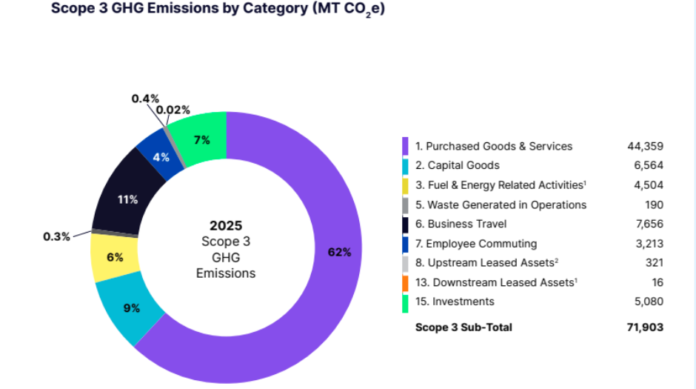
Scope 3 emissions remained the largest contributor to Nasdaq’s carbon footprint at 71,903 metric tons CO₂e in 2025, down from 86,780 metric tons in 2024. Purchased Goods and Services represented the largest category at 44,359 metric tons CO₂e, accounting for approximately 61.7 percent of Scope 3 emissions and declining 22 percent year over year following the integration of direct activity data from a major cloud hardware supplier. Business Travel emissions fell 39 percent to 7,656 metric tons CO₂e, while Employee Commuting emissions declined 22 percent to 3,213 metric tons CO₂e. Other Scope 3 categories included Capital Goods at 6,564 metric tons CO₂e, Investments at 5,080 metric tons CO₂e, Fuel and Energy Activities at 4,504 metric tons CO₂e, and Other Categories at 527 metric tons CO₂e.
Nasdaq’s climate strategy focuses on reducing Scope 1, Scope 2, and Scope 3 emissions through energy efficiency improvements, supplier decarbonization, renewable electricity procurement, and the use of engineered and nature-based carbon credits. The company also applies an internal shadow carbon price based on renewable electricity and carbon offset costs. The internal carbon price covers 100 percent of reported annual emissions and guides investment decisions across the business.
Carbon removal remains an important component of Nasdaq’s long-term decarbonization strategy. The company highlighted its investment in the Gevo North Dakota Geological Storage carbon removal project, which captures CO₂ at 99.9 percent purity and permanently stores it 1.3 miles underground. Operating since 2022, the facility sources corn from more than 200 local farmers within a 75-mile radius, became the first Puro.earth-certified CO₂ storage facility in the United States, has issued more than 560,000 verified tonnes of carbon removals, provides certified storage for more than 1,000 years, and has received an A rating from BeZero, placing it among the top 10 percent of rated carbon removal projects globally.
Nasdaq also reported strong momentum in sustainable finance. Outstanding sustainable debt listed across its markets exceeded €88 billion during 2025, representing annual growth of 21 percent. The Sustainable Bond Network expanded to more than 2,200 issuers, increasing 18 percent year over year and demonstrating growing demand for sustainable capital markets.
The company’s carbon removal platform, Puro.earth, continued rapid expansion by issuing 657,000 verified CO₂ Removal Certificates (CORCs) during 2025, representing a 62 percent increase from the previous year. Puro.earth’s certified portfolio now includes 109 carbon removal projects across 22 countries, supporting the growing demand for permanent carbon removal solutions.
Nasdaq continued strengthening sustainability reporting by aligning disclosures with the Task Force on Climate-related Financial Disclosures (TCFD) and the International Sustainability Standards Board’s IFRS S2 framework. The company also enhanced Nasdaq Metrio to support Corporate Sustainability Reporting Directive compliance and established an AI Integration Team to monitor the energy implications of artificial intelligence while maintaining renewable electricity commitments.
Community investment and workforce development also remained priorities. Employees contributed more than 7,000 volunteer hours through the Purpose@Work initiative, which offers two paid volunteer days annually. Nasdaq donated more than $580,000 to over 800 nonprofit organizations worldwide and continued matching employee donations up to $1,000 per employee. Nearly 50 percent of managers completed the Accelerator Management Program to strengthen leadership capabilities.
Nasdaq’s sustainability performance received continued external recognition during 2025. The company maintained its CDP A List status for climate disclosure and achieved a Sustainalytics ESG Risk Rating of 14.9, earning a Low Risk classification.
Nina Eisenman, Vice President and Head of Corporate Sustainability Strategy and Reporting at Nasdaq, said: “Our approach to sustainability is focused on creating lasting value and is grounded in Nasdaq’s purpose to empower economic opportunity.”
Looking ahead, Nasdaq will continue prioritizing emissions reductions, supplier decarbonization, renewable electricity procurement, carbon removal, transparent ESG reporting, and science-based climate targets as it advances toward its 2050 net-zero commitment.
SHAFANA FAZAL
