
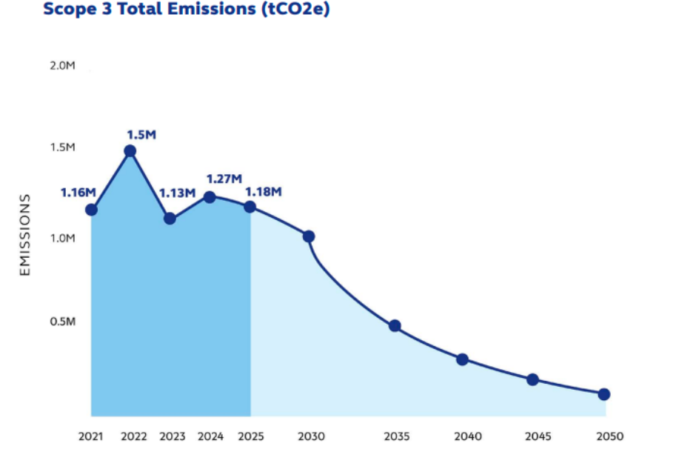
Globe Telecom has strengthened its sustainability leadership by accelerating progress toward its 2050 net zero target, achieving significant reductions in greenhouse gas emissions while expanding renewable energy adoption across its operations. The company has validated its near-term and long-term climate goals through the Science Based Targets initiative (SBTi), with targets aligned to limiting global warming to 1.5°C above pre-industrial levels.
A major sustainability achievement in 2025 was a 15 percent year-on-year reduction in Scope 1 and Scope 2 greenhouse gas emissions, alongside a 9 percent decline in Scope 3 emissions. These results significantly outperformed Globe’s annual emissions reduction pathway of 4.2 percent for Scope 1 and 2 emissions and 2.5 percent for Scope 3 emissions. To further strengthen its climate strategy, Globe will establish 2025 as its new emissions baseline while remaining aligned with SBTi requirements, Globe Telecom sustainability report 2025 indicated.
Renewable energy continues to play a central role in Globe’s decarbonisation strategy. Renewable electricity accounted for 34 percent of the company’s total electricity consumption in 2025, with a target to increase this share to 42 percent by 2030, Carl R Cruz, President and CEO of Globe Telecom, said.
More than 358 Globe sites now operate on renewable energy, supported by accelerated rooftop solar installations and renewable electricity procurement through the Green Energy Option Program (GEOP), Retail Aggregation Program (RAP), and Retail Competition and Open Access (RCOA).
The company’s energy profile highlights its growing reliance on clean energy. Globe reported 442.66 million MWh of total energy consumption, including 290.88 million MWh of purchased electricity. Of this, 151.71 million MWh came from renewable electricity purchases, while Globe generated and consumed an additional 4.06 million MWh of renewable electricity from its own facilities. Network operations accounted for 373.73 million MWh of energy consumption.
Globe also disclosed detailed greenhouse gas emissions data, reporting 19,758.2 tonnes CO₂e of Scope 1 emissions, 317,151.52 tonnes CO₂e of location-based Scope 2 emissions, 210,077.70 tonnes CO₂e of market-based Scope 2 emissions, and 1,187,743.07 tonnes CO₂e of Scope 3 emissions. Overall, combined Scope 1 and Scope 2 emissions declined by 15.13 percent on a market-based basis compared with the previous year.
Beyond emissions reductions, Globe continues investing in greener infrastructure. The company has deployed 245 hybrid and electric vehicles across its fleet and aims to increase this number to 500 vehicles by 2028. It has also expanded green digital infrastructure, with 358 renewable-powered sites, 115,082 fibre-to-the-home connections, and more than 58,000 green network solutions supporting lower-carbon telecommunications services.
Globe’s sustainability performance has earned international recognition. During 2025, the company received an A- rating from CDP Climate, an A rating in the CDP Supplier Engagement Assessment, maintained an AA MSCI ESG Rating, remained a constituent of the FTSE4Good Index for the tenth consecutive year, and was recognised among TIME World’s Most Sustainable Companies 2025. Globe also became one of only six telecom operators worldwide to participate in the inaugural GSMA Green Network Index, highlighting its commitment to reducing emissions across telecommunications networks.
While Globe’s renewable energy strategy is heavily focused on solar energy and renewable electricity procurement, the report does not disclose any wind energy projects or wind power investments, indicating that solar and purchased renewable electricity remain the company’s primary pathways for achieving its net-zero ambitions.
SHAFANA FAZAL
