
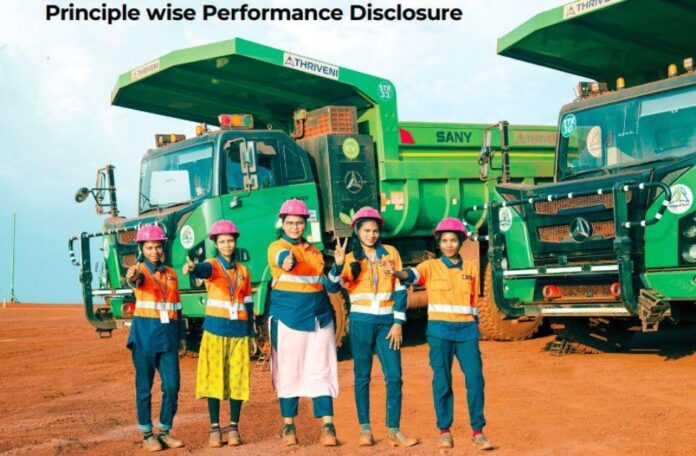
Lloyds Metals and Energy significantly strengthened its sustainability strategy during FY 2025-26 with record investments in renewable energy, green mining technologies, emissions reduction, water stewardship, circular economy initiatives, and employee welfare. The company’s sustainability roadmap focuses on achieving long-term net-zero readiness through cleaner operations, renewable energy adoption, resource efficiency, and responsible mining practices.
Managing Director Balasubramanian Prabhakaran said Lloyds Metals continues to build capabilities to create lasting social impact while scaling sustainable and green mining across its operations.
₹13,513 Crore Sustainability Investments Accelerate Green Growth
Lloyds Metals invested ₹8,131 crore in capital expenditure during FY 2025-26, taking cumulative investments over the last three years to ₹13,513 crore. The company also invested ₹6.21 crore in research and development, ₹6.50 crore in digital technologies supporting environmental monitoring, emissions management and operational efficiency, and ₹221.11 crore in employee welfare, healthcare, safety infrastructure and workforce development.
Community development remained a priority with ₹181.20 crore invested across 34 Corporate Social Responsibility (CSR) projects covering education, healthcare, skill development, infrastructure and social welfare, Lloyds Metals and Energy Sustainability Report 2025-26 indicated.
Renewable Energy Surges 1,759 percent
Renewable energy became one of Lloyds Metals’ strongest sustainability achievements during FY26.
Renewable energy consumption increased 1,759 percent year-on-year to 129,750 gigajoules, reflecting the company’s rapid transition toward cleaner energy.
To accelerate decarbonisation, Lloyds Metals secured Power Purchase Agreements (PPAs) for more than 100 MW of hybrid solar and wind power capacity. The renewable energy projects will support future electricity demand while reducing dependence on fossil fuels.
The company is integrating solar and wind energy at Konsari and Unit-3 Hedri and aims to further increase renewable energy’s share in total energy consumption.
Lloyds Metals also introduced bamboo dust biomass as an alternative fuel, reducing specific boiler emissions by 14 percent.
Net Zero Roadmap and Climate Targets
Lloyds Metals has established ambitious long-term environmental goals that include:
Zero Hazardous Waste to Landfill
100 percent Zero Liquid Discharge (ZLD) by 2030
100 percent utilisation of slag from iron and steelmaking by 2035
Minimum 3 percent annual increase in iron ore tailings utilisation from 2028
100 percent utilisation of iron ore tailings by 2050
Development of an internal carbon-pricing mechanism for capital allocation
Comprehensive Scope 3 greenhouse gas emissions assessment across the value chain
These targets support the company’s broader ESG and climate strategy.
Scope 1 and Scope 2 Emissions
Combined Scope 1 and Scope 2 greenhouse gas emissions during FY26 totalled 1,319,229.58 metric tonnes of CO₂ equivalent.
The company is pursuing multiple decarbonisation initiatives, including renewable energy deployment, equipment electrification, cleaner fuels, energy-efficient technologies and low-carbon logistics to reduce emissions intensity.
Green Mining Technologies Reduce Carbon Footprint
Lloyds Metals continues investing in innovative technologies that reduce greenhouse gas emissions.
A major milestone was the deployment of the world’s first excavator-mounted electric compressor drill at the Surjagarh mine, enabling 100 percent diesel-free drilling operations.
The company has also expanded its battery-electric mining fleet to more than 100 electric vehicles, lowering diesel consumption and improving energy efficiency.
Its 85-kilometre Hedri-Konsari slurry pipeline has transformed iron ore logistics by replacing diesel truck transport.
The project:
reduces transportation emissions by approximately 55 percent
can reduce logistics-related carbon emissions by up to 61,000 tonnes annually
significantly lowers diesel consumption
reduces thousands of truck movements each year
Additional emission-reduction initiatives include:
In-Pit Crushing and Conveyor (IPCC) systems replacing diesel haulage
BHQ Beneficiation Plant reducing energy consumption and coke usage
500 kg/day biogas plant converting organic waste into clean fuel and bio-manure, reducing methane emissions
deployment of battery-electric mining equipment across operations
Water Stewardship and Zero Liquid Discharge
Water sustainability remains central to Lloyds Metals’ ESG strategy.
The company has already implemented Zero Liquid Discharge (ZLD) systems at:
Unit-1 Ghugus
Surjagarh Iron Ore Mines
Unit-3 Hedri
At Unit-2 Konsari, wastewater undergoes tertiary treatment before discharge.
Treated water is reused for:
cooling tower make-up
dust suppression
green belt development
industrial process requirements
During FY26, Lloyds Metals achieved:
Water positivity ratio: 1.45
Freshwater consumption: 5,551,105 kilolitres
Water intensity: 0.0000401 kilolitres per rupee of turnover
Circular Economy Achievements
Circular economy initiatives delivered impressive results.
The company achieved:
99.99 percent diversion of non-hazardous waste from landfill
recycling and reuse of approximately 0.25 million tonnes of industrial by-products including fly ash and slag
Its long-term resource efficiency roadmap targets:
100 percent slag utilisation by 2035
100 percent tailings utilisation by 2050
Zero hazardous waste to landfill
Air Emissions
Air emissions reported during FY26 were:
| Parameter | FY26 | FY25 |
| NOx | 2,016.44 MT | 1,319.54 MT |
| SOx | 3,062.01 MT | 2,348.86 MT |
| Particulate Matter | 293.64 MT | 214.26 MT |
The increase reflects the expansion of Pellet Plant-1 and commissioning of new DRI kilns. Lloyds Metals continues investing in advanced emission-control technologies, Continuous Emission Monitoring Systems (CEMS), environmental monitoring, and energy-efficiency improvements.
Workplace Sustainability
Employee wellbeing remains a strategic priority.
FY26 highlights include:
4,866 employees
₹221.11 crore invested in employee welfare
Lost Time Injury Frequency Rate (LTIFR): 0.15 for employees
LTIFR: 0.18 for workers
Zero fatalities across mining operations, manufacturing facilities and corporate offices
The company continues strengthening occupational safety through ISO 45001 systems, digital safety reporting, annual health surveillance and continuous workforce training.
Independent Sustainability Assurance
Lloyds Metals’ sustainability disclosures received independent assurance from Intertek India Pvt. Ltd. under ISAE 3000 (Revised). The company also maintains ISO 14001 Environmental Management Systems and continues strengthening energy efficiency, climate governance and responsible environmental management.
With ₹13,513 crore in green investments, 1,759 percent renewable energy growth, 100 MW+ hybrid solar and wind capacity, 100 percent diesel-free drilling, 55 percent lower transportation emissions, 61,000 tonnes of annual logistics emission reduction potential, ambitious 2030, 2035 and 2050 sustainability targets, and continued investments in circular economy, water stewardship and low-carbon mining, Lloyds Metals is building one of India’s most comprehensive sustainability strategies for the metals and mining sector.
SHAFANA FAZAL
