
Lifezone Metals has outlined major sustainability achievements in its 2025 Sustainability Report, highlighting progress in renewable energy adoption, emissions reduction, cleaner mineral processing, workplace safety, community engagement, and ESG governance.
Beatriz Orrantia Director, Sustainability Committee Chair at Lifezone Metals, said its sustainability initiatives support lower-carbon critical mineral production while advancing responsible mining practices aligned with international environmental and social standards.
A significant milestone during 2025 was the Kabanga Nickel Project’s complete transition from off-grid diesel generators to Tanzania’s national electricity grid. The move reduced diesel fuel consumption by 49 percent compared with the previous year, lowering annual diesel use to 95,481 liters. Lifezone Metals 2025 Sustainability Report indicated.
The environmental benefits were further enhanced because approximately 64.8 percent of electricity supplied through Tanzania’s national grid comes from renewable energy sources, primarily hydropower. The combination of grid electrification and renewable electricity has significantly reduced operational greenhouse gas emissions while improving energy efficiency across the Kabanga Nickel Project.
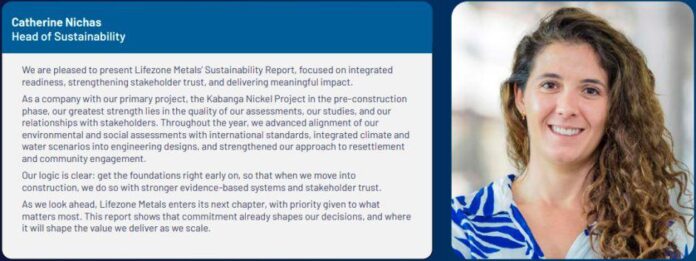
Lifezone Metals’ proprietary Hydromet Technology remained central to its sustainability strategy. The water-based processing technology offers an alternative to conventional pyrometallurgical smelting and is designed to improve resource efficiency while lowering emissions from nickel production, Catherine Nichas Head of Sustainability at Lifezone Metals, said.
According to the report, Hydromet Technology can reduce Scope 1 and Scope 2 carbon dioxide emissions by up to 73 percent compared with traditional smelting processes. By eliminating conventional smelting, the technology also removes direct sulfur dioxide emissions, reducing one of the major sources of localized air pollution associated with metal production.
The technology also supports circular economy objectives. When used to recycle platinum group metals recovered from end-of-life automotive catalytic converters, Hydromet Technology cuts processing emissions by 46 percent compared with conventional refining methods while improving recovery of valuable metals from recycled materials.
Lifezone Metals said these technological advantages position the Kabanga Nickel Project within the first quartile of the global nickel carbon curve, enabling production of lower-carbon nickel that can help electric vehicle manufacturers reduce the embodied carbon of battery materials and lower Scope 3 emissions across their supply chains.
The company maintained an outstanding environmental and workplace safety record throughout 2025. It reported zero environmental, health, or safety incidents across its corporate operations during the reporting year.
The Kabanga Nickel Project also achieved more than 2.5 million consecutive work hours without a Lost Time Injury, demonstrating continued focus on hazard prevention, employee training, operational discipline, and proactive risk management. In addition, the project completed its third consecutive year without a reportable environmental incident, reflecting effective environmental monitoring and operational controls.
Community engagement remained another important sustainability priority. Between 2023 and 2025, Lifezone Metals distributed a cumulative $12 million in compensation payments to project-affected households, including $1.52 million during 2025.
The report noted that 97 percent of affected households completed compensation agreements and received payments directly. For the remaining 3 percent of cases involving unresolved land ownership issues or unavailable beneficiaries, compensation funds were placed in protected escrow accounts to safeguard the rights of affected families until ownership issues are resolved.
Lifezone Metals also strengthened ESG governance by introducing its first company-wide sustainability Key Performance Indicator, directly linking executive performance to sustainability outcomes and reinforcing accountability across the business.
Board oversight remained strong, with the Board Sustainability Committee recording a 100 percent attendance rate during all scheduled meetings. Despite restructuring its workforce in response to lower global nickel prices, the company ensured every employee participated in formal performance and development reviews.
As part of its capital discipline strategy, the active workforce was optimized from 153 employees and long-term contractors in 2024 to 93 during 2025 while maintaining investment in workforce capability and professional development.
The Kabanga Feasibility Study, completed in July 2025, integrated environmental management, biodiversity conservation, and social impact considerations directly into engineering design. The study aligns with the IFC Performance Standards and the Equator Principles, embedding internationally recognized sustainability frameworks into future project development.
Lifezone Metals said these initiatives strengthen environmental risk management, improve stakeholder confidence, and support responsible mining throughout the project lifecycle.
The 2025 Sustainability Report demonstrates measurable progress across renewable energy adoption, emissions reduction, low-carbon mineral processing, workplace safety, responsible community engagement, and ESG governance. With a 49 percent reduction in diesel consumption, 64.8 percent renewable electricity, Hydromet Technology capable of reducing Scope 1 and Scope 2 emissions by up to 73 percent, a 46 percent reduction in recycling emissions, zero environmental and safety incidents, more than 2.5 million work hours without a Lost Time Injury, and $12 million in community compensation since 2023, Lifezone Metals is advancing a lower-carbon and more responsible approach to critical mineral production for the global clean energy transition.
SHAFANA FAZAL
