
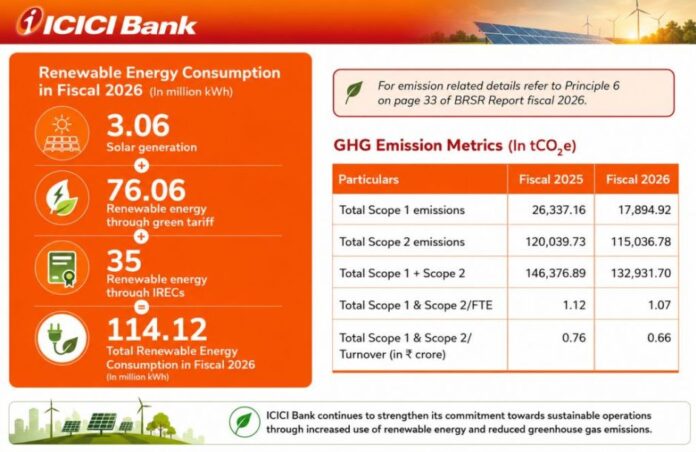
ICICI Bank strengthened its climate action, sustainable finance and environmental stewardship initiatives during fiscal 2026, expanding its sustainable financing portfolio to ₹993.85 billion, increasing renewable electricity consumption to 114.12 million kWh, and advancing toward Scope 1 and Scope 2 carbon neutrality by fiscal 2032.
The ICICI Bank Sustainability Report 2026 outlines measurable progress across responsible lending, renewable energy adoption, resource efficiency, water conservation, biodiversity protection, green buildings and community development.
Sandeep Batra, Executive Director of ICICI Bank, said the bank’s fifth annual Environmental, Social and Governance report reflects its commitment to building a sustainable organisation based on the principles of “Fair to Customer, Fair to Bank” and “One Bank, One Team,” supported by a strong balance of risk and compliance.
ICICI Bank Targets Scope 1 and Scope 2 Carbon Neutrality by FY2032
ICICI Bank has committed to achieving carbon neutrality across its Scope 1 and Scope 2 emissions by fiscal 2032.
During fiscal 2026, the bank reduced Scope 1 and Scope 2 greenhouse gas emissions through energy-efficiency improvements, renewable electricity procurement and the expansion of on-site clean energy infrastructure.
As of March 31, 2026, approximately 43 percent of total energy consumed in the bank’s own operations came from non-fossil fuel sources. Separately, renewable sources represented 48 percent of its electricity consumption, covering solar and wind power, green tariffs and other clean electricity procurement mechanisms.
The bank also incorporates ESG and climate-related risks into borrower assessments to strengthen responsible lending decisions and improve the resilience of its financing portfolio.
Renewable Electricity Consumption Reaches 114.12 Million kWh
ICICI Bank consumed 114.12 million kWh of renewable electricity during fiscal 2026.
Of this total, 76.06 million kWh was procured through green tariffs, 35 million kWh was covered through International Renewable Energy Certificates and 3.06 million kWh was generated from on-site solar installations.
The bank purchased 35,000 MWh equivalent of IRECs backed by solar power generation in India during fiscal 2026.
Its installed solar capacity reached 13.03 MW, strengthening the contribution of directly generated renewable electricity to its operational energy requirements.
Renewable energy procurement, on-site solar generation and green electricity tariffs will remain important components of the bank’s roadmap toward Scope 1 and Scope 2 carbon neutrality by fiscal 2032.
Sustainable Financing Portfolio Expands to ₹993.85 Billion
ICICI Bank’s sustainable financing portfolio increased to ₹993.85 billion in fiscal 2026, up from ₹906.24 billion in fiscal 2025.
Green financing accounted for approximately one-third of the sustainable financing portfolio, with the green financing portfolio reaching ₹307.04 billion during fiscal 2026.
More than 30 percent of the sustainable financing portfolio was allocated to renewable energy, electric vehicles, green buildings and hydrogen fuel projects as of March 31, 2026.
The bank’s Framework for Sustainable Financing establishes eligibility criteria, governance processes and monitoring mechanisms for allocating capital to green and sustainable activities. It supports financing for clean energy, sustainable infrastructure, energy-efficient technologies and climate-focused development projects.
Energy-Efficiency Systems Could Save 3.4 Million Electricity Units
ICICI Bank continued to improve energy efficiency across its office and operational infrastructure.
Automatic condenser cleaning systems were installed at 23 large offices. These systems are expected to save approximately 3.4 million units of electricity, equivalent to around 8 percent of the offices’ annual energy consumption.
Air-conditioning efficiency initiatives delivered energy savings of up to 25 percent, while water aerators generated water savings of approximately 30 percent at locations where they were installed.
These operational improvements are designed to lower electricity demand, reduce emissions and improve resource efficiency across the bank’s nationwide property portfolio.
ICICI Bank Expands Green Building Portfolio to 187 Facilities
By the end of fiscal 2026, 187 ICICI Bank facilities had received Indian Green Building Council certification.
The certified facilities incorporate measures related to energy-efficient design, water conservation, responsible material use and improved environmental performance.
ICICI Bank also maintained ISO 45001:2018 certification across 32 premises, demonstrating adherence to internationally recognised occupational health and safety management standards.
The expansion of certified green buildings and workplace safety systems supports the bank’s broader strategy of operating environmentally responsible and employee-focused facilities.
Water Recharge and Storage Capacity Reaches 34.37 Billion Litres
Water stewardship remained a major element of ICICI Bank’s environmental and community strategy.
During fiscal 2026, the bank created 490 million litres of water recharge and storage capacity. Cumulative water recharge and storage capacity since the inception of its water conservation initiatives reached 34.37 billion litres.
Rainwater harvesting systems installed at five offices provide an annual capacity of 8,600 kilolitres.
Atmospheric Water Generators deployed across seven offices provide combined drinking-water generation capacity of 8,750 litres per day.
These measures support groundwater recharge, improve community water security and reduce pressure on conventional water sources.
More Than 5 Million Trees Planted Since Fiscal 2022
ICICI Bank planted 86,600 trees during fiscal 2026, supporting afforestation, biodiversity restoration and carbon sequestration.
Since fiscal 2022, the bank has planted more than 5 million trees through environmental conservation and community-based restoration programs.
Its ecological conservation initiatives cover 83 forests and tiger reserves across 21 states, supporting biodiversity protection and the restoration of natural habitats.
The bank has also installed 2,100 biogas units during fiscal 2026, supporting cleaner energy access, organic waste management and lower dependence on traditional fuels in participating communities.
Digitisation Saves 32.15 Million Paper Sheets
ICICI Bank’s digitisation initiatives avoided the use of 32.15 million sheets of paper, equivalent to approximately 14,960 trees.
The bank reported that 91 percent of A4 paper and pre-printed forms used at its business centres consisted of Forest Stewardship Council-certified recycled paper.
Digital banking processes, electronic documentation and the use of recycled materials are helping the bank reduce paper consumption and the environmental impact associated with physical transactions and records.
CSR Investment Reaches ₹9.94 Billion
ICICI Bank invested ₹9.94 billion in Corporate Social Responsibility initiatives during fiscal 2026.
The programs supported healthcare, education, rural development, environmental conservation, water security and community empowerment.
Healthcare initiatives included support for cancer care infrastructure and projects designed to improve access to quality medical services.
The bank’s community investments complement its financing and operational sustainability programs by addressing social development and climate resilience at the local level.
ESG Materiality Assessment Identifies 10 Priority Topics
ICICI Bank assessed an initial universe of 14 sustainability issues and identified 10 priority ESG topics through its materiality assessment.
The priority areas include climate action, environmental stewardship, responsible lending, employee well-being, customer transparency, ethical governance and regulatory compliance.
The Risk Committee of the Board of Directors oversees ESG strategy, climate-related initiatives, sustainability risks and the implementation of environmental action plans across the organisation.
This governance structure helps embed ESG considerations into lending, risk management, investment decisions and business strategy.
ICICI Bank Strengthens Responsible Banking and Climate Action
ICICI Bank’s fiscal 2026 sustainability performance reflects an integrated approach combining climate action, renewable electricity, sustainable finance, resource conservation and community investment.
Major achievements included expanding the sustainable financing portfolio from ₹906.24 billion in fiscal 2025 to ₹993.85 billion in fiscal 2026, growing green financing to ₹307.04 billion, and allocating more than 30 percent of sustainable financing to renewable energy, electric vehicles, green buildings and hydrogen fuel projects.
Operationally, the bank consumed 114.12 million kWh of renewable electricity, including 76.06 million kWh through green tariffs, 35 million kWh through IRECs, and 3.06 million kWh from on-site solar power. Installed solar capacity reached 13.03 MW, while non-fossil sources accounted for around 43 percent of total operational energy consumption and renewable sources represented 48 percent of electricity use.
Environmental achievements included creating 490 million litres of water capacity during fiscal 2026, reaching 34.37 billion litres cumulatively, planting 86,600 trees during the year, surpassing 5 million trees since fiscal 2022, and conserving ecosystems across 83 forests and tiger reserves in 21 states.
Combined with 187 IGBC-certified facilities, 32 ISO 45001:2018-certified premises, 2,100 biogas units, ₹9.94 billion in CSR investment, and a commitment to Scope 1 and Scope 2 carbon neutrality by fiscal 2032, ICICI Bank is positioning responsible finance and sustainability as central pillars of its long-term growth strategy.
SHAFANA FAZAL
