
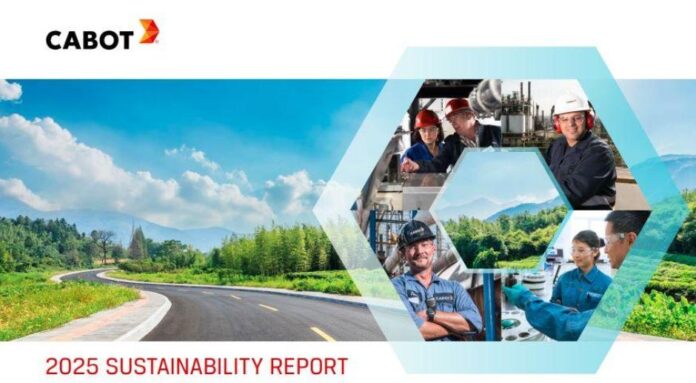
Cabot Corporation delivered strong sustainability performance in 2025, achieving 93 percent of its environmental, social and governance (ESG) goals by completing 14 of its 15 targets while advancing 11 objectives ahead of schedule. The company also retained its sixth consecutive EcoVadis Platinum rating, placing it among the top 1 percent of companies assessed globally, while updating its 2030 ESG targets to accelerate progress toward its Net Zero greenhouse gas emissions target by 2050.
Cabot’s sustainability report 2025 indicated that it focuses on reducing greenhouse gas emissions, improving energy efficiency, expanding renewable energy use, strengthening water stewardship, advancing circular economy initiatives and increasing sustainable product innovation. The updated 2030 framework serves as a key milestone toward achieving the company’s long-term decarbonization strategy by 2050.
Sean D. Keohane, President and Chief Executive Officer of Cabot, said: “We have set a new GHG target: to reduce Scope 1 and 2 GHG intensity by 15 percent below 2022 levels by 2030. Meeting this target will require sustained effort, innovation, and collaboration.”
The company reported measurable emissions reductions across all major categories during 2025. Scope 1 emissions declined to 3.60 million metric tons of CO₂ equivalent, while Scope 3 emissions fell to 5.34 million metric tons of CO₂ equivalent through improvements in supplier efficiency, logistics and product lifecycle performance. Both market-based and location-based Scope 2 emissions also declined as renewable electricity procurement increased.
Cabot improved its overall greenhouse gas emissions intensity from 1.89 to 1.83 metric tons of CO₂ equivalent per metric ton of production, exceeding its interim climate target ahead of schedule with more than a 5 percent reduction compared with its 2022 baseline. Air pollutant emissions also improved, with nitrogen oxide (NOx) emissions falling from 6.86 thousand metric tons to 5.96 thousand metric tons, although sulfur dioxide (SO₂) emissions increased from 31.45 thousand metric tons to 32.46 thousand metric tons.
Energy efficiency remained a major contributor to Cabot’s decarbonization efforts. Total energy consumption declined from 120.69 million gigajoules in 2024 to 114.69 million gigajoules in 2025. The company maintained an energy export ratio of 211 percent, supported by cogeneration and waste heat recovery systems, while continuing to target a 250 percent energy export ratio by 2030.
Renewable energy deployment also expanded during the year. Cabot’s solar installation in Chiba, Japan, now generates approximately 3,500 megawatt-hours of electricity annually, while its Münster, Germany facility transitioned to 100 percent certified wind electricity, eliminating market-based Scope 2 emissions at that site.
Water conservation showed significant improvement across operations. Total water withdrawal decreased from 43.19 million cubic metres to 34.74 million cubic metres, while water consumption declined from 10.42 million cubic metres to 9.82 million cubic metres. Water discharge also dropped from 32.76 million cubic metres to 24.92 million cubic metres. Water withdrawal intensity improved from 19.89 cubic metres per metric ton of production to 16.81 cubic metres, supporting Cabot’s target of reducing freshwater withdrawal intensity in water-stressed regions by 10 percent by 2030.
Cabot also strengthened its circular economy strategy by significantly reducing waste generation. Total waste fell from 216.41 thousand metric tons to 178.93 thousand metric tons. Hazardous waste decreased from 154.93 thousand metric tons to 129.34 thousand metric tons, while non-hazardous waste declined from 61.47 thousand metric tons to 49.60 thousand metric tons. Waste disposal volumes were reduced from 182.61 thousand metric tons to 133.60 thousand metric tons, while beneficial reuse increased from 33.80 thousand metric tons to 45.33 thousand metric tons.
The company reduced global non-hazardous landfill waste by 70 percent. At its Franklin, Louisiana facility, approximately 15,000 metric tons of synthetic gypsum were diverted into cement production, cutting landfill dependence by 87 percent and generating approximately US$1.2 million in savings.
Sustainable innovation continued to advance, with 100 percent of new product development projects delivering measurable sustainability benefits, compared with 98 percent in 2024. ESG assessments now cover 54 percent of Cabot’s critical suppliers, improving responsible sourcing and supply chain transparency. Life-cycle assessments of the company’s E2C technologies demonstrated 5 percent to 6 percent lower greenhouse gas emissions during vehicle operation through reduced rolling resistance and more than 10 percent lifecycle emissions reductions due to improved product durability.
Cabot generated US$665 million in operating cash flow during 2025, providing funding for energy efficiency upgrades and emissions reduction initiatives. The company is also negotiating a US$50 million grant from the U.S. Department of Energy to support an advanced battery materials conductive additive facility in Michigan. In addition, Cabot maintains a US$1.3 billion sustainability-linked revolving credit facility tied to ESG performance and completed a US$10 million community investment programme supporting social sustainability initiatives.
With 93 percent of ESG goals achieved, substantial reductions in emissions, water use and waste, and continued investments in clean energy technologies, Cabot has strengthened its pathway toward meeting its 2030 sustainability targets and achieving Net Zero greenhouse gas emissions by 2050.
SHAFANA FAZAL
