
AkzoNobel has strengthened its position as a sustainability leader by making substantial progress toward its long-term climate goals.
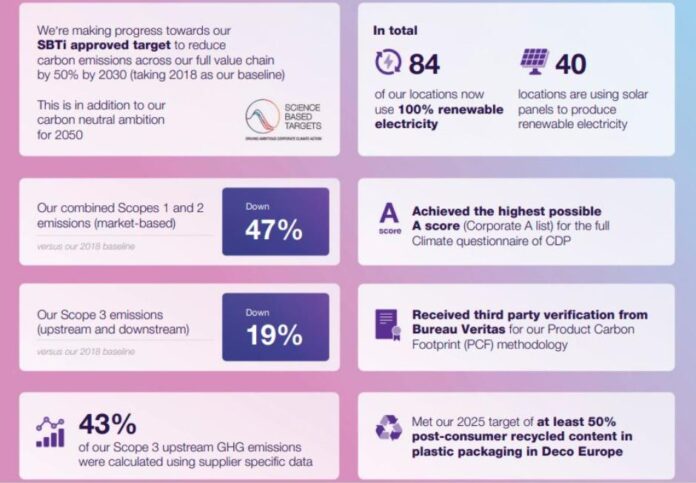
AkzoNobel, which reported annual revenue of €10.158 billion in 2025, has reduced Scope 1 and Scope 2 greenhouse gas emissions by 47 percent compared with its 2018 baseline, moving close to its target of achieving a 50 percent reduction by 2030.
At the same time, it reduced value chain (Scope 3) emissions by 19 percent, while maintaining its commitment to cut Scope 3 emissions by 50 percent by 2030 and achieve carbon neutrality across its value chain by 2050. The Science Based Targets initiative (SBTi)-aligned climate strategy is supported by renewable electricity, energy-efficient manufacturing, sustainable product innovation, and strategic investments across global operations, AkzoNobel Sustainability Report 2025 indicated.
Sustainability Leadership Focuses on Innovation and Climate Action
AkzoNobel’s sustainability strategy is led by Wijnand Bruinsma, Director of Sustainability, under the strategic oversight of Armand Sohet, Chief Human Resources, Communications, and Sustainability Officer. The company continues to integrate sustainability into product development, manufacturing, sourcing, and long-term business strategy.
Wijnand Bruinsma said: “If we make concrete plans for 2050 based on the knowledge we have now, we’d be assuming there won’t be any further innovation for the next 20 years or so. This makes no sense, because innovation will be crucial in terms of tackling climate change, not just for our industry, but for all industries.”
This innovation-led strategy continues to guide AkzoNobel’s transition toward net zero while creating lower-carbon solutions for customers.
Net Zero Targets and Emissions Reduction Progress
AkzoNobel’s climate roadmap includes reducing carbon emissions from its own operations (Scope 1 and Scope 2) by 50 percent by 2030 while also targeting a 50 percent reduction in value chain (Scope 3) emissions over the same period. By the end of 2025, the company had already achieved a 47 percent reduction in Scope 1 and Scope 2 emissions against the 2018 baseline, alongside a 19 percent reduction in Scope 3 emissions. The company notes that operational emissions are now close to the 2030 target, while additional partnerships with suppliers and raw material producers are helping accelerate reductions across the value chain.
Renewable Electricity Accelerates Manufacturing Decarbonization
Renewable electricity continues to play a central role in AkzoNobel’s decarbonization strategy. The company now operates on 100 percent renewable electricity across North America, Latin America, and Europe. Globally, renewable electricity supplies 69 percent of manufacturing operations, while 92 production sites now operate entirely on renewable electricity.
The company’s manufacturing investments continue to expand renewable energy capacity worldwide. At its Pilawa facility in Poland, a €1.7 million investment replaced gas-fired boilers with energy-efficient heat pumps while installing the company’s largest European solar project, comprising 3,551 solar panels operational since 2024. In the Czech Republic, the Opava facility added 1,300 solar panels across almost 2,800 square meters, generating approximately 15 percent of the site’s electricity demand.
Across AkzoNobel’s manufacturing network, more than 30 facilities now operate with on-site solar generation, including installations featuring more than 5,600 solar panels across manufacturing sites in China, alongside renewable energy projects in Mexico, Spain, Thailand, and Malaysia.
€274 Million R&D Investment Expands Sustainable Innovation
Innovation remains fundamental to AkzoNobel’s sustainability strategy. During 2025, the company invested €274 million in research and development to advance sustainable coatings, lower-carbon manufacturing technologies, and environmentally responsible products.
The company introduced bio-attributed raw materials through partnerships with Arkema and BASF to reduce the carbon footprint of Interpon architectural powder coatings. It also launched a waterborne vehicle repair basecoat requiring only a single spray booth visit, reducing both energy consumption and carbon emissions. Other innovations include a radiative cooling coating system in China that improves building energy efficiency, a partnership with IPG Photonics to introduce laser curing for powder coatings, and exclusive supply of Calosol heat-absorbing façade technology in the Netherlands, enabling buildings to generate energy.
AkzoNobel is also investing €50 million to modernize its Aerospace Coatings manufacturing facility in Waukegan, United States, introducing advanced automation and production technologies that improve manufacturing efficiency while lowering environmental impacts.
To help industrial customers reduce emissions, the company introduced the Interpon Eco+ Cure energy calculator, enabling manufacturers to optimize curing temperatures and gas consumption during powder coating operations. Calosol façade technology also enables buildings to reduce electricity consumption by 20 percent to 30 percent compared with traditional heat pump systems.
Sustainability Investments Improve Manufacturing Efficiency
AkzoNobel continues investing in sustainable manufacturing worldwide. The company is investing €7 million at its Rapla decorative paints facility in Estonia to improve operational efficiency, increase production capacity by more than three million liters per year, and enhance sustainability, with completion expected by Q3 2026.
Additional investments include more than €15 million in the United Kingdom to modernize filler production and expand Chartek fire protection coatings, together with around €20 million across Powder Coatings facilities in the United States and Mexico to increase sustainable manufacturing capacity.
Responsible Supply Chain and ESG Performance Continue to Improve
AkzoNobel continues strengthening sustainability across its supply chain and workforce. By 2025, 73 percent of suppliers met the company’s sustainability expectations, moving closer to its 75 percent target for 2030.
The company’s workforce engagement also remained strong. The annual Voices employee survey recorded a 90 percent participation rate, while Employee Net Promoter Score reached +16, outperforming the industry benchmark by 12 points.
Women represented 27 percent of executive leadership positions during 2025, with the company targeting 30 percent female executive representation by 2030. AkzoNobel also achieved its social objective of empowering 100,000 members of local communities with new skills.
AkzoNobel Strengthens Path Toward Net Zero
AkzoNobel’s 2025 sustainability performance demonstrates measurable progress across emissions reduction, renewable energy adoption, sustainable innovation, and responsible business practices. With a 47 percent reduction in operational emissions, 69 percent renewable electricity across manufacturing, 92 production sites powered entirely by renewable electricity, €274 million invested in research and development, and continued expansion of solar energy and energy-efficient manufacturing, the company is building momentum toward its next milestones. Supported by strong supplier engagement, responsible sourcing, workforce participation, and customer-focused sustainable technologies, AkzoNobel remains on track to reduce Scope 3 emissions by 50 percent by 2030 and achieve carbon neutrality across its value chain by 2050.
SHAFANA FAZAL
