
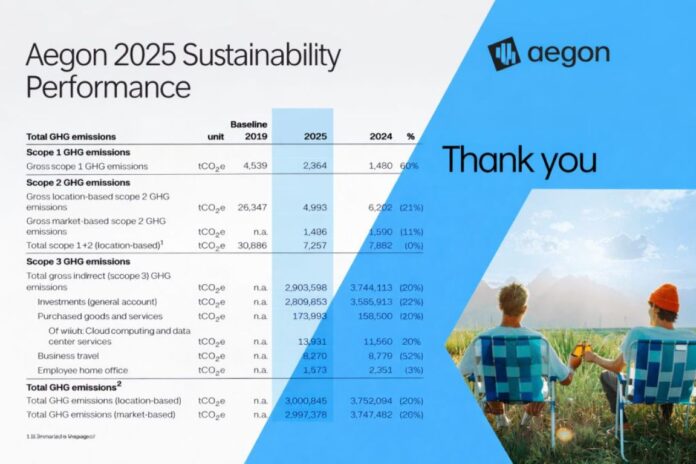
Aegon’s 2025 Sustainability Report highlights a finance-led sustainability strategy where capital allocation, portfolio transformation, and governance integration are driving measurable environmental outcomes. Aegon has delivered strong progress across its climate investment, emissions reduction, and asset decarbonization targets, with several key milestones achieved ahead of schedule.
Aegon, as part of its sustainability goals, committed to invest $2.5 billion in climate-related activities by 2025 to support mitigation and adaptation initiatives. By the end of the reporting period, the company exceeded this target, reaching $2.7 billion in climate investments. This acceleration reflects a strategic shift toward sustainable finance, with an additional $1 billion climate investment target now set for 2030. These investments are embedded within the group’s broader 70 billion EUR general account portfolio, aligning capital deployment with long-term climate objectives.
Portfolio decarbonization remains a central pillar of Aegon’s sustainability roadmap. The company had targeted a 25 percent reduction in the weighted average carbon intensity of its corporate fixed income and listed equity portfolios compared to 2019. While the official milestone reflects a 25 percent reduction, Aegon had already achieved a 52 percent reduction in carbon intensity by 2024, more than doubling its original target and demonstrating accelerated progress toward net-zero alignment.
A similar trajectory is visible in real estate investments, where Aegon aimed for a 25 percent reduction in Scope 1 and Scope 2 carbon intensity by 2025. The company surpassed this goal with a 51 percent reduction compared to the 2019 baseline, ensuring consistency in decarbonization across asset classes and reinforcing its commitment to a standardized emissions reduction pathway.
Aegon’s stewardship strategy, under the leadership of CEO Lard Friese, plays a critical role in driving impact beyond its direct operations. The company committed to engaging with at least the top 20 carbon-emitting companies within its portfolio by 2025 and has confirmed active engagement with these entities. This approach is designed to enforce transparency, encourage alignment with the Paris Agreement, and extend decarbonization efforts across the broader economy.
Operational performance further supports Aegon’s sustainability positioning. The company reduced its operational carbon footprint by 59 percent compared to 2019, supported by renewable electricity usage reaching 94 percent across its global operations. Several key offices have already transitioned to 100 percent renewable energy, and the organization remains on track to achieve a 75 percent reduction in operational emissions by 2030, reflecting strong internal alignment with its external investment strategy.
Governance mechanisms have been strengthened to ensure accountability. Aegon has integrated sustainability metrics into executive compensation, linking a defined portion of its Long-Term Incentive plan to climate transition and diversity targets. This framework is supported by advanced risk management systems that incorporate climate scenario analysis, ensuring resilience against both physical and transition risks.
The company has also expanded its environmental scope beyond carbon metrics by incorporating biodiversity risk assessments aligned with the Taskforce on Nature-related Financial Disclosures. Approximately 35 percent of its general account assets are exposed to sectors with high or very high dependency on ecosystem services, prompting targeted engagement with companies in agriculture and forestry to implement no-deforestation policies.
On the social front, Aegon has embedded human rights due diligence across all strategic markets, while advancing inclusion and diversity through measurable workforce metrics. These efforts are aligned with European Sustainability Reporting Standards and reinforce the company’s commitment to responsible business practices across its value chain.
Aegon’s sustainability performance is further validated by strong external ESG ratings. The company holds an MSCI ESG rating of AAA, a Sustainalytics risk score of 14.4 categorized as low risk, an S&P Global Corporate Sustainability Assessment score of 65 with an 89th percentile ranking, and an FTSE4Good score of 4.7, placing it in the 100th percentile. These ratings confirm the strength of its governance, transparency, and environmental performance.
Overall, Aegon’s 2025 results demonstrate clear overachievement across key sustainability targets, including $2.7 billion in climate investments, a 52 percent reduction in portfolio carbon intensity, and a 51 percent reduction in real estate emissions intensity. Combined with a 59 percent reduction in operational emissions and 94 percent renewable energy usage, the company has established a strong foundation for long-term decarbonization.
FASNA SHABEER
