
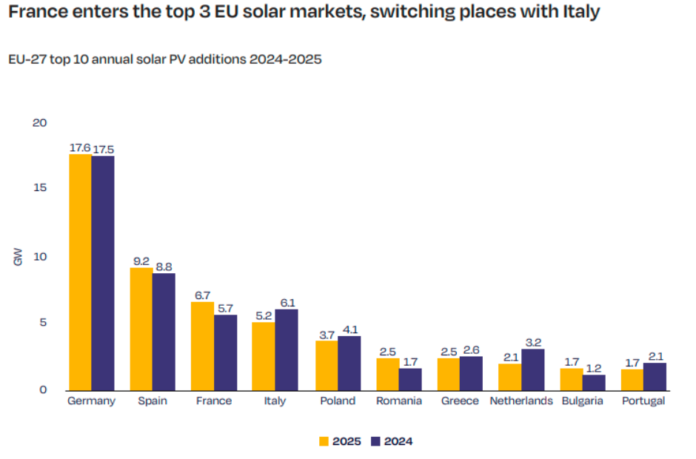
Solar Power Europe reports a marked normalisation in the EU solar market in 2024 and 2025 after the exceptional surge of 2023. Five of the top 10 European solar markets installed less capacity in 2025 than in 2024, highlighting a shift from broad, multi-segment growth to country-specific and segment-specific dynamics.
In 2023, all leading EU markets recorded strong increases, many registering double-digit GW gains. By contrast, 2024 already saw four of the top 10 countries posting lower additions, and the trend intensified in 2025. The declines are now accompanied by smaller overall swings, signalling a stabilised but subdued market environment.
Germany continues to hold its position as Europe’s largest solar market, though the structure of its growth has shifted significantly. The strong rooftop boom seen in 2023 has lost momentum, with slower expansions in both the residential and commercial categories. Very small plug-in systems have grown, but not enough to offset the broader rooftop slowdown. Instead, utility-scale solar has become Germany’s key growth driver, backed by a strengthened auction framework. In 2025, gains from large-scale projects are nearly neutralised by shrinking rooftop activity, resulting in only marginal net growth year-on-year.
Spain experienced a mild contraction in 2024, mainly due to a slowdown in the rooftop and industrial segments. In 2025, the market sees a partial recovery, gaining about 0.4 GW, with utility-scale deployments driving this rebound.
A major shift occurs between France and Italy. In 2025, France overtakes Italy as the third-largest solar market in Europe. France benefits from strong commercial segment expansion and a growing utility-scale pipeline, boosting annual additions in 2024 and 2025. Italy presents the opposite pattern. While utility-scale installations have more than doubled since 2023, rooftop demand has weakened sharply. The phaseout of the Superbonus incentive has significantly reduced residential and commercial uptake, while large projects have been hampered by grid congestion and local permitting challenges.
Poland records a second consecutive year of decline. The residential and small-commercial segments, once buoyed by a generous net-metering scheme, have settled at about half their 2023 levels after the scheme’s phaseout. Although Poland remains in the top 5, overall additions have edged downward despite strong funding under the ‘My Electricity’ programme.
The steepest contraction within the top 10 occurs in the Netherlands, which drops from fourth place in 2023 to eighth in 2025. The rooftop-heavy market is strongly affected by the phaseout of net-metering. Residential additions fall to less than one-third of their 2023 volume, with policy uncertainty and a weakening business case reducing demand well ahead of the scheme’s scheduled end in 2027.
Shifts in mid-sized markets further reshape the top 10. Romania continues its rapid rise after first entering the top 10 in 2024. The country adds 2.5 GW in 2025, up from 1.7 GW in 2024, marking a 45 percent increase – the fastest growth rate among all major EU markets. Romania’s surge is driven by stable rooftop demand, fast-growing utility-scale capacity, strong policies, fast permitting, rising energy storage deployment, and an expanding PPA and CfD environment. This momentum pushes Romania ahead of Greece, where rooftop demand is falling due to the phaseout of net-metering and delays in net-billing implementation. In Portugal, utility-scale additions fall below the GW level because of delays in pipeline execution, even though the country holds a large pipeline of future projects.
The second major shift is Bulgaria entering the top 10 for the first time. With 1.7 GW added in 2025, the country grows nearly 40 percent year-on-year. Its expansion is driven mainly by utility-scale projects linked to National Recovery and Resilience Plan deadlines. Bulgaria replaces Austria in the top 10, where annual additions have gradually declined since the 2023 peak. Austria faced changes in rooftop support mechanisms in 2025, followed by budget cuts to solar incentives, slowing overall installations.
The changing composition of the top 10 reflects the broader transition underway in the EU solar sector. Markets that once grew uniformly across segments are now diverging sharply, influenced by policy shifts, support scheme phaseouts, permitting barriers and grid constraints. While utility-scale solar is strengthening in several countries, rooftop markets in others are entering a period of consolidation. The evolving dynamics underline the need for stable policy frameworks and improved grid flexibility to sustain Europe’s solar growth trajectory through the decade.
Baburajan Kizhakedath
