
Wood Mackenzie projects robust growth for the solar industry in 2026, driven by accelerating global electricity demand. Key factors include expanding data centers, manufacturing facilities, and transport electrification, particularly in the US and Asia Pacific.
Strong Solar Growth in 2026 Amid Rising Global Electricity Demand
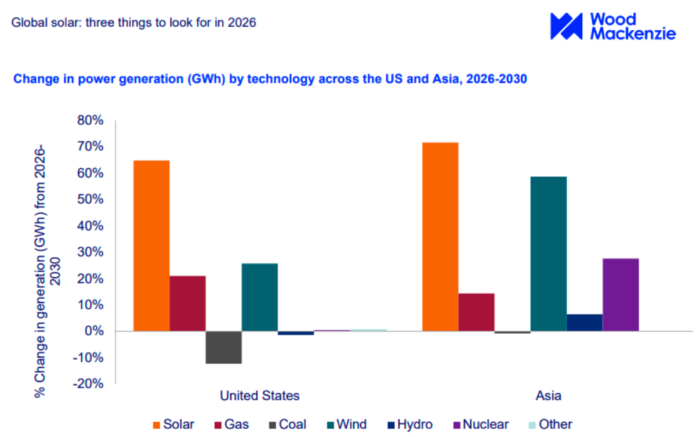
In the US, solar is expected to contribute significantly to new power supply, with annual solar generation projected to grow by 232 GWh (65 percent) between 2026 and 2030, closely following gas generation growth. Despite policy favoring fossil fuels, solar and renewables remain essential to meet near-term power demand.
In the Asia Pacific region, solar continues to dominate new capacity investments due to cost competitiveness. Solar’s share of the power generation mix is forecast to rise from 11 percent in 2025 to 17 percent by 2030, while solar, wind, and storage combined will account for one-third of total generation, up from less than 10 percent in 2020, Michelle Davis, Head of Global Solar at Wood Mackenzie, said.
Balcony Solar Gaining Traction Globally, Set for Growth in 2026
Balcony solar, or plug-in solar, is rapidly emerging as a significant segment of the residential solar market. Popularized in Germany, where apartment living is common and electricity regulations support easy installation, balcony solar accounted for 40 percent of registered solar installations in 2024, with unregistered systems potentially two to three times higher. Growth is also evident across other EU countries, supported by declining battery costs that allow homeowners to store and use more solar energy.
In the US, the market is nascent but expanding. Utah became the first state in 2025 to allow small plug-in solar systems without utility interconnection, and more than a dozen states are following suit. Short payback periods and rising electricity demand may drive adoption, though challenges like fragmented electrical standards, lower residential voltage, and lower electricity costs could slow uptake compared to Europe.
UAE Launches 5.2 GW Solar-Plus-Storage Project to Deliver Baseload Power
Masdar and the Emirates Water and Electricity Company (EWEC) have begun construction on a 5.2 GWdc solar PV facility in Abu Dhabi, paired with 19 GWh of battery storage. Scheduled for completion in Q4 2027, the project is designed to provide 1 GW of continuous, “around-the-clock” baseload renewable power, targeting high-demand users such as data centers and AI hubs.
At an estimated cost of US$6 billion, largely driven by the battery storage component, the project is currently expensive compared to gas-fired plants. However, it represents a potential shift in hybrid solar development, offering firm renewable power as gas plant costs rise and supply chain delays persist, positioning it as a model for future large-scale, decarbonized baseload solutions.
BABURAJAN KIZHAKEDATH
