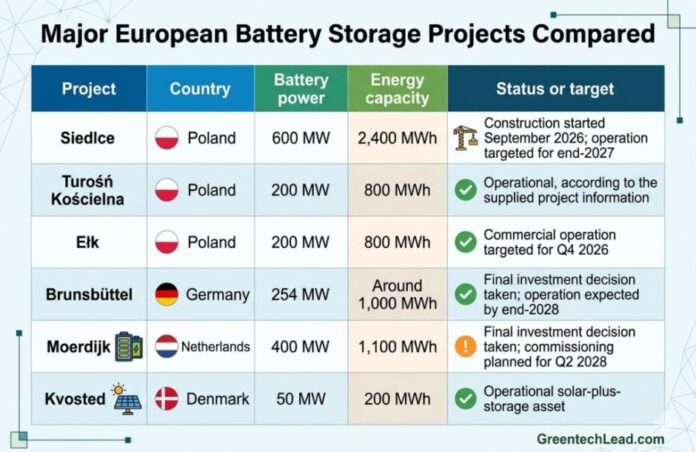
Europe’s battery energy storage market is expanding through large standalone facilities, solar-linked systems and projects designed to relieve electricity-grid congestion. Developments in Poland, Germany, the Netherlands and Denmark show how storage investment is moving beyond short-duration balancing into larger infrastructure assets.
Europe installed 36 GWh of battery storage in 2025, while annual additions are expected to exceed 50 GWh in 2026 and reach 138 GWh by 2030, according to SolarPower Europe’s latest outlook. These figures cover residential, commercial and utility-scale systems, rather than grid-scale batteries alone.
The European Battery Market Outlook 2026–2030 identifies utility-scale storage as an important growth segment. For developers and investors, project maturity, grid access, discharge duration and revenue security are becoming essential measures alongside capacity.
These are selected major developments, not a complete ranking of Europe’s largest batteries. Their operating status and development timelines differ, so planned capacity should remain separate from commissioned assets.
Siedlce: Poland’s 600 MW Storage Development
Greenvolt Power’s 600 MW/2.4 GWh Siedlce project, which started construction in September 2026, has four-hour configuration placing it among Europe’s largest battery developments.
According to the supplied project information, commercial operation is targeted for the end of 2027, BYD Energy Storage is supplying battery technology, and the project has secured revenues through Poland’s capacity-market mechanism.
The Greenvolt Siedlce battery project forms part of a wider Polish portfolio. Together with 200 MW/800 MWh Turośń Kościelna and 200 MW/800 MWh Ełk, the three developments represent 1 GW/4 GWh.
That portfolio includes different stages of maturity. Operating facilities provide performance evidence, while construction-stage projects still face delivery, commissioning and contractual risks.
Greenvolt reports a probability-weighted battery pipeline of approximately 4.6 GW, including around 2.4 GW in Poland. Pipeline figures indicate development opportunities rather than installed capacity.
Brunsbuttel: Germany Repurposes a Nuclear Power Site
Vattenfall has taken a final investment decision on a 254 MW battery facility with around 1,000 MWh of storage at Brunsbuttel in Germany.
The battery will occupy the former nuclear power plant site, which is being decommissioned. The facility and its connection to the 50Hertz transmission grid are expected to become operational by the end of 2028.
Capacity of Vattenfall’s 254 MW battery facility with 1,000 MWh of storage in Germany corresponds to approximately 3.9 hours of nominal discharge duration. Repurposing an established energy site can offer access to suitable land and transmission infrastructure, although developers must still complete connection works, permitting and construction.
Brunsbüttel illustrates why location matters: a battery’s value depends partly on where it can absorb and deliver electricity within the network.
Moerdijk: 400 MW Battery Targets Dutch Grid Congestion
RWE’s planned 400 MW/1,100 MWh Moerdijk battery will use an existing power-station site in the Netherlands. Commissioning is scheduled for the second quarter of 2028.
The RWE Moerdijk battery storage project will contain 208 lithium-ion battery containers and deliver full output for approximately 2.75 hours.
Its location near the 150 kV Moerdijk-Noord substation is intended to help alleviate a regional bottleneck affecting Noord-Brabant. The project will also support system integration of the OranjeWind offshore wind development.
Moerdijk demonstrates a storage business case built around network needs as well as electricity trading. However, congestion-management obligations can influence when a battery may charge or discharge, shaping its other revenue opportunities.
Kvosted: Operating Hybrid Secures €64.5 Million Financing
European Energy’s Kvosted development in Denmark combines approximately 100 MW of solar capacity with a 50 MW/200 MWh battery.
The battery was commissioned in December 2025, and the upgraded hybrid park was inaugurated in February 2026. Its four-hour system can shift solar electricity into periods of stronger demand while participating in flexibility markets.
The Kvosted solar and battery financing agreement secured €64.5 million in long-term senior debt. Ringkjøbing Landbobank committed approximately €43 million, while the Nordic Investment Bank provided €21.5 million, with InvestEU support.
The financing covers the hybrid asset and should not be treated as a standalone battery construction-cost benchmark.
Battery Storage Costs and ROI Need Clear Assumptions
Europe-wide battery cost estimates can be misleading when project scope differs. Equipment prices may exclude grid connections, transformers, civil works, development expenditure, financing and contingency.
For illustration, an assumed €200/kWh applied to a 100 MW/400 MWh battery produces an €80 million expenditure estimate. This arithmetic is not a verified project quotation.
Similarly, dividing investment by annual cash flow gives simple payback, not a complete return on investment. Financial models must include charging costs, efficiency losses, degradation, maintenance, augmentation, taxes and financing.
Revenue can come from energy arbitrage, capacity mechanisms, balancing services, tolling agreements and congestion management. These income sources are subject to market rules and cannot always be earned simultaneously.
Europe’s Battery Storage Outlook to 2030
Rising renewable generation creates demand for electricity shifting and rapid grid response. Yet faster battery deployment also increases competition for trading and ancillary-service revenues.
The strongest projects will combine secured interconnection, realistic operating assumptions and contracts that support debt repayment. Procurement must also address usable capacity, efficiency, warranties, fire protection and long-term maintenance.
Siedlce highlights large-scale construction, Brunsbüttel demonstrates infrastructure reuse, Moerdijk targets congestion, and Kvosted provides an operating hybrid-financing example. Together, they show that Europe’s storage expansion depends on converting MW and MWh into reliable grid services and sustainable cash flow.
SHAFANA FAZAL