
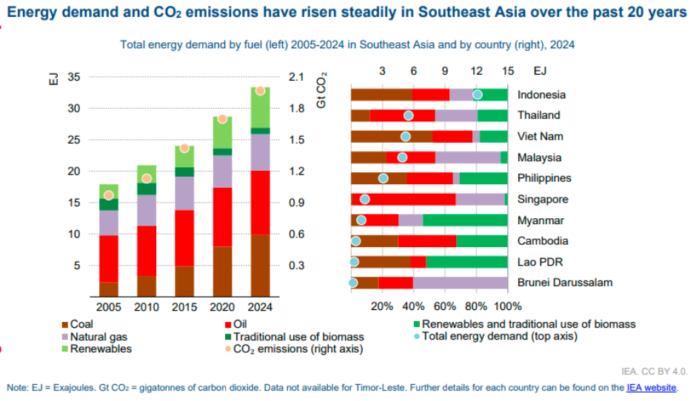
Southeast Asia is emerging as one of the world’s most important energy markets, accounting for 9 percent of the global population, 4 percent of global GDP, and nearly 20 percent of global energy demand growth through 2035 under current policy settings, according to the International Energy Agency’s (IEA) Southeast Asia Energy Outlook 2026. The report highlights both the region’s rapid economic expansion and its growing vulnerability to global energy shocks.
The ongoing Middle East conflict has exposed significant structural weaknesses in Southeast Asia’s energy system. Prior to the crisis, approximately 60 percent of crude oil imports and one-third of natural gas imports originated from the Middle East, while 45 percent of oil product supplies depended on Middle Eastern crude.
As a result, energy costs, inflation, and economic risks have intensified across the region. Fossil fuel subsidies, which stood at around $40 billion before the crisis, are expected to increase sharply during 2026. Without major structural reforms, Southeast Asia’s energy import bill could surge from more than $80 billion in 2024 to around $245 billion by 2035. Achieving announced climate commitments could cut that fossil fuel import bill by roughly half.
The report notes that clean energy investments have already generated substantial benefits. Since 2015, investments in renewable energy, electrification, and energy efficiency have reduced fossil fuel import requirements, saving the region approximately $30 billion in import costs during 2025 alone. Renewable energy capacity reached 120 GW in 2024 and is projected to nearly triple by 2035 under existing policies, while capacity could grow five-fold if countries achieve their announced energy and climate targets.
Southeast Asia’s overall energy demand continues to expand rapidly. Total energy demand is now 40 percent higher than in 2015, increasing at an average annual rate of 4 percent. Fossil fuels supplied more than 70 percent of additional energy demand since 2015, causing energy-related carbon dioxide emissions to increase by 4 percent annually. Coal remains the fastest-growing major energy source, with demand rising by 8 percent per year, increasing its share of the energy mix from 20 percent in 2015 to 30 percent in 2024. Renewable energy followed closely, growing by 7 percent annually, while solar and wind power expanded by approximately 35 percent per year.
Coal continues to dominate electricity generation across Southeast Asia. Regional electricity generation increased by 60 percent between 2015 and 2024, reaching 1,457 TWh. Coal-fired generation surged from 338 TWh in 2015 to 691 TWh in 2024, raising coal’s share of electricity generation from 37 percent to 47 percent. Coal now supplies around 70 percent of Indonesia’s electricity, nearly two-thirds of generation in the Philippines, around 45 percent in Malaysia, and nearly 50 percent in Viet Nam. Natural gas generation remained relatively stable at approximately 380 TWh, although gas-fired capacity increased by around one-third to 118 GW, highlighting its growing role in grid flexibility.
Electricity demand is becoming central to the region’s energy future. Electricity consumption has grown by 6 percent annually since 2015, almost double the global average, and now exceeds 1,300 TWh, accounting for more than 20 percent of total final energy consumption. Cooling demand is one of the fastest-growing drivers, with residential air conditioner ownership doubling since 2015. Nearly 30 percent of households now own an air conditioner, although ownership rates vary widely, ranging from around 80 percent in Singapore and Brunei Darussalam to approximately 5 percent in Myanmar. Residential air conditioner stock is expected to triple by 2035, while electricity demand over the next decade will increase by an amount equivalent to Japan’s current annual power generation.
The transport sector is also undergoing transformation. Electric vehicle sales more than doubled during 2025 to around 500,000 units, representing nearly 20 percent of total vehicle sales. In Singapore and Viet Nam, electric vehicles accounted for approximately 40 percent of new vehicle sales in 2025, compared with 20 percent and 10 percent, respectively, in 2023. Southeast Asia also hosts the world’s largest fleet of two- and three-wheelers, with electric models expected to represent nearly 60 percent of sales by 2035. Despite these gains, transport oil demand is still projected to increase by 20 percent through 2035.
The IEA expects renewable energy and low-emission technologies to play a much larger role in Southeast Asia’s future energy mix. By 2035, low-emission energy sources could provide around 50 percent of electricity generation, rising to 90 percent by 2050 if countries meet their announced pledges. Wind and solar projects are gaining momentum, with nearly 19 GW of renewable energy capacity awarded through auctions in 2025. The Philippines recently awarded 10.2 GW of solar, wind, and storage projects, while an additional 3.3 GW offshore wind auction is underway.
Meeting these ambitions will require a major increase in energy infrastructure investment. Total energy investment exceeded $100 billion in 2025, up 30 percent from the previous year. Clean energy investment has increased by 60 percent since 2015, while grid investment reached $12.4 billion in 2025. Investment in battery energy storage systems rose threefold during the last two years, surpassing $550 million in 2025. To achieve announced climate and energy targets, annual investment in grids and storage will need to increase from $13 billion today to approximately $50 billion by 2050, including around $27 billion for ASEAN Power Grid interconnections through 2040.
The report also highlights the social dimension of Southeast Asia’s energy transition. While electricity access has improved to 97 percent from 86 percent in 2015, around 120 million people, representing nearly one-fifth of the region’s population, still lack access to clean cooking solutions. Policymakers face the challenge of balancing energy affordability, energy security, economic development, and emissions reduction as the region navigates an increasingly complex global energy industry.
BABURAJAN KIZHAKEDATH
