The US battery storage market is expanding through large standalone facilities and solar-plus-storage developments serving utilities and corporate electricity buyers. Nearly 52 GW of utility-scale battery capacity was operating by June 2026, after operators added 8.3 GW during the first half, according to the US Energy Information Administration. Developers reported plans for another 54 GW through 2028, although planned capacity is not guaranteed to reach operation.
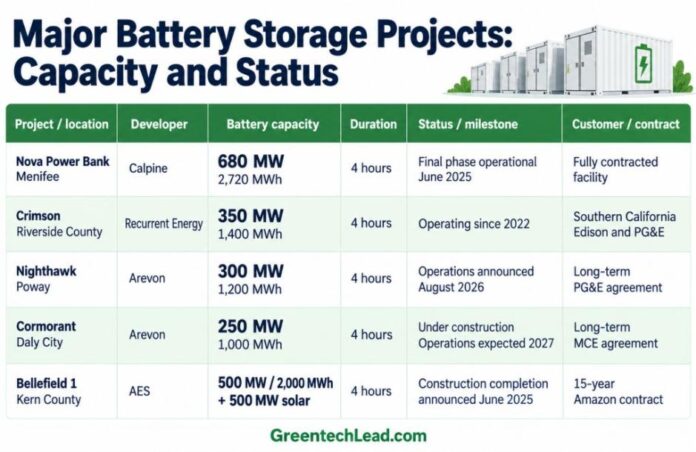
Nova Power Bank, Crimson, Nighthawk, Cormorant and Bellefield illustrate different approaches to this expansion. Their distinguishing features include four-hour discharge capability, utility capacity agreements, corporate power contracts and financing structures.
The following comparison focuses on selected major California developments within the US market. It is not a national ranking. Operating facilities, construction projects and individual development phases are identified separately.
Nova’s energy capacity and Bellefield 1’s energy capacity follow from their disclosed power ratings and four-hour duration. Project disclosures support the capacities, contracts and milestones above.
Nova Power Bank: 680 MW on a Former Gas-Plant Site
Calpine’s Nova Power Bank in Menifee provides 680 MW of battery power and four-hour discharge capability, equivalent to 2,720 MWh at its rated power.
The fifth and final phase achieved commercial operation in June 2025, completing the fully contracted facility. Nova therefore represents an established operating asset rather than a new 2026 construction announcement.
The development occupies a former gas-fired power-plant site. Mortenson announced completion of its first four phases in 2024, documenting the conversion of an existing energy site into battery infrastructure. This makes Nova a useful example of land reuse, although the available disclosures do not establish how much the location reduced development costs or construction time.
Crimson: Two Utility Contracts Cover 1,400 MWh
The 350 MW/1,400 MWh Crimson Storage project has operated in Riverside County since 2022. At commissioning, an Axium-managed fund owned 80 percent and developer Recurrent Energy retained 20 percent. CSI Energy Storage supplied turnkey integration and operational services.
Crimson’s customer arrangements explain how a large battery can serve different commercial requirements within one facility.
Southern California Edison contracted 200 MW/800 MWh through a full tolling agreement lasting 14 years and 10 months. PG&E contracted 150 MW/600 MWh under a 15-year resource-adequacy agreement.
The PG&E agreement covers capacity availability, while the associated battery capacity can participate in California’s wholesale electricity market. The Edison agreement uses a different structure governing the contracted capacity’s operation.
These disclosed terms provide a clearer picture of Crimson’s business model than a general statement that long-term contracts improve project bankability.
Nighthawk: Operations Begin After $920 Million Financing Package
Arevon announced operations at its Nighthawk Energy Storage Project in August 2026. The Poway facility provides 300 MW/1,200 MWh and uses lithium iron phosphate batteries.
Arevon developed, constructed, owns and operates Nighthawk under a long-term agreement with PG&E. Peak construction employment exceeded 130 workers, and the developer expects lifetime property-tax revenue of more than $30 million.
In March 2026, Arevon announced a $920 million financing package comprising a $482 million debt facility, $169 million preferred equity investment and $268 million tax-credit transfer commitment. The rounded components total approximately $919 million.
CIBC led the debt arrangement alongside ING Capital, NORD/LB, Santander and Zions Bancorporation. Goldman Sachs Alternatives provided the preferred equity investment.
The announced financing amount should not be treated as Nighthawk’s construction cost: the package combines several capital and tax-credit monetization arrangements.
Cormorant: $600 Million Investment and Expanded MCE Contract
Arevon began construction of Cormorant in March 2026, describing the Daly City development as a $600 million investment. The facility is designed for 250 MW/1,000 MWh, with operations expected in 2027.
A September construction update disclosed that Cormorant had expanded from its original 188 MW/752 MWh configuration. MCE contracted for the additional capacity, increasing the development by 62 MW and 248 MWh.
MCE serves residents and businesses across Contra Costa, Marin, Napa and Solano counties. Its long-term agreement connects the project’s expansion to a disclosed electricity customer.
Primoris Services Corporation’s Renewables group is the construction partner. Arevon expects approximately 175 workers at peak construction and more than $73 million in lifetime property-tax revenue. These remain developer projections rather than realized outcomes.
Bellefield: Amazon Contract Supports Solar-Plus-Storage
AES’s Bellefield solar-plus-storage development in Kern County combines solar generation with batteries.
Each of its two phases includes 500 MW of solar and 500 MW of four-hour battery storage. Each battery phase therefore represents 2,000 MWh, giving the complete development a planned battery configuration of 1,000 MW/4,000 MWh, alongside 1,000 MW of solar.
AES announced completion of Bellefield 1 construction in June 2025 under a 15-year contract with Amazon. At that announcement, the company scheduled Bellefield 2 construction completion for 2026; that schedule should be distinguished from confirmed completion.
Bellefield provides a specific corporate customer example for the storage demand story. Its combined solar-and-battery power rating should not be presented as battery capacity alone.
What the Capacity and Investment Figures Mean
MW measures the rate at which a battery can supply electricity; MWh measures the energy it can store. A 300 MW/1,200 MWh system has a nominal four-hour duration at rated output. Actual delivery also depends on operating limits, losses and available charge.
Investment comparisons require similar care. Cormorant’s reported project investment and Nighthawk’s financing package describe different measures. Dividing both by MWh would produce misleading cost comparisons.
The US Energy Storage Monitor reported utility-scale battery system prices of $916/kW in Q2 2026, down 2 percent year over year. That benchmark should not be substituted for a specific project’s total development cost.
US Battery Storage Outlook Through 2031
US installations across storage segments reached 5.4 GW/18.9 GWh in Q2 2026. Utility-scale projects accounted for 4.7 GW/17.6 GWh. Across all segments, installed energy capacity increased 17 percent year over year while power additions declined 7 percent.
ACP and Wood Mackenzie forecast cumulative US storage capacity of 207 GW/715 GWh by 2031, including utility-scale and distributed storage. The forecast also identifies potential supply-chain bottlenecks in 2026 and 2027.
For these selected projects, the next milestones are Cormorant’s expected 2027 commissioning and confirmation of Bellefield 2’s completion. Future comparisons should track those developments alongside disclosed contract coverage, available energy capacity and operating performance.
SHAFANA FAZAL