India’s battery energy storage system (BESS) market is expanding through large renewable-integrated installations, batteries supporting contracted peak power, and standalone facilities serving electricity utilities.
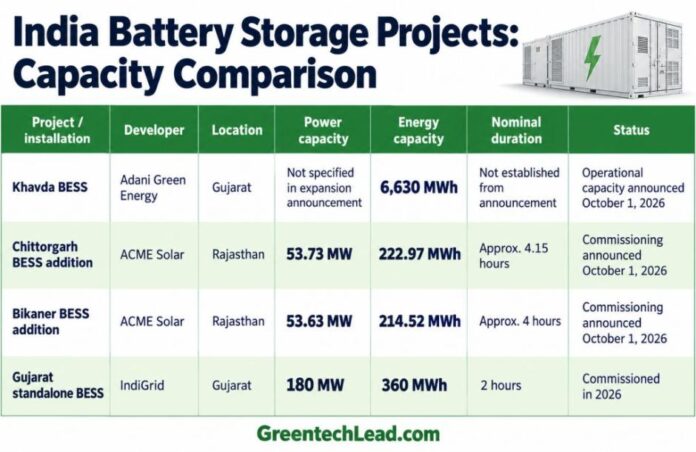
Adani Green Energy’s 6.63 GWh Khavda installation, ACME Solar’s latest 437.49 MWh Rajasthan additions, and IndiGrid’s 180 MW/360 MWh Gujarat project illustrate these different business models. Comparing them requires attention to energy capacity, discharge duration, customers and financing—not just headline megawatts.
The National Electricity Plan projects a requirement for 47.24 GW/236 GWh of BESS by 2031-32, with estimated investment of approximately ₹3.49 lakh crore. These are planning estimates from the plan notified in 2023, reiterated by the Ministry of Power in July 2026; they are not committed project investments.
The ACME rows describe the two additions discussed here, rather than their complete associated renewable developments. Duration is calculated by dividing MWh by MW. Khavda’s duration cannot be established from energy capacity alone.
Khavda: Adani Expands Operating Storage to 6.63 GWh
Adani Green Energy announced on October 1 that its operational battery storage at Khavda had increased to 6.63 GWh, from 3.55 GWh in June 2026. The increase amounts to approximately 3.08 GWh.
In its Khavda battery storage expansion announcement, AGEL described the facility as the world’s largest operational BESS installation at a single location.
The company also said it accounted for more than half of India’s approximately 12.6 GWh operational BESS capacity. Its national estimate combines CEA data as of August 31, 2026, with industry disclosures during September.
Khavda’s batteries are integrated with AGEL’s planned 30 GW renewable-energy development, covering 538 square kilometres. The company reported reaching the storage milestone within 14 months of starting on-site BESS construction.
AGEL uses lithium-ion batteries, energy-management systems and automated monitoring to control charging and discharging. Its announcement did not provide sufficient power-rating information to calculate duration, or a separate capital-cost figure for the 6.63 GWh installation.
ACME: Rajasthan Additions Support Firm and Peak Power
ACME Solar announced an additional 107.36 MW/437.49 MWh across two Rajasthan systems in October 2026.
The Chittorgarh addition comprises 53.73 MW/222.97 MWh, while Bikaner contributes 53.63 MW/214.52 MWh. Both provide approximately four hours of nominal storage.
Chittorgarh is associated with a firm and dispatchable renewable-energy project, while Bikaner supports assured peak-power supply. Batteries in these configurations help renewable generators deliver electricity during specified demand periods.
ACME’s October Rajasthan BESS commissioning disclosure reported the additions, taking its operating storage portfolio to approximately 4.96 GWh.
That portfolio total must remain separate from the capacity of these two additions. Similarly, a renewable-project PPA should not automatically be described as a standalone battery-service contract. The commercial product includes the associated generation and its delivery obligations.
The two additions provide a useful comparison with IndiGrid’s two-hour system: ACME’s batteries have roughly twice the nominal duration, supporting longer delivery windows. This does not establish superior returns, which depend on contract terms and operating costs.
IndiGrid: Standalone Storage for GUVNL
IndiGrid’s 180 MW/360 MWh Gujarat BESS represents a standalone utility-storage model. GUVNL awarded the project through competitive bidding, with development under a build-own-operate structure.
The project has a 12-year Battery Energy Storage Service Agreement. Its two-hour configuration provides storage capacity for utility requirements without combining the asset’s rating with an attached solar or wind plant.
IndiGrid announced commissioning in 2026. GUVNL is the customer, giving the project an identifiable utility relationship rather than relying entirely on merchant electricity-price arbitrage.
The IFC financing disclosure for IndiGrid’s Gujarat BESS gives an expected project cost of $76 million, alongside financing of up to $55 million through rupee-denominated non-convertible debentures.
The financing comprises up to $38.5 million from IFC’s own account and $16.5 million from the Clean Technology Fund. IFC’s record lists approval, signing and investment events in 2025.
The $76 million figure is a disclosed estimate, not a confirmed final construction cost. The $55 million financing amount is a separate measure and should not be substituted for project CAPEX.
Battery CAPEX and Storage Tariffs Measure Different Costs
Project CAPEX covers the development of a facility, including batteries, power-conversion equipment, electrical infrastructure, civil works, installation and grid connection. Its scope varies between disclosures.
A storage-service tariff measures payment for using storage under specified conditions. It does not automatically represent the complete price of electricity delivered to a customer.
In December 2025, the Ministry of Power reported competitive-bid storage costs of approximately ₹2.1/kWh without VGF, assuming two cycles daily. At 1.5 cycles daily, the corresponding cost was approximately ₹2.8/kWh.
These are dated benchmarks, not newly discovered October 2026 tariffs. The ministry’s summary also does not establish a universal treatment of charging electricity for every contract. Charging costs, losses, cycling limits and availability obligations therefore need separate examination.
VGF Supports Development, Not Commissioned Capacity
Government viability gap funding helps support BESS development, but scheme allocations should remain separate from operating installations.
The CEA monitoring portal lists 13,850 MWh under market, state and central public-sector components supported by ₹3,760 crore, plus 30,000 MWh under the Power System Development Fund component supported by ₹5,400 crore.
Together, these represent approximately 43.85 GWh of scheme-supported capacity. Earlier government releases used 13,220 MWh for the first component; reporting dates and definitions should accompany comparisons.
The Ministry of Power’s July 2026 energy storage policy update also reiterated the extension of the 100 percent inter-state transmission-charge waiver for qualifying co-located BESS commissioned through June 2028. Eligibility depends on the applicable rules.
What to Track Next
The next useful indicators are commissioned energy capacity, confirmed commercial-operation dates, disclosed customer contracts and project costs.
For operating assets, availability, delivered MWh, efficiency and augmentation requirements will show how batteries perform after commissioning. For projects under development, financing completion, equipment delivery and grid readiness will determine whether announced capacity enters service.
Khavda, ACME’s Rajasthan systems and IndiGrid’s Gujarat facility provide three distinct reference points. Keeping their project boundaries and commercial arrangements clear makes comparisons more useful for utilities, developers and electricity buyers.
SHAFANA FAZAL