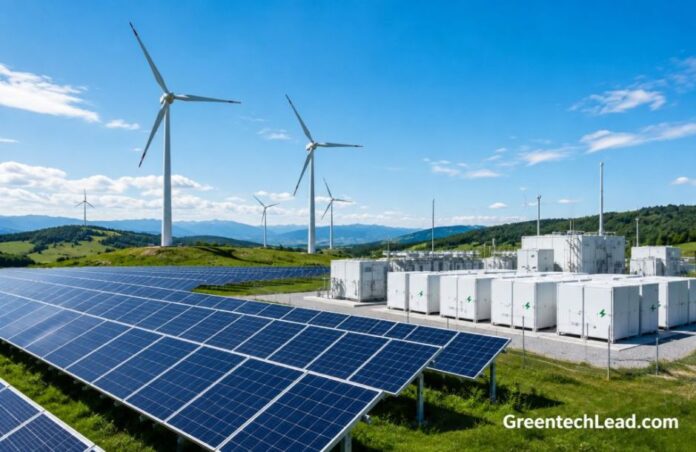
India’s power sector continued to improve in the third quarter of 2026, supported by higher renewable energy investment, expanding solar and wind capacity, growing non-fossil power infrastructure and stronger financing for energy storage and transmission projects.
According to the Institute for Energy Economics and Financial Analysis (IEEFA), renewable energy investment increased 21 percent quarter on quarter to $5.284 billion (₹50,241 crore) during July–September 2026, compared with $4.349 billion in the preceding quarter.
The latest IEEFA POWERup Q3 2026 report highlights India’s progress towards a cleaner electricity system, although slower quarterly capacity additions and renewable energy curtailment demonstrate the need for further improvements in grid infrastructure and storage.
Renewable Energy Drives India’s Power Capacity Expansion
India added 12,128 megawatts (MW) of gross electricity generation capacity during Q3 2026, with non-fossil energy accounting for 87.9 percent of additions.
Solar energy dominated new installations, contributing 8,899 MW, or 73.4 percent of gross capacity additions. Wind power contributed another 1,758 MW, representing 14.5 percent.
Wind installations improved 30.4 percent quarter on quarter, indicating stronger development activity despite the broader slowdown in renewable capacity expansion.
However, solar additions declined 25.2 percent quarter on quarter, while overall net capacity additions fell 37.7 percent sequentially to 10,038 MW.
The slowdown followed a period of rapid capacity expansion and highlights the importance of maintaining consistent project execution, transmission connectivity and financing availability.
India’s installed electricity generation capacity increased from 548.86 GW in June 2026 to 558.90 GW by September 30.
Importantly, the share of non-fossil power capacity improved from 54.2 percent to 55.1 percent during the quarter.
Solar capacity reached 171.05 GW, followed by wind at 59.20 GW, large hydropower at 52.07 GW and nuclear power at 8.78 GW.
Total renewable capacity, including large hydropower, reached 299.25 GW, while overall non-fossil capacity increased to 308.03 GW.
Coal and lignite accounted for 231.44 GW, representing 41.4 percent of installed capacity.
Renewable Energy Investment Improves 21 Percent
One of the most encouraging developments was the recovery in renewable energy investment.
India attracted approximately ₹50,241 crore during Q3 2026, compared with $4.349 billion in Q2 2026 and $3.370 billion in Q1 2026.
Investment also improved 1 percent compared with $5.229 billion in Q3 2025.
The quarterly recovery indicates renewed financing activity across solar, wind, hybrid generation, battery storage and related infrastructure.
IEEFA identified 13 major renewable energy financing and investment transactions with a combined value of approximately $8.98 billion.
These transactions included acquisitions, project loans, refinancing, grants and planned investments. Their combined value should not be treated as additional quarterly renewable energy investment.
Among the largest transactions, Aditya Birla Renewables secured a ₹15,213-crore loan from MUFG for its proposed acquisition of Shell’s Solenergi Power, including Sprng Energy.
The ₹17,322-crore acquisition covers a renewable energy portfolio of approximately 5 GWp, including 3.3 GWp of operational assets and 1.7 GWp of contracted capacity.
Avaada achieved financial closure for a 2.15 GW renewable energy portfolio across Gujarat and Maharashtra, supported by ₹12,360 crore from SBI, REC and Canara Bank.
The portfolio comprises 1.35 GW of hybrid renewable capacity and 800 MW of solar generation.
Brookfield also announced plans to invest $600 million through Lumara in renewable energy and storage, targeting an initial portfolio exceeding 6 GW.
These investments demonstrate growing institutional interest in larger renewable portfolios, long-term power purchase agreements and projects combining generation with storage.
Gujarat and Rajasthan Lead Renewable Capacity Growth
India’s renewable energy expansion continued to gain momentum during the first nine months of 2026.
Net power capacity additions reached 45,167 MW between January and September, representing 16 percent annual growth.
Renewable energy accounted for 41,239 MW, or 91.3 percent of total net additions.
Solar contributed 35,242 MW, representing approximately 78 percent of net capacity additions.
Gujarat led major states in Q3 renewable capacity additions with 3,972 MW, followed by Rajasthan with 2,103 MW.
Uttar Pradesh added 912 MW, Karnataka 890 MW and Andhra Pradesh 479 MW.
Karnataka recorded a 48 percent quarter-on-quarter increase in renewable additions, while Uttar Pradesh achieved 168 percent annual growth and crossed 10 GW of installed renewable capacity.
Andhra Pradesh also demonstrated significant improvement, with annual renewable additions increasing from 1,085 MW in FY2024–25 to 3,866 MW in FY2025–26.
The expansion reflects improvements in state-level renewable energy policies, transmission planning, project approvals and investor participation.
However, Maharashtra’s quarterly additions declined 77 percent, while Tamil Nadu reported a 56 percent reduction, highlighting uneven progress across states.
Electricity Generation Increases 11.8 Percent
India’s electricity generation increased 11.8 percent year on year to 541 billion units during Q3 2026, compared with 484 billion units in the corresponding quarter of 2025.
Renewable electricity generation improved 7.7 percent to 170.8 billion units, supported by the country’s expanding clean energy capacity.
Nuclear electricity generation increased 25.7 percent, contributing to diversification of the electricity supply mix.
Fossil-fuel electricity generation increased 13.3 percent to 354.2 billion units, reflecting continued reliance on conventional power to meet demand.
Hydropower generation, including imports from Bhutan, declined 14.4 percent, creating additional pressure on electricity supply.
Although renewable installations are increasing rapidly, the stronger growth in fossil-fuel generation demonstrates that capacity expansion alone is insufficient to reduce dependence on thermal electricity.
Improving renewable generation availability, storage capacity and transmission efficiency will be essential to translating installed capacity into higher clean electricity consumption.
Battery Storage and Transmission Investments Gain Importance
India’s next phase of power sector improvement is increasingly focused on battery storage, pumped hydropower and transmission infrastructure.
The Central Electricity Authority estimates that India will require 73.93 GW of energy storage power capacity by 2031–32.
This includes 47.24 GW of battery energy storage and 26.69 GW of pumped storage capacity.
The government’s Green Energy Corridor Phase III programme, approved in September 2026, envisages investment of ₹1.864 lakh crore.
The programme includes ₹1.364 lakh crore for intra-state transmission infrastructure and ₹50,000 crore for 50 GWh of battery energy storage.
The infrastructure is intended to facilitate the integration of up to 135 GW of renewable energy capacity.
In a further development, the government approved ₹14,500 crore in viability-gap funding on November 4, 2026, to support 92 GWh of energy storage projects.
The government’s energy storage investment initiative covers 30 GWh of battery storage, 60 GWh of pumped hydropower and 2 GWh of emerging storage technologies.
The initiative could mobilise approximately ₹97,600 crore in project investments, while the battery component includes a 40 percent domestic-content requirement.
These measures, announced after the reporting quarter, could improve renewable energy integration and create opportunities for battery manufacturers, equipment suppliers, engineering companies and project developers.
Grid Improvements Could Reduce Renewable Energy Curtailment
India’s expanding renewable energy infrastructure is creating new requirements for transmission and grid flexibility.
IEEFA estimated renewable electricity curtailment of approximately 378 million units during September 2026.
Solar accounted for 314 million units, while wind contributed 64 million units.
Gujarat recorded the highest curtailment at 187.76 million units, followed by Rajasthan at 110 million units.
Together, these two states accounted for approximately 79 percent of reported renewable energy curtailment.
The figures indicate that faster grid development, energy storage deployment and improved electricity scheduling could help India utilise more of its existing renewable generation assets.
Lower curtailment would improve electricity delivery and potentially strengthen project economics, depending on tariff arrangements and contractual compensation.
Rooftop Solar and Domestic Manufacturing Strengthen Growth
India’s renewable energy expansion is also benefiting from increased financial support for rooftop solar and domestic equipment manufacturing.
The World Bank approved approximately ₹8,462 crore for the PM Surya Ghar programme, combining loans and grant financing.
The programme is expected to mobilise approximately $4.2 billion in private lending.
The Asian Development Bank approved another ₹8,082 crore to support rooftop solar expansion targeting 30 GW across 10 million households.
In manufacturing, Agastya Green Energy announced plans to invest ₹7,800 crore in Andhra Pradesh for 12 GW each of solar ingot and wafer production capacity.
These initiatives could improve access to distributed renewable energy, expand domestic solar manufacturing and reduce dependence on imported components.
Outlook: Improving Investment and Infrastructure to Support India’s Clean Energy Transition
India’s Q3 2026 power sector performance demonstrates continued improvement in renewable investment, installed non-fossil capacity, wind installations and financing for clean energy infrastructure.
However, the 37.7 percent quarterly decline in net capacity additions, higher fossil-fuel generation and renewable curtailment show that the transition remains uneven.
IEEFA also identifies a potential 18-terawatt-hour electricity supply-demand gap through June 2027, underscoring the importance of dependable generation and flexible power infrastructure.
The Ministry of New and Renewable Energy estimates that India will require approximately ₹47.5 lakh crore ($500 billion) in clean energy investment by 2030.
The priorities for the coming years will include accelerating project commissioning, improving transmission connectivity, reducing renewable curtailment, expanding battery storage, strengthening electricity distribution companies and attracting affordable long-term financing.
India’s power sector is making measurable progress, but its next major improvement will depend on converting rising renewable capacity and investment into reliable, affordable electricity delivered through a more flexible and efficient grid.
SHAFANA FAZAL