
India’s aggressive clean energy storage expansion is entering a dangerous phase as ultra-low auction tariffs, speculative bidding behavior, and mounting supply chain risks threaten the long-term viability of battery storage projects critical to achieving the country’s 500 GW renewable energy target by 2030.
A joint market analysis by the Institute for Energy Economics and Financial Analysis and JMK Research & Analytics warns that the country’s rapidly growing energy storage market is becoming economically unstable despite record procurement volumes and strong policy support.
India’s Energy Storage Tender Pipeline Surges to 90.7 GW
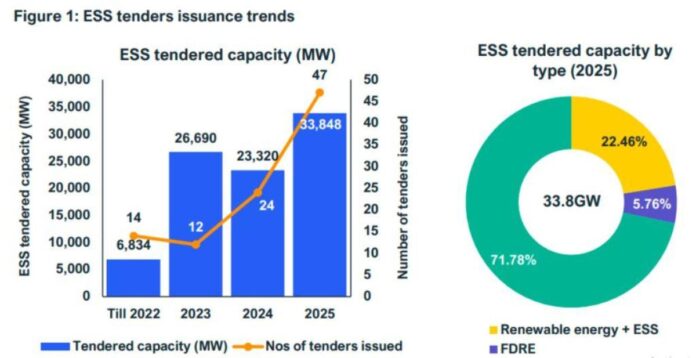
India’s total tendered energy storage capacity expanded dramatically from 6.8 GW in 2018 to 90.7 GW by 2025, reflecting the country’s urgent push to stabilize renewable-heavy electricity grids.
A major structural shift has emerged in procurement strategy. Standalone energy storage systems (ESS) now dominate India’s utility-scale storage market, accounting for more than 71 percent of all tendered capacity in 2025. Standalone battery energy storage systems (BESS) alone represented roughly 60 percent of total storage procurement.
Government incentives played a major role in accelerating deployment. India’s Viability Gap Funding (VGF) scheme currently offers up to 30 percent capital expenditure support for standalone battery installations, significantly improving project attractiveness.
India allocated 10.4 GW of standalone BESS capacity across 18 auctions during 2025. The dominant market configuration was the two-hour, two-cycle system operating under a 12-year contract structure, representing 57 percent of all allocated BESS projects. Utilities favor this design because it can support both morning and evening peak electricity demand within the same day.
Battery Storage Tariffs Collapse Below Viable Levels
Despite booming procurement activity, the report highlights severe financial stress across India’s short-duration battery storage segment.
Aggressive bidding during 2025 pushed discovered tariffs sharply downward. The lowest winning tariff fell to just ₹1.48 lakh per megawatt per month for a two-hour battery system, equivalent to approximately $1,576 per megawatt monthly.
However, JMK Research financial modeling shows economically viable tariffs should be at least:
2.3 lakh INR per MW per month2.3\ \text{lakh INR per MW per month}2.3 lakh INR per MW per month
This widening gap has placed nearly 75 percent of India’s allocated two-hour BESS projects into the “at-risk” category.
The report notes that four-hour storage systems demonstrate healthier economics because they better align with India’s prolonged evening electricity peaks. More than two-thirds of allocated four-hour storage capacity currently remains economically viable.
Early-stage state-led auctions in Karnataka, Tamil Nadu, Telangana, and Gujarat achieved relatively sustainable pricing. However, late-2025 mega-tenders became heavily distorted by speculative developer strategies aimed at securing market share.
Battery Supply Chain Pressures Intensify
The economic imbalance is worsening because battery storage tariffs are declining much faster than actual hardware costs.
Between 2022 and 2025:
Standalone BESS tariffs in India declined by 79.6 percent
Global battery pack prices fell only 36.5 percent during the same period
This mismatch suggests developers relied too heavily on assumptions of continued steep battery cost reductions that ultimately failed to materialize.
Additional pressure is emerging from global supply chains. Lithium carbonate prices increased sharply in China during the second half of 2025, directly impacting lithium iron phosphate (LFP) battery cell economics. China’s phased removal of export tax rebates beginning in April 2026 is also expected to increase the landed cost of imported battery cells in India.
Financial Closure Risks and Project Delays Mount
Commercial banks are increasingly reluctant to finance ultra-low-tariff storage projects, viewing many developments as unbankable.
The report forecasts widespread implementation delays ranging from 9 to 18 months, alongside the possibility of outright project cancellations.
India’s overwhelming dependence on imported lithium-ion technologies has also exposed developers to global commodity volatility and geopolitical supply chain disruptions.
The report warns that cost pressure could eventually force developers to compromise on:
Battery cell quality
Thermal cooling systems
Operational safety standards
Long-term asset reliability
Such compromises could weaken renewable integration performance across India’s future power grid.
Major Indian Energy Companies Shift Toward Multi-Technology Storage Strategies
India’s leading power developers are responding by diversifying beyond standalone short-duration battery assets.
JSW Energy Expands Long-Duration Storage Portfolio
JSW Energy’s “Strategy 3.0” framework includes nearly 2 GW of awarded standalone storage projects within a broader 29.6 GWh storage pipeline.
The company is prioritizing pumped hydro storage over batteries:
26.4 GWh allocated to pumped hydro assets
3.2 GWh allocated to battery projects
JSW Energy expanded renewable capacity by 2.6 GW during FY2026, reaching total operational generation capacity of 13.7 GW.
Its portfolio is now 59 percent renewable, including:
3,924 MW wind
2,440 MW solar
1,681 MW hydro
The company plans approximately ₹20,000 crore ($2.4 billion) in capital expenditure during FY2027 to support another 3 GW of renewable additions while targeting 30 GW generation capacity and 40 GWh storage by 2030.
Greenko Group Builds Dispatchable Renewable Infrastructure
Greenko is transforming its 11 GW operational portfolio across 20 Indian states into dispatchable round-the-clock renewable power infrastructure.
Its flagship Pinnapuram Integrated Renewable Energy Project in Andhra Pradesh combines:
4,000 MW solar
1,000 MW wind
1,680 MW pumped storage
More than 11,000 MWh daily grid support
Greenko is also developing an additional 5.2 GW of pumped hydro assets across Karnataka and Madhya Pradesh.
The company plans to support its green ammonia affiliate AM Green through continuous renewable energy supply. AM Green aims to convert a Kakinada chemical facility into a 1.5 million tonnes per annum green ammonia export hub.
Greenko has already secured a long-term agreement to supply 500,000 tonnes annually to Uniper beginning in 2028.
Torrent Power Accelerates Pumped Storage Investments
Torrent Power plans capital expenditure exceeding ₹60,000 crore ($7.2 billion) between FY2026 and FY2032.
Key investment areas include:
₹24,000-25,000 crore for 3.8 GW renewable projects
₹14,000 crore for pumped hydro storage infrastructure
Its flagship Saidongar-1 Pumped Storage Project in Maharashtra includes:
3,000 MW capacity
16 GWh energy storage
Ten 300 MW reversible pump-turbines
6,241 GWh annual peak-load generation
Torrent signed a 40-year Energy Storage Facility Agreement with Maharashtra State Electricity Distribution Corporation Limited for 2,000 MW of availability-based storage capacity.
EPC and Engineering Firms Gain Strategic Importance
India’s storage buildout is also creating opportunities for engineering and EPC specialists.
Key participants include:
Pace Digitek
Oriana Power
Kintech Synergy
Bondada Engineering
Larsen & Toubro
Andritz Hydro
Larsen & Toubro Renewables has already delivered 25.2 GW of solar installations and 12.8 GWh of battery storage globally, strengthening its position in large-scale utility infrastructure.
Andritz Hydro is supplying reversible Francis pump-turbines for both Greenko’s Pinnapuram and Torrent’s Saidongar projects.
International Financing Becomes Critical
As Indian commercial banks tighten lending standards, developers are increasingly relying on global capital markets and sovereign funding sources.
Major international investors supporting India’s clean energy storage sector include:
Abu Dhabi Investment Authority
GIC
World Bank
Asian Development Bank
New Development Bank
Indian financing agencies such as Power Finance Corporation and REC Limited are also expanding low-interest funding support tied to the VGF scheme.
Meanwhile, developers are increasingly using dollar-denominated green bonds listed on international exchanges including the London Stock Exchange and Singapore Exchange.
State Utilities Delay Agreements Amid Falling Price Expectations
The report highlights growing hesitation among state distribution companies to finalize storage procurement agreements.
Many utilities are delaying power purchase and storage contracts in anticipation of further battery price declines.
This procurement uncertainty has already resulted in the cancellation of 6.4 GW of previously awarded storage capacity.
IEEFA and JMK Recommend Auction Reforms
To prevent systemic failures across India’s storage market, the report recommends major policy and auction reforms.
Key recommendations include:
Introducing cost-reflective tariff floors
Tightening financial and technical qualification standards
Establishing legally binding payment security mechanisms
Accelerating domestic battery manufacturing under the PLI scheme
Expanding the National Critical Mineral Mission
Diversifying storage procurement beyond lithium-ion technologies The report concludes that without immediate structural corrections, India risks undermining the very energy storage infrastructure needed to stabilize its rapidly expanding renewable power system.
FASNA SHABEER
