
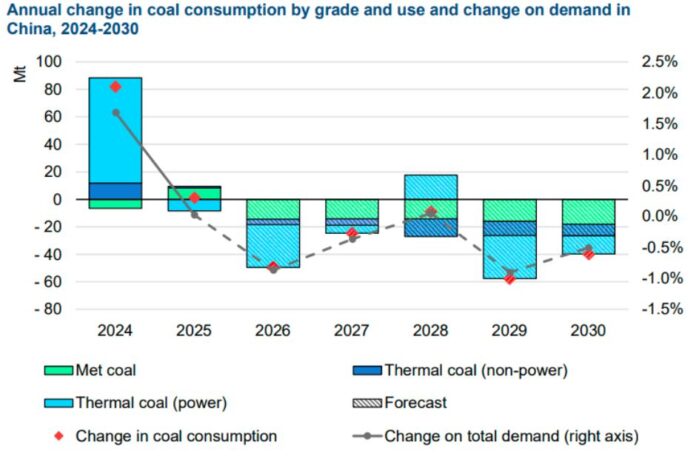
China’s coal demand remains broadly stable, but the underlying drivers are shifting across sectors, according to the International Energy Agency (IEA). As the world’s largest coal consumer, China continues to shape global coal markets, even as renewables expand rapidly and structural changes take hold in industry.
China coal consumption stabilises near record levels
China’s coal consumption reached about 4,952 million tonnes in 2024, up 1.7 percent year on year. Growth was led by thermal coal, which rose to around 4,218 million tonnes on the back of strong electricity demand. Non-power steam coal stood at 1,116 million tonnes, while metallurgical coal declined slightly to 734 million tonnes due to weaker pig iron production and a gradual shift toward electric arc furnace steelmaking.
In 2025, China’s total coal demand is projected to remain flat at around 4,953 million tonnes, accounting for roughly 56 percent of global coal consumption. Thermal coal continues to dominate at about 4,211 million tonnes, while metallurgical coal demand is expected to recover modestly to 742 million tonnes.
Power generation remains the main pillar of coal use
Electricity generation continues to be the backbone of coal demand in China. Power and heat generation account for around 73 percent of thermal coal demand and about 62 percent of total coal consumption in 2025. Electricity demand is forecast to grow by around 5 percent year on year, supporting coal’s strategic role in the power system.
Coal-fired power generation is expected to decline slightly by around 0.2 percent compared with 2024, reflecting the rapid expansion of renewable energy. Wind and solar generation are forecast to grow by about 15 percent, while hydropower output remains close to last year’s level and nuclear capacity continues its steady expansion.
Coal’s role shifts from baseload to flexibility
While coal remains central to China’s power system, its role is evolving. Authorities are increasingly positioning coal-fired plants as providers of flexibility rather than baseload supply, supporting grid stability as variable renewable generation grows. Thermal coal consumption for power and heat is projected at around 3,094 million tonnes in 2025, a slight decline driven by strong wind and solar output.
Industrial coal demand shows contrasting trends
Industrial coal use reflects diverging sectoral dynamics. Cement production continues to weaken due to structural challenges in construction and real estate, reducing coal demand in building materials. At the same time, coal demand for chemicals is rising sharply, supported by coal-to-chemicals expansion and strong fertiliser output.
These opposing trends largely offset each other, keeping non-power coal demand broadly stable at about 1,859 million tonnes in 2025.
Metallurgical coal supported by coke production
Metallurgical coal demand is expected to increase slightly in 2025, supported by higher coke production, even as overall steel output remains subdued. While pig iron production stays weak, increased coke output helps sustain coking coal demand. Policy measures, including tariffs on imported coking coal and tighter capacity controls, reinforce expectations of a gradual decline in met coal demand over the medium term.
Outlook points to gradual decline by 2030
Looking ahead, the IEA expects China’s coal consumption to begin declining toward the end of the decade, mainly due to the continued surge in renewable energy. By 2030, total coal demand is projected to fall to around 4,772 million tonnes. Thermal coal for power is expected to ease to about 3,030 million tonnes, while metallurgical coal declines to around 665 million tonnes. Non-power steam coal is forecast to fall to roughly 1,077 million tonnes, with growth in chemicals largely offsetting structural declines in cement and other industries.
Coal capacity continues to expand but focus shifts
China’s installed coal-fired capacity reached about 1,170 GW by the end of 2024, with an estimated 21 GW commissioned in the first half of 2025. Following the power shortages of 2021, more than 200 GW of capacity was approved in 2022 and 2023, followed by 67 GW in 2024 and 42 GW in the first three quarters of 2025.
After accounting for retirements of older and inefficient units, coal-fired capacity is expected to reach around 1,400 GW by 2030. New projects are concentrated in provinces such as Xinjiang, Inner Mongolia and Shaanxi, with additional clusters in Jiangsu and Shandong, reflecting the development of northwestern energy bases and industrial load centres.
Policy emphasis on flexibility and modernisation
Policy priorities are shifting away from pure baseload expansion toward flexibility and modernisation. China’s special action plan for 2025 to 2027 calls for new and upgraded coal units capable of operating at very low minimum loads, around 20 to 25 percent of rated capacity. This is designed to support higher renewable penetration and reduce cycling costs. Capacity remuneration reforms also remain in place to ensure investment recovery as coal plant load factors decline.
Baburajan Kizhakedath
