
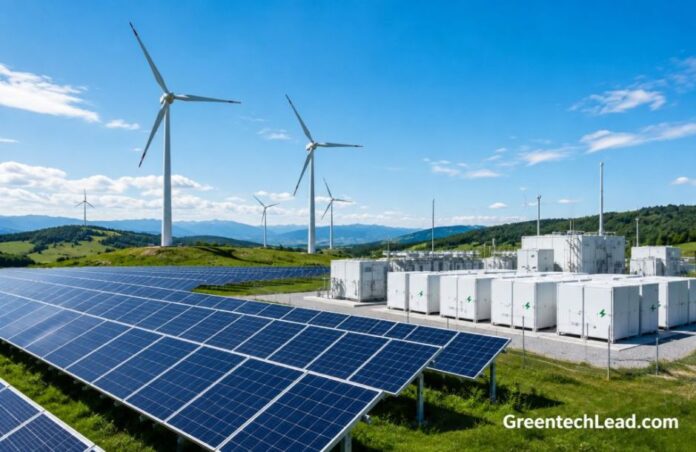
AI data center electricity demand is projected to surge 96 percent by 2030, but grid connection delays across the United States, United Kingdom, Germany, Netherlands and Ireland are threatening billions of dollars in infrastructure investments.
The global artificial intelligence boom is exposing a critical weakness in electricity infrastructure. Technology companies are investing billions in AI chips, servers and data centers, but many projects face delays because electricity grids cannot deliver sufficient power when facilities are ready to operate.
The International Energy Agency (IEA) expects global data center electricity consumption to increase from 485 terawatt-hours (TWh) in 2025 to approximately 950 TWh by 2030.
Meanwhile, more than 2,500 gigawatts (GW) of electricity generation, storage and large-load projects are waiting for grid connections worldwide. These projects are not exclusively data centers, but the backlog highlights mounting pressure on electricity networks.
For Microsoft, Google, Amazon and other AI infrastructure investors, access to reliable electricity is becoming as important as securing advanced processors.
The financial consequences can be substantial. A hypothetical 100 MW AI data center could lose an estimated $543 million in lifecycle value if its opening is delayed by one year, according to a Carnegie Endowment model.
Which Countries Face the Biggest AI Data Center Grid Bottlenecks?
Grid constraints are affecting major data center markets, although the causes differ significantly between countries.
| Country | Major grid challenge | Impact on data centers |
| United States | Regional transmission and substation constraints | Delayed connections and infrastructure upgrades |
| United Kingdom | Long grid connection timelines | Project delays and relocation risks |
| Germany | Lengthy infrastructure development | Higher investment and execution risks |
| Netherlands | Widespread regional grid congestion | Limited capacity for new large-load connections |
| Ireland | High concentration of data center electricity demand | Tighter connection requirements |
This comparison identifies important markets experiencing documented constraints. It is not a ranking of national grid congestion severity.
United States: AI Data Center Growth Pressures Electricity Networks
The United States remains one of the world’s largest AI data center investment markets, supported by spending from Microsoft, Amazon, Google, Meta and other technology companies.
However, rapid expansion is increasing pressure on regional electricity infrastructure.
Northern Virginia, a major global data center hub, illustrates the challenge of accommodating concentrated demand for high-capacity electricity connections.
Developers require additional substations, transmission capacity and dependable generation to support new facilities.
Grid constraints are not uniform across the United States. Some locations can accommodate new electricity demand more quickly, while others require substantial infrastructure upgrades.
For investors, the most important consideration is whether sufficient electricity can reach a proposed facility on its scheduled opening date.
A location offering lower electricity tariffs may become financially unattractive if network upgrades delay operations for several years.
United Kingdom: Microsoft Data Center Deal Exposes Grid Connection Risks
The United Kingdom provides a significant example of how electricity infrastructure delays can affect AI investments.
In October 2026, Microsoft withdrew from an agreement to anchor Nscale’s planned 50 MW AI data center in Loughton, Essex, after the expected grid connection was pushed into the 2030s.
The project was designed to support Microsoft Azure services using 23,040 Nvidia GB300 GPUs.
Microsoft indicated that its decision concerned the specific location, while Nscale continued evaluating alternative power arrangements and UK sites.
The Microsoft–Nscale data center development highlights the commercial risks associated with delayed electricity connections.
AI infrastructure projects require substantial investment in computing equipment, buildings, cooling systems and networking infrastructure.
When electricity connections are delayed, developers face the risk of postponing revenue generation while financing and other project expenses continue.
The UK case demonstrates why grid connection commitments must be evaluated before developers finalize major AI infrastructure investments.
Germany: Long Development Timelines Threaten Data Center Competitiveness
Germany faces challenges in expanding electricity infrastructure while supporting industrial demand, renewable energy integration and electrification.
Data centers compete with manufacturing, transportation and other electricity-intensive sectors for available network capacity.
A June 2026 Carnegie Endowment assessment ranked Germany last among ten countries in its modeled data center competitiveness comparison.
Lengthy development timelines were an important factor behind Germany’s position.
The assessment does not establish that Germany has the world’s most congested electricity grid. However, it highlights how project delivery schedules influence data center investment decisions.
For developers, delays in obtaining electricity connections, permits and infrastructure approvals can outweigh advantages in electricity pricing or market access.
Germany’s competitiveness will depend partly on its ability to accelerate grid expansion and reduce infrastructure delivery uncertainty.
Netherlands: Grid Congestion Restricts New Electricity Connections
The Netherlands faces significant electricity grid congestion across multiple economic regions.
Demand from businesses, industrial facilities, electrification and digital infrastructure is placing pressure on transmission and distribution networks.
For data center developers, insufficient network capacity can delay connections even when land, financing and construction plans are available.
The challenge is particularly relevant to facilities requiring large and continuous electricity supplies.
Developers may need to consider alternative locations, phased electricity connections or investments in dedicated infrastructure.
Grid congestion also creates opportunities for electricity network upgrades, battery storage, demand management and technologies that improve utilization of existing infrastructure.
However, these solutions cannot automatically eliminate the need for additional transmission and substation capacity.
Ireland: Data Centers Account for 22 Percent of Electricity Demand
Ireland illustrates how concentrated data center development can reshape national electricity planning.
According to the Commission for Regulation of Utilities, data centers accounted for 22 percent of Ireland’s electricity demand in 2024, compared with just 5 percent in 2015.
This represents an increase of 17 percentage points over nine years.
The growing electricity requirements of data centers have contributed to tighter scrutiny of new grid connection applications.
Connection decisions increasingly consider local network constraints, electricity security, on-site generation or storage and additional renewable energy supply.
Ireland’s experience highlights a broader challenge for countries seeking to attract AI infrastructure investment.
Rapid data center expansion can support digital investment but also increase competition for electricity infrastructure serving households and other businesses.
Why AI Data Centers Cannot Wait for Grid Expansion
The central problem is the mismatch between data center construction schedules and electricity infrastructure development.
AI data centers can sometimes be developed within one to three years, while major transmission infrastructure may require five to fifteen years for planning, permitting and construction.
This creates a potentially significant gap between the completion of computing facilities and the availability of electricity.
Three infrastructure constraints are particularly important.
Transmission and substations: Large data centers require high-capacity connections, transformers and sufficient upstream network capacity. Existing electricity generation cannot support new facilities if transmission infrastructure is inadequate.
Electrical equipment: Transformers, switchgear, circuit breakers and cables are essential for electricity delivery. Manufacturing lead times and equipment shortages can delay projects even after network expansion is approved.
Reliable generation: A grid connection does not guarantee uninterrupted electricity availability. Data centers also require sufficient generation capacity, backup systems and power-quality management.
The IEA’s energy and AI analysis highlights the growing electricity requirements associated with AI infrastructure.
These constraints mean that expanding electricity generation alone will not resolve every data center power shortage.
Grid Connection Delays: How Much Money Can AI Investors Lose?
Electricity infrastructure delays can have significant financial consequences for AI data center developers.
A Carnegie Endowment model examined the impact of delayed operations on a hypothetical 100 MW AI data center in the United States.
| Data center opening delay | Estimated lifecycle value loss |
| 3 months | $178 million |
| 6 months | $353 million |
| 12 months | $543 million |
The model uses a 12-year lifecycle and specific financial assumptions. The estimates are illustrative rather than representative of every AI data center.
Nevertheless, they demonstrate why electricity availability is becoming a major factor in investment decisions.
A developer may prefer a location with higher electricity tariffs if the facility can begin generating revenue significantly earlier.
For AI infrastructure investors, the cost of waiting can exceed the savings available from cheaper electricity.
Global Grid Investment Needs to Increase 50 Percent by 2030
The electricity infrastructure challenge is also creating substantial investment opportunities.
The IEA’s Electricity 2026 grid analysis estimates that annual global grid investment, currently around $400 billion, must increase by approximately 50 percent by 2030.
That implies annual investment of roughly $600 billion by the end of the decade.
The additional spending requirement reflects the needs of the broader electricity system, including renewable energy integration, electrification and growing power demand—not data centers alone.
Major investment opportunities include transmission networks, substations, transformers, high-voltage cables, switchgear, battery storage and grid-management technologies.
Equipment suppliers could benefit from rising orders as utilities and developers expand electricity infrastructure.
However, investment announcements do not automatically translate into supplier revenue.
Manufacturing capacity, order execution, construction schedules, financing and regulatory approvals will influence the commercial benefits.
Investors should distinguish between announced projects and funded infrastructure developments with confirmed equipment orders.
Can Solar, Nuclear and Natural Gas Solve Data Center Power Shortages?
Technology companies are increasingly evaluating different electricity supply strategies to reduce dependence on constrained grids.
Solar and wind can provide competitively priced renewable electricity, but their output varies with weather conditions and time of day.
Battery storage can shift electricity across operating hours, although storage duration and capital costs influence project economics.
Nuclear power can provide continuous low-carbon generation, but new facilities face substantial investment requirements and long development schedules.
Natural gas can provide dispatchable electricity, although operators remain exposed to fuel prices, emissions and fuel-supply risks.
On-site electricity generation may help developers overcome some grid connection delays.
However, dedicated generation requires additional infrastructure, permits, maintenance and backup arrangements.
For many AI data centers, combining grid electricity, renewable power purchase agreements, batteries and firm generation may offer greater flexibility than depending on a single electricity source.
How Can Countries Reduce Grid Connection Delays?
Governments, electricity utilities and data center developers must coordinate infrastructure planning more closely.
The IEA estimates that grid-enhancing technologies and regulatory reforms could unlock capacity for approximately 1,200 GW to 1,600 GW of advanced-stage projects currently in global connection queues.
These projects include electricity generation, storage and large loads beyond data centers.
Improving grid utilization, accelerating permitting and increasing transparency around connection queues could help reduce infrastructure delays.
Utilities also need more reliable forecasts of future electricity demand from AI data centers.
Developers can reduce exposure by selecting sites with available network capacity, negotiating phased connections and investing in flexible power arrangements.
Electricity supply contracts should clearly allocate responsibility for network upgrades, delays and cancellation risks.
What Should AI Data Center Investors Prioritize?
Electricity availability is becoming a critical factor in determining the financial viability of AI infrastructure projects.
Investors should evaluate four commercial considerations before approving major developments:
Grid connection timeline: Can the facility receive sufficient electricity when construction is completed?
Delivered electricity cost: What is the total cost after transmission, network charges, backup and storage?
Infrastructure investment: Who will finance substations, transformers and network upgrades?
Reliability and contract risks: What happens if electricity connections, equipment deliveries or generation projects are delayed?
A lower electricity tariff may offer limited financial benefits if infrastructure constraints postpone commercial operations.
Conversely, securing dependable electricity earlier can improve the economics of AI data center investments.
Outlook: Grid Capacity Will Influence the Next Wave of AI Data Center Investment
Global data center electricity consumption is projected to approach 950 TWh by 2030, placing additional pressure on electricity networks already supporting industrial growth, renewable energy integration and electrification.
The United States, United Kingdom, Germany, Netherlands and Ireland illustrate different challenges associated with grid congestion, connection delays and concentrated electricity demand.
For technology companies, the availability of electricity is increasingly influencing where AI infrastructure can be developed.
For utilities and equipment suppliers, grid expansion creates opportunities in transmission, substations, transformers, storage and power-management technologies.
The next major competitive advantage in AI infrastructure may not be cheaper land, lower electricity tariffs or access to advanced chips. It may be the ability to secure reliable grid-connected electricity years ahead of competing projects.
SHAFANA FAZAL
