
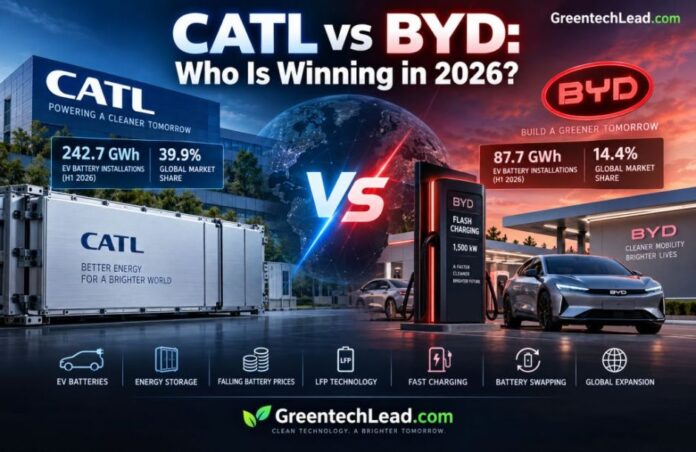
CATL vs BYD Battery Race 2026: CATL is extending its lead in the global EV battery market with 242.7 GWh of installations and 39.9 percent market share in H1 2026, while BYD is building a different competitive advantage through its Blade Battery, ultra-fast charging, vehicle manufacturing and international expansion.
The battle between China’s two battery giants is expanding beyond electric vehicles into energy storage, LFP batteries, fast charging, battery swapping, sodium-ion technology and overseas manufacturing.
CATL supplied 242.7 GWh of EV batteries during January-June 2026, up 25.3 percent, according to SNE Research data. BYD supplied 87.7 GWh, up 1.6 percent.
Together, CATL and BYD controlled 54.3 percent of global EV battery installations, demonstrating the extraordinary concentration of battery manufacturing in the hands of the two Chinese companies. The figures also highlight how global EV battery market trends are increasingly being shaped by Chinese battery manufacturers.
CATL Extends EV Battery Lead With 39.9% Market Share
CATL increased its global EV battery share from 38.2 percent in H1 2025 to 39.9 percent in H1 2026.
BYD’s share moved in the opposite direction, falling from 17 percent to 14.4 percent, despite installations reaching 87.7 GWh.
The gap between the companies is substantial: CATL supplied approximately 155 GWh more EV batteries than BYD during the first six months of 2026.
CATL’s advantage is partly driven by its position as an independent supplier serving multiple global automakers rather than relying primarily on its own vehicle sales.
The company’s manufacturing scale is equally significant. CATL sold 661 GWh of lithium-ion batteries in 2025, up 39 percent, while production capacity reached approximately 772 GWh, with another 321 GWh under construction.
Its 2025 revenue reached RMB423.7 billion, while R&D investment totaled RMB22.1 billion, highlighting the scale of capital supporting its battery technology strategy.
More details on its manufacturing, technology and international strategy are available in CATL’s 2025 annual report.
CATL Leads BYD Outside China
International markets are becoming an increasingly important battleground.
CATL supplied approximately 90.5 GWh of EV batteries outside China during H1 2026, capturing 33.6 percent of the non-China market.
BYD supplied around 28.2 GWh, representing a 10.5 percent share.
BYD’s overseas battery installations are expanding rapidly, but CATL retains a significant advantage because it can participate in international EV growth through batteries supplied to multiple automakers.
BYD follows a different strategy: its battery technology increasingly reaches international markets through its own rapidly expanding EV business.
BYD sold more than 790,000 vehicles overseas during H1 2026, an increase of approximately 71 percent. Overseas revenue reached roughly RMB181.3 billion, accounting for more than half of its first-half revenue.
The expansion is part of a broader shift in EV battery manufacturing and overseas investment, as Chinese battery and EV companies establish production and supply-chain operations closer to major international markets.
BYD Blade Battery Creates Vertical Integration Advantage
BYD’s Blade Battery remains central to its strategy.
Unlike CATL’s broad third-party supply model, BYD integrates batteries with its own electric vehicles, powertrains, electronics and charging technology. This gives BYD greater control over the entire battery-to-vehicle ecosystem.
The next phase combines its LFP-based Blade Battery architecture with FLASH Charging.
BYD says its charging technology can deliver up to 1,500 kW of power. It plans to have 20,000 FLASH Charging stations in China by the end of 2026, compared with 4,239 stations installed as of March 5.
The BYD Blade Battery 2.0 and FLASH Charging strategy demonstrates why battery market share alone does not fully measure BYD’s competitive position. Its advantage lies in combining batteries, vehicles, power electronics and charging infrastructure.
Energy Storage Gives CATL Another Major Growth Engine
The CATL-BYD battle is also moving rapidly into stationary energy storage.
Global ESS battery shipments reached 461.3 GWh in H1 2026, representing an extraordinary 71 percent increase from 269.7 GWh a year earlier.
CATL shipped 125 GWh of energy-storage batteries, equivalent to approximately 27.1 percent of the global market.
CATL’s energy-storage battery-system revenue reached RMB53.26 billion in H1 2026, soaring 87.5 percent year over year and accounting for approximately 19.2 percent of total company revenue.
The rapid expansion of the global battery energy storage market is creating another major growth engine for battery manufacturers as utilities and renewable-energy developers deploy storage alongside solar and wind projects.
This diversification is strategically important. Grid-scale batteries are becoming essential as utilities add more solar and wind capacity, while AI data centers and industrial facilities are creating additional demand for reliable and flexible electricity infrastructure.
CATL and BYD compete differently in this market. CATL’s 125 GWh figure represents battery shipments, while BYD participates across battery manufacturing, storage systems and project integration. Cell shipments and complete energy-storage system deployments therefore should not be treated as directly comparable measures.
Falling Battery Prices Intensify CATL vs BYD Competition
Rapidly falling battery prices are making EVs and energy storage more economical while increasing competitive pressure on manufacturers.
The global average lithium-ion battery-pack price dropped 8 percent to $108 per kWh in 2025, according to BloombergNEF.
LFP battery packs averaged $81 per kWh, while stationary-storage battery packs plunged 45 percent to $70 per kWh.
The benchmark cost of a four-hour battery-storage project also declined 27 percent to $78 per MWh.
These EV battery prices and LFP cost trends are becoming increasingly important to automakers and energy-storage developers because lower battery costs can improve the economics of both electric vehicles and grid-scale storage projects.
Lower prices could accelerate EV adoption and battery-storage installations, but they also put pressure on manufacturers to improve factory utilization, procurement, technology and production efficiency.
CATL benefits from enormous manufacturing scale, while BYD can extract efficiencies through vertical integration between battery and vehicle production.
LFP Remains Critical to CATL and BYD
Lithium iron phosphate, or LFP, has become one of the most important technologies in the battery race because of its combination of cost, safety, durability and cycle life.
CATL deploys LFP across passenger vehicles, commercial vehicles and stationary energy storage.
BYD has made LFP central to its brand through the Blade Battery, combining the chemistry with vehicle architecture and increasingly powerful charging systems.
CATL is simultaneously broadening its technology portfolio with sodium-ion batteries, targeting passenger vehicles, commercial applications, energy storage and battery swapping.
This creates an important strategic difference: CATL is diversifying across battery chemistries and applications, while BYD is deepening integration around its LFP-based vehicle ecosystem.
CATL Battery Swapping vs BYD Ultra-Fast Charging
The companies are also pursuing different solutions to one of the biggest EV challenges: charging time.
CATL’s Choco-Swap network has exceeded 1,000 passenger-vehicle swapping stations across 45 Chinese cities. Its QIJI heavy-duty battery-swapping network has surpassed 300 stations across 26 provinces.
CATL completed more than 1.15 million battery-swapping services during 2025.
BYD instead wants to reduce charging time through its 1,500 kW FLASH Charging technology and planned network of 20,000 stations.
The competing strategies could eventually serve different parts of the EV market. Battery swapping may prove particularly attractive for taxis, fleets and commercial vehicles, while ultra-fast charging could have broader appeal among private EV owners.
CATL vs BYD: Who Is Winning in 2026?
On global battery volume, CATL is clearly ahead.
Its 39.9 percent EV battery share versus BYD’s 14.4 percent, combined with 125 GWh of H1 energy-storage battery shipments, gives CATL greater scale across the two biggest battery markets.
But BYD has a different advantage. Its batteries are integrated directly into one of the world’s largest EV manufacturing operations, while Blade Battery, 1,500 kW FLASH Charging and rapid overseas vehicle expansion give it control over technologies extending from the battery cell to the customer.
The CATL vs BYD race is therefore evolving into a competition between two models: CATL’s global battery-supply platform versus BYD’s vertically integrated battery-EV-charging ecosystem.
As battery prices fall and demand expands across EVs, renewable energy storage and power-intensive infrastructure, the winner through 2030 may be determined not simply by who manufactures the most batteries, but by who can deliver the strongest combination of scale, cost, charging speed, safety, international reach and next-generation battery technology.
SHAFANA FAZAL
