
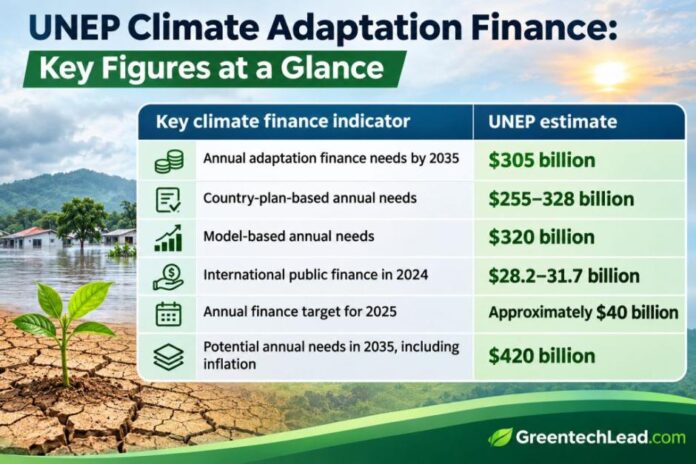
Developing countries will require approximately $305 billion annually by 2035 to protect their economies, infrastructure and populations from climate change, while international public adaptation finance reached only $28.2–31.7 billion in 2024, according to the United Nations Environment Programme (UNEP) Adaptation Gap Report 2026.
The report — Ready? Not. Climate impacts will not wait. Adaptation finance must rise — warns that climate adaptation investments are failing to keep pace with increasing floods, droughts, heatwaves and other climate-related disasters.
The findings highlight a significant investment gap and growing demand for climate-resilient infrastructure, water management, agriculture, disaster protection and environmental technologies.
Climate Adaptation Investment Needs Reach $305 Billion Annually
UNEP estimates that 155 developing countries will require between $255 billion and $328 billion annually over the coming decade, based on their national climate commitments and adaptation plans.
A separate modelling assessment estimates annual adaptation requirements at approximately $320 billion.
Combining these approaches produces a central estimate of $305 billion annually by 2035, excluding most private-sector adaptation requirements.
Including private-sector needs could almost double the total investment requirement.
Climate Adaptation Finance Rises Just $1 Billion in 2024
International public adaptation finance from developed to developing countries increased by approximately $1 billion between 2023 and 2024.
Total financing reached $28.2–31.7 billion in 2024, the latest year with available data.
However, this growth remains insufficient to achieve the Glasgow Climate Pact objective of doubling adaptation finance to approximately $40 billion annually by 2025.
UNEP notes that increased financing from multilateral development banks during 2025 could help close the shortfall, although reductions in development assistance remain a concern.
The financing structure also presents challenges. Loans represented 55 percent of international public adaptation finance in 2024, compared with 44 percent provided through grants.
Approximately half of lending was non-concessional, potentially increasing financial pressure on developing economies.
Climate Finance Could Reach $120 Billion by 2035, Still Far Below Requirements
The COP30 agreement called for efforts to at least triple adaptation finance by 2035.
Depending on the baseline used, this could increase annual international adaptation financing to between $85 billion and $120 billion.
However, UNEP estimates that annual adaptation requirements could reach $420 billion by 2035 when future inflation is considered.
Consequently, even tripling international adaptation finance would cover only 20–29 percent of estimated requirements.
This would leave a substantial financing gap despite stronger international commitments.
Least Developed Countries Need Up to $50 Billion Annually
Least developed countries and small island developing states face particularly severe financing challenges.
Their combined annual adaptation finance needs are estimated at approximately $40–50 billion over the coming decade.
These requirements represent 3–4 percent of their GDP, approximately twice the relative burden faced by upper-middle-income developing economies.
International public adaptation finance for these vulnerable countries remains below its 2022 peak.
In 2024, almost 90 percent of financing directed toward least developed countries consisted of grants or highly concessional loans.
For small island developing states, the corresponding proportion was approximately 80 percent.
By 2035, their annual adaptation requirements could reach $53–71 billion after accounting for inflation.
Tripling financial support could increase annual flows to $35–44 billion, covering an estimated 49–84 percent of their requirements.
Developing Countries Increase Climate Finance Support to $9.6 Billion
South-South climate finance cooperation is becoming an increasingly important funding source.
Financial support flowing between developing countries increased from $3.8 billion in 2019 to $9.6 billion in 2024.
This represents an increase of approximately 153 percent over five years.
Such financing, provided primarily through multilateral development banks and bilateral cooperation, is equivalent to almost one-third of the adaptation finance supplied by developed countries.
However, these contributions do not count toward existing developed-country climate finance commitments.
Private Climate Adaptation Finance Doubles to $3 Billion
Private financing mobilized through international public adaptation finance doubled from $1.5 billion in 2019 to $3 billion in 2024.
An additional $3 billion in private adaptation finance was reported globally, excluding Western Europe and the United States.
Despite increasing corporate interest in climate resilience, UNEP estimates that private investment may close only 15–20 percent of the financing gap for more public-oriented adaptation requirements.
Private companies are expected to increase investments in protecting their factories, infrastructure, supply chains and business operations from climate risks.
However, these investments cannot fully replace government spending on public infrastructure, disaster preparedness and community protection.
Climate Disasters Affect 765 Million People
UNEP highlights the growing human and economic consequences of inadequate climate adaptation.
Between 2020 and 2025, approximately 765 million people were recorded as affected by floods and landslides.
Low- and middle-income countries accounted for 99 percent of those affected.
The report also identifies nearly 240,000 recorded deaths associated with extreme heat during the same period.
Only 27 percent of these deaths were reported in lower-income countries, potentially reflecting differences in monitoring capacity, reporting practices and preparedness.
UNEP cautions that additional evidence is necessary to attribute these recorded impacts fully to human-induced climate change.
Climate Loss and Damage Funding Requests Reach $2.8 Billion
Demand for financial assistance to address climate-related losses significantly exceeds available resources.
A total of 119 developing countries submitted funding requests worth approximately $2.8 billion to the Fund for Responding to Loss and Damage.
However, the initial funding envelope amounted to just $342 million.
Requests were therefore approximately eight times the available financing.
The funding shortage underscores the challenges facing countries recovering from climate-related disasters, including damaged infrastructure, agricultural losses and disruptions to essential services.
Climate Adaptation Creates Investment Opportunities
The UNEP findings point to increasing demand for climate adaptation technologies and infrastructure.
Major investment areas include flood protection systems, water conservation, drought-resistant agriculture, resilient electricity networks, coastal protection, climate monitoring and early-warning technologies.
Energy infrastructure operators, engineering companies, water technology providers and digital monitoring businesses could benefit from stronger adaptation spending.
However, the report emphasizes that financing alone will not deliver effective adaptation. Governments must also strengthen institutions, improve coordination and ensure funding reaches vulnerable communities.
The UNEP Adaptation Gap Report 2026 concludes that developing countries face a widening climate investment challenge. With annual financing requirements approaching $305 billion and international public support remaining below $32 billion in 2024, substantially greater public investment, international cooperation and private-sector participation will be essential to strengthen climate resilience.
BABURAJAN KIZHAKEDATH
