
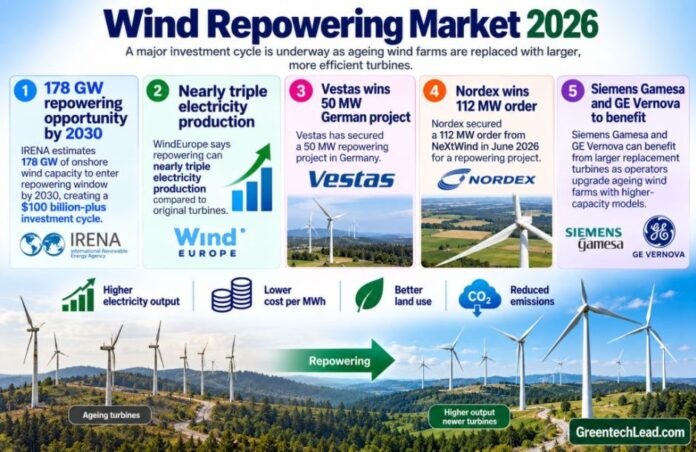
Around 178 GW of aging onshore wind capacity could enter the prime repowering window by 2030, creating a major investment opportunity for Vestas, Siemens Gamesa, Nordex, GE Vernova, developers, grid-equipment suppliers and renewable-energy investors.
Wind repowering is emerging as one of the next major investment opportunities in renewable energy as thousands of turbines installed during the first wind-development boom approach the end of their original operating lives.
Unlike greenfield development, repowering can potentially reuse valuable infrastructure including land rights, access roads, grid connections, substations and operating data while replacing older turbines with much larger and more productive machines.
IRENA estimates that approximately 178 GW of onshore wind capacity across 89 countries — around 17 percent of the global onshore fleet — could enter the prime repowering window by 2030.
The investment opportunity extends well beyond turbines. Repowering can trigger spending on engineering, foundations, cranes, transformers, substations, transmission, battery storage, recycling and long-term maintenance.
178 GW Could Create a $100 Billion-Plus Investment Cycle
The 178 GW figure represents an addressable fleet rather than a forecast that every turbine will be replaced.
But it illustrates the potential capital requirement.
IRENA’s weighted-average installed cost for new onshore wind was around $1,041/kW in 2024. Applying approximately $1,041/kW to the entire 178 GW fleet gives a theoretical new-build-equivalent asset value of around $185 billion.
Repowering costs cannot simply be equated with greenfield costs because projects can potentially reuse existing infrastructure.
Another way to assess the opportunity is incremental capacity.
If repowering increased the 178 GW fleet’s capacity by an average 50 percent, approximately 89 GW of additional capacity would be created.
At an illustrative investment requirement of $1,000-$1,500/kW for that incremental capacity, the capital opportunity could reach approximately $89 billion-$134 billion.
This is not a spending forecast, but it demonstrates why wind repowering is becoming a major global renewable investment opportunity.
Modern Turbines Can Transform the Economics of Existing Sites
The most important benefit is not additional MW. It is additional MWh.
Consider an older 100 MW wind farm operating at a 25 percent capacity factor.
Annual generation would be approximately:
100 MW × 8,760 hours × 25% = 219 GWh
Suppose repowering increases capacity to 150 MW while modern turbines increase the capacity factor to 40 percent.
Annual generation becomes:
150 MW × 8,760 × 40% = 526 GWh
Generation increases by approximately 307 GWh, or 140 percent, despite installed capacity increasing only 50 percent.
WindEurope says repowering can nearly triple electricity production while reducing the number of turbines, illustrating how dramatically modern turbine technology can improve utilization of established wind sites.
Repowering Can Generate Millions in Incremental EBITDA
The additional generation can materially change project cash flow.
For the hypothetical 307 GWh increase:
At $40/MWh, incremental gross revenue would be about $12.3 million annually.
At $50/MWh, revenue reaches approximately $15.4 million.
At $60/MWh, it increases to around $18.4 million.
Assuming incremental O&M of $4/MWh, the $50/MWh case would involve around $1.2 million in additional operating expenditure, leaving approximately $14.1 million of incremental EBITDA.
If redevelopment investment were hypothetically $90 million, simple EBITDA payback would be around 6.4 years.
Actual returns will vary substantially with electricity prices, PPAs, financing costs, taxes, curtailment, construction downtime and availability.
The important investment metric is therefore incremental lifetime EBITDA per dollar of redevelopment CAPEX, rather than simply the number of MW replaced.
Europe Is Already Building a Repowering Market
Europe provides the clearest evidence that repowering is moving into the mainstream.
Europe installed 19.1 GW of new wind capacity in 2025, including 17.2 GW of onshore wind. Repowering accounted for approximately 2 GW of the new onshore capacity.
WindEurope’s latest September 2026 update shows the market accelerating further.
Europe installed 8.8 GW in H1 2026, up 30 percent, taking total capacity above 311 GW. Onshore wind accounted for 6.5 GW of the additions.
WindEurope now expects approximately 24 GW of new European wind capacity in full-year 2026, which would represent a record.
Europe also raised €9 billion for 5.2 GW of future wind projects during H1, while firm turbine orders reached 10.6 GW.
The broader repowering and decommissioning market has already been estimated at $9 billion-$11 billion, with expectations that it could nearly double by the end of the decade.
Vestas Wins 50 MW German Repowering Project
Recent turbine orders show how the opportunity is translating into business for manufacturers.
In September 2026, Vestas secured a 50 MW repowering order from European Energy in Germany.
Germany is particularly attractive because it combines one of Europe’s largest aging wind fleets with strong wind resources, established grid infrastructure and an active market for modern onshore turbines.
The opportunity for Vestas extends beyond supplying replacement turbines. Repowering can also generate long-term service agreements, spare-parts revenue and digital optimization opportunities over the next 20-30 years.
Nordex Secures Major German Repowering Orders
Nordex provides another example.
The company secured a 112 MW order from NeXtWind in June 2026 for the Altmark wind farm in Saxony-Anhalt.
Nordex will supply 16 N175/6.X turbines, each using a 179-metre hub height. Installation is scheduled to begin in November 2027, with commissioning planned for spring 2028.
The contract also includes a 20-year Premium Service agreement.
Another NeXtWind repowering project ordered seven Nordex N149/5.X turbines totaling 39.9 MW for Lütau 2. Combined with an existing project, site capacity will reach 68.4 MW. That contract also includes 20 years of service.
These projects show why wind repowering can create recurring revenue for turbine manufacturers long after turbine delivery.
India Could Unlock ₹40,000 Crore of Investment
India represents one of the largest potential repowering markets outside Europe because early wind farms frequently used turbines dramatically smaller than modern machines.
CRISIL has estimated that repowering could attract approximately ₹40,000 crore of investment over three to five years, with more than 5 GW of potential, particularly in Gujarat and Tamil Nadu.
The productivity difference is substantial.
CRISIL estimates that a modern 3 MW turbine operating at a 34-36 percent PLF could generate around 200 percent more electricity than an older 1 MW machine operating at a 22-24 percent PLF on the same site.
The challenge is cost. Dismantling alone can cost around ₹80 lakh-₹1 crore per MW.
India therefore needs project structures where additional generation can justify turbine replacement, grid upgrades and lost production during redevelopment.
Grid Upgrades Create Another $9 Billion-$27 Billion Opportunity
Repowering turbines does not automatically mean the grid can absorb the additional electricity.
If 178 GW of aging capacity received a 50 percent capacity uplift, approximately 89 GW of incremental capacity would need grid access.
At an illustrative grid-upgrade requirement of $100-$300/kW, this could represent another $8.9 billion-$26.7 billion of investment.
Potential beneficiaries include suppliers of transformers, substations, switchgear, power electronics and transmission infrastructure.
This creates a second investment layer around repowering.
A project may have excellent wind resources and strong turbine economics but still fail if additional electricity cannot be evacuated.
Repowering Plus Solar and BESS Creates a Bigger Asset
The opportunity becomes more interesting when aging wind sites are converted into multi-technology renewable hubs.
Consider the earlier 150 MW repowered wind project.
Adding 75 MW of solar PV at a 20 percent capacity factor could produce approximately another 131 GWh annually.
A 100 MW/400 MWh battery storage system could then shift some renewable generation into higher-value periods, reduce certain curtailment risks and provide ancillary grid services.
Existing grid connections become particularly valuable in this model.
Instead of viewing an old wind farm as a single-generation asset, developers can potentially transform it into a wind + solar + battery platform.
Decommissioning and Recycling Create Another Market
Every repowering project also creates an end-of-life economy.
Old turbines need to be dismantled and transported. Steel, copper and aluminum can potentially generate salvage revenue.
Blades remain more difficult because composite materials are challenging to recycle economically.
As repowering volumes increase, companies involved in cranes, heavy transportation, component refurbishment, metals recovery, blade recycling and site restoration could capture part of the investment cycle.
Repowering Can Be Faster Than Finding New Wind Sites
One of the strongest advantages of brownfield wind is location.
Many aging projects were built on attractive wind sites decades ago.
Replacing old turbines allows developers to reuse those resources without searching for entirely new sites.
But existing infrastructure does not eliminate development risk.
Permitting and grids remain major obstacles. WindEurope says Europe could install 148 GW during 2026-2030, but inadequate grid development and permitting continue to constrain growth.
Repowering policies therefore become almost as important as turbine technology.
Who Benefits from the Wind Repowering Boom?
The investment opportunity extends across the wind value chain.
Vestas, Siemens Gamesa, Nordex and GE Vernova can benefit from larger replacement turbines and long-term service contracts.
Developers can increase generation from existing land and grid assets.
Transformer, switchgear and transmission companies can benefit from grid reinforcement.
Battery suppliers can capture hybridization opportunities.
Engineering, crane and logistics companies benefit from dismantling and reconstruction, while recycling businesses gain access to growing volumes of retired materials.
The European wind repowering market therefore represents much more than turbine replacement.
Wind Repowering Could Become a $100 Billion-Plus Brownfield Opportunity
The 178 GW of global onshore wind capacity potentially entering the prime repowering window by 2030 creates a substantial addressable market.
Europe is already demonstrating the model, with 2 GW of repowering capacity added in 2025, while recent Vestas and Nordex orders show developers committing capital to modernize established wind sites.
India could potentially attract around ₹40,000 crore, while grid upgrades, solar hybridization, battery storage, decommissioning and recycling create additional investment layers.
The most attractive projects will not necessarily be the oldest wind farms.
They will be sites combining excellent wind resources, weak legacy turbine productivity, major capacity-factor improvement potential, available grid capacity, favorable power prices and manageable redevelopment downtime.
For investors, the key question is therefore not simply how many MW can be replaced.
It is how many additional MWh and how much incremental EBITDA can be generated for every dollar invested in redevelopment.
That equation could turn wind repowering into one of the largest brownfield renewable-energy investment cycles of the next decade.
SHAFANA FAZAL
