Solar manufacturing is becoming an important source of industrial employment as governments and companies localize supply chains covering modules, cells, wafers and polysilicon.
China remains the world’s largest solar manufacturing ecosystem, but India and the United States are emerging as major hotspots for new factory investment and jobs. India is moving rapidly beyond module assembly into cells and wafers, while U.S. investment is creating highly automated manufacturing hubs.
There is no globally comparable dataset that conclusively identifies the country with the fastest year-on-year growth specifically in solar manufacturing jobs. The best assessment therefore combines factory capacity, investment, announced employment, operating capacity and supply-chain depth.
Global Solar PV Employment Reaches 7.2 Million
IRENA estimates global solar PV employment at approximately 7.2 million jobs in 2024.
China accounted for roughly 4.2 million, or 58 percent, followed by Europe with about 821,200, India with 384,900 and the United States with approximately 280,100.
These figures cover the broader PV value chain, including installation, and should not be interpreted as factory jobs alone. They nevertheless show where the world’s largest solar employment ecosystems are concentrated.
Manufacturing investment provides another indicator. Global solar manufacturing investment has weakened from its 2023 peak, but new investment is becoming more geographically diversified.
India: 261.7 GW Module Capacity Creates Manufacturing Hotspot
India is arguably one of the strongest candidates for new solar manufacturing employment growth.
During the first half of 2026, India added 50.6 GW of module manufacturing capacity and 9.7 GW of cell capacity, taking cumulative capacity to 261.7 GW of modules and 36.6 GW of cells. Gujarat accounts for about 45 percent of module capacity and 37 percent of cell capacity.
The expansion is now moving upstream, potentially creating more technically specialized manufacturing jobs.
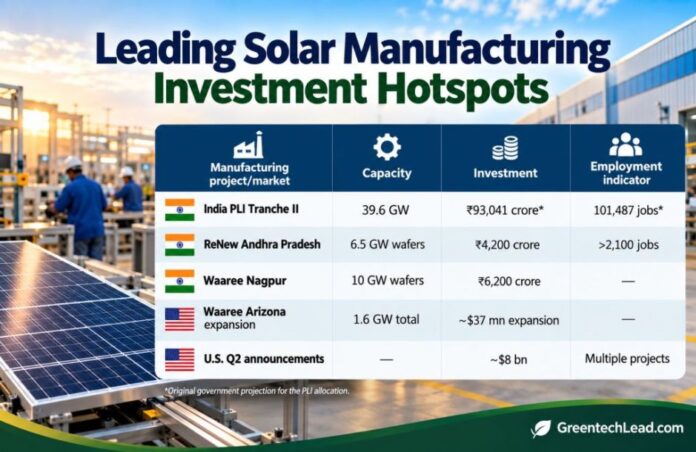
India’s Production Linked Incentive program allocated 39.6 GW of manufacturing capacity under its second tranche. The government originally estimated that projects under this tranche could attract ₹93,041 crore of investment and create 101,487 direct and indirect jobs. India’s solar manufacturing PLI program includes Reliance, First Solar, Waaree, ReNew, Tata Power Solar and other manufacturers.
ReNew Invests ₹4,200 Crore in 6.5 GW Wafer Factory
One of the strongest 2026 employment examples comes from Andhra Pradesh.
ReNew announced a 6.5 GW solar ingot-wafer manufacturing facility in Anakapalli district near Visakhapatnam involving investment of ₹4,200 crore.
The factory is expected to be commissioned within 24 months and generate more than 2,100 direct and indirect jobs.
The ReNew ingot-wafer manufacturing project forms part of ReNew’s broader ₹82,000 crore investment commitments in Andhra Pradesh.
ReNew already operates 6.5 GW of module capacity and 2.5 GW of cell capacity and plans another 4 GW of cell expansion by December 2026. Its manufacturing operations produced more than 4.1 GW of modules and nearly 1.86 GW of cells during FY2026.
Waaree Builds Deeper Solar Supply Chain
Waaree provides another example of India’s move toward integrated manufacturing.
The company had 20.17 GW of module manufacturing capacity in India by December 2025 and operates 5.4 GW of cell capacity.
It is also constructing a 10 GW ingot-wafer manufacturing facility in Nagpur involving approximately ₹6,200 crore of capex.
This is important for employment because wafer manufacturing requires process engineers, equipment specialists, quality-control personnel, maintenance teams and other skilled industrial workers rather than relying only on module assembly.
India’s manufacturing-job opportunity will therefore depend on how much of the upstream supply chain moves into domestic production.
United States: Multibillion-Dollar Factories Drive Job Creation
The United States is another major investment hotspot.
Clean Investment Monitor data indicate that U.S. projects represented about $8 billion of global solar manufacturing investment announcements in Q2 2026. Two large projects in Texas and New Mexico accounted for about $5.8 billion.
U.S. solar manufacturing employment is likely to be relatively capital- and skill-intensive because factories rely on automation, robotics and sophisticated production equipment.
Waaree demonstrates the cross-border nature of this expansion. The company approved approximately $37 million to upgrade its Arizona module factory from 1 GW to 1.6 GW.
Following the expansion, Waaree expects to have 4.8 GW of U.S. module manufacturing capacity, comprising 3.2 GW in Texas and 1.6 GW in Arizona.
First Solar Shows Scale of U.S. Manufacturing Investment
First Solar represents another important U.S. manufacturing model because it has built a vertically integrated thin-film manufacturing platform.
Its manufacturing expansion across states including Ohio, Alabama and Louisiana demonstrates how solar industrial policy can create regional manufacturing clusters rather than standalone assembly facilities.
Such investments generate direct factory employment while supporting construction, equipment, glass, logistics, engineering and maintenance jobs.
The larger employment impact therefore comes from the manufacturing ecosystem surrounding a plant rather than production-line workers alone.
China Remains the World’s Solar Manufacturing Center
Despite rapid investment elsewhere, China remains overwhelmingly dominant.
IRENA estimates approximately 4.2 million Chinese PV jobs, while the country maintains an integrated industrial chain covering polysilicon, ingots, wafers, cells, modules, glass, chemicals and manufacturing equipment.
The IEA’s solar PV supply-chain analysis found China responsible for more than 80 percent of manufacturing capacity across major solar-panel production stages in its assessment.
China’s challenge is different from India’s or America’s. Enormous manufacturing capacity combined with increasing automation means production can rise without employment increasing at the same rate.
Southeast Asia Remains an Export Manufacturing Hub
Vietnam, Malaysia and Thailand remain important solar manufacturing locations, supported partly by investment from Chinese manufacturers.
The region’s employment ecosystem includes cells, modules, components, equipment, logistics and export services.
However, trade policies influence investment decisions. Manufacturers serving the U.S. and other markets are reassessing where cells and modules should be produced as tariffs and local-content requirements change supply-chain economics.
Europe Focuses on Higher-Value Solar Jobs
Europe had approximately 821,200 PV jobs in 2024, including around 764,400 in EU member states.
Much of this employment comes from deployment, engineering and services rather than mass commodity manufacturing.
Europe’s opportunity is concentrated around high-efficiency cells, advanced equipment, automation, research, power electronics and specialized manufacturing, potentially producing fewer but more technically intensive factory jobs.
Automation Is Changing Solar Factory Employment
Gigawatts alone do not determine employment. A highly automated 10 GW plant may employ fewer workers per GW than an older factory but require more engineers, robotics technicians and process specialists.
Demand is consequently shifting toward process engineering, automation, robotics, quality control, data analytics, equipment maintenance and advanced-material expertise.
Upstream integration also matters. A country producing polysilicon, wafers, cells and modules can capture a much larger industrial workforce than one importing cells and assembling modules.
Where Are Solar Manufacturing Jobs Growing Fastest?
A definitive global ranking is not yet possible, but the investment evidence identifies clear trends.
China remains the largest solar manufacturing employment ecosystem. India appears to have one of the strongest new manufacturing expansion stories, with 261.7 GW of module capacity and substantial investment moving into cells and wafers. The United States is developing highly capital-intensive manufacturing hubs, while Southeast Asia remains important to export supply chains and Europe focuses on specialized technology.
The next phase of solar manufacturing employment will therefore be determined not simply by module capacity but by how successfully countries build integrated supply chains from materials and wafers through cells, modules, equipment and recycling.
Regions that turn announced gigawatts into operating factories with high utilization are likely to capture the greatest long-term industrial and employment benefits.
SHAFANA FAZAL