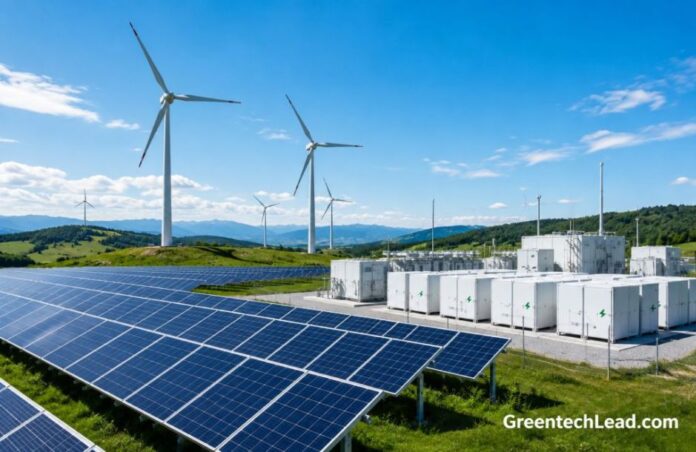
The latest renewable energy news includes announcements from Sungrow, Decade Energy, Vena Energy, Langa, and others.
Decade Energy Signs 200 MWh Battery Framework with Sungrow in France
Decade Energy has signed a two-year framework agreement with Sungrow covering 200 MWh of battery energy storage systems in France. The agreement gives Decade access to storage equipment for projects serving its flexible-power infrastructure platform, which is increasingly focused on electrification of commercial transport and logistics sites. Decade raised €22 million earlier in 2026 to scale deployments in France and expand into additional European markets, including Germany. Battery storage is central to its model because electric-truck depots can require large power connections and create concentrated charging demand. Integrating batteries allows sites to reduce grid-capacity requirements and optimise electricity consumption. The 200 MWh agreement provides a defined equipment pipeline for the next stage of deployment.
Vena Energy Wins 46.8 MW Japanese Long-Term Battery Auction Award
Vena Energy has secured a 46.828 MW award for its NRE Nakagawa No. 2 battery-storage project in Japan’s FY2025 Long-Term Decarbonisation Power Source Auction. The mechanism was introduced to provide long-term revenue visibility for new low-carbon generation and storage investments needed to support Japan’s 2050 carbon-neutrality target. Winning the auction gives the battery project greater certainty over future revenue, improving its ability to progress through financing and construction. Vena already operates storage assets in Japan, including a 2 MW battery in Hikone, Shiga Prefecture. The new award materially expands the company’s utility-scale storage pipeline as Japan adds batteries to integrate more variable renewable generation.
Langa Secures BPCE Financing for 18 MWh Battery on Réunion Island
French renewable developer Langa has secured financing from BPCE for an 18 MWh battery energy storage system on Réunion Island, providing project debt for another storage asset in the French overseas electricity system. Island grids have particularly strong requirements for storage because their limited interconnection means fluctuations in renewable generation must largely be balanced locally. The battery will provide additional flexibility as Réunion increases deployment of solar and other renewable resources. Project financing is the material new milestone because it establishes the capital required to move the BESS toward construction and operation. The transaction also demonstrates growing lender willingness to finance standalone and hybrid battery projects in smaller electricity markets where storage can directly reduce dependence on conventional generation.