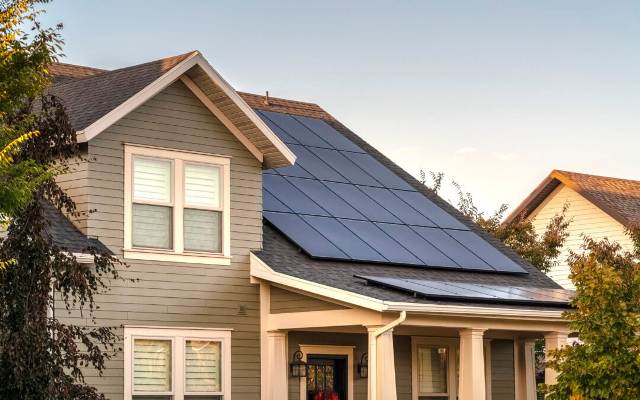
Thailand’s rooftop solar market has significant growth potential, but high installation costs, restrictive capacity rules and weak compensation for exported electricity are slowing investment as the country becomes increasingly dependent on imported LNG.
The Institute for Energy Economics and Financial Analysis (IEEFA), in an August 19, 2026 report, says rooftop solar reform could help Thailand reduce gas-fired generation, improve energy security and ease financial pressure on the electricity system.
Natural gas currently supplies 66 percent of Thailand’s electricity generation, while declining domestic gas production has increased exposure to volatile LNG prices. By March 2026, the Electricity Generating Authority of Thailand (EGAT) was carrying more than THB36 billion, or about US$1 billion, in accumulated losses linked to earlier energy crises, IEEFA report said.
The IEEFA report — prepared by Haneea Isaad — said Thailand had approximately 11.8 GW of installed solar capacity in early 2026, including around 8 GW of ground-mounted solar and 3.6 GW of rooftop solar. Rooftop systems therefore account for roughly 30 percent of total installed solar capacity.
Thailand Targets 60 Percent Renewable Energy by 2050
Thailand’s PDP 2026 targets a 60 percent renewable-energy share by 2050, making solar central to the country’s long-term power strategy.
Solar has led incremental renewable-energy additions since 2018, but rooftop installations have expanded more slowly than utility-scale projects.
IEEFA identifies high upfront costs, low export compensation, capacity restrictions and policy uncertainty as key barriers.
The economics are particularly important for commercial and industrial customers because rooftop solar can reduce daytime grid purchases while cutting emissions. At system level, greater distributed generation could also displace part of Thailand’s gas-fired electricity output.
Rooftop Solar Installation Costs Reach US$936 per kW
IEEFA estimates rooftop solar installation costs in Thailand at around US$936 per kilowatt, nearly 50 percent higher than comparable markets such as Pakistan, Malaysia and Vietnam.
Under the current “Solar for Thai People” net-billing framework, exported electricity receives THB2.2 per kWh, equivalent to approximately US$0.07/kWh.
Average retail electricity tariffs are around THB3.88/kWh, or about US$0.12/kWh.
This large gap between the retail tariff and export compensation means households achieve the strongest returns when they consume most of their rooftop generation directly.
Residential rooftop solar payback periods are currently around six to seven years.
Net Metering Could Cut Solar Payback to Four Years
IEEFA recommends replacing net billing with net metering, allowing consumers to offset grid electricity purchases against rooftop solar generation on a kWh-for-kWh basis.
Under its broader scenario analysis, net metering could reduce residential solar payback to approximately four years.
For a 5 kW rooftop system, IEEFA estimates a payback period of around 5.5 years, while a 10 kW system could achieve approximately 4.5 years, depending on electricity consumption and self-consumption levels.
If Thailand retains net billing, raising the buyback tariff from THB2.2/kWh to THB3/kWh could reduce residential payback to around five years.
Improved compensation would also strengthen the economics of larger residential and commercial systems and support rooftop solar financing and Private PPA models.
Thailand Raises Residential Rooftop Solar Cap From 90 MW to 500 MW
Thailand’s residential rooftop program has also been constrained by quotas.
The 2019 residential net-billing scheme established a 90 MW quota that was intended to remain available through 2030. However, the entire allocation was used by 2024, six years ahead of schedule.
A 2026 resolution increased the national cap to 500 MW, but IEEFA says the 5 kW-per-meter export limit could continue to restrict project economics.
The early exhaustion of the original 90 MW quota indicates that consumer demand already exists. IEEFA recommends relaxing self-consumption thresholds and capacity limits so consumers can size systems according to actual electricity requirements.
Tax Incentives Could Reduce Rooftop Solar Costs
Thailand has introduced tax incentives that could further improve project economics.
Households can receive personal income-tax deductions of up to THB200,000, while companies can claim corporate tax deductions of up to 150 percent for qualifying investments.
IEEFA argues that these incentives need to be easier to access and should work alongside improved electricity compensation.
For residential customers, combining tax benefits with higher export values could materially reduce the effective upfront investment. For commercial users, the corporate deduction can strengthen the investment case for larger rooftop projects.
Solar-Plus-Storage Could Increase Self-Consumption
Battery storage is another area of opportunity.
Solar-plus-storage can increase the share of rooftop electricity consumed on-site, improving economics under Thailand’s current net-billing structure.
Greater deployment of batteries could also support a broader distributed-energy market involving rooftop solar, storage and intelligent energy-management systems rather than treating rooftop PV purely as an electricity-export asset.
GUNKUL Operates 94.6 MW Across 108 Rooftop Projects
Thailand already has an established group of rooftop solar developers capable of scaling if policy conditions improve.
GUNKUL Engineering reports 94.6 MW of rooftop solar capacity across 108 projects.
Its portfolio includes projects linked to the Metropolitan Electricity Authority and Provincial Electricity Authority, demonstrating established development and operating capabilities in distributed solar.
BCPG Targets 100 MW Private PPA Rooftop Portfolio
BCPG has expanded into rooftop solar through the Private PPA model.
The company completed an investment in 17.5 MW of Thai rooftop solar projects and is targeting 43.6 MW by the end of 2026, approximately double its previous-year level.
BCPG has also set a longer-term target of reaching 100 MW of Thai rooftop solar projects under Private PPAs.
The model is particularly attractive for commercial and industrial customers with predictable daytime electricity demand because the developer can finance and operate the system under a long-term power-purchase arrangement.
Banpu NEXT Rooftop Projects Deliver THB20 Million Annual Savings
Banpu NEXT reported 67.0 MW of rooftop solar capacity in Thailand in 1Q26, plus a separate 1.4 MW rooftop portfolio under Ecoserve.
At BITEC BURI, Banpu NEXT developed a 4 MW rooftop and solar-carport project covering approximately 40,000 square meters.
The installation is expected to generate annual electricity-cost savings of up to THB20 million.
Together with its Summer Lasalle project, the installations are expected to reduce carbon dioxide emissions by approximately 3,700 tonnes annually.
These figures show why commercial rooftop solar can be attractive even under Thailand’s existing policy framework.
SPCG Solar-Roof Revenue Jumps 56.58 Percent
SPCG is positioning residential rooftop solar as a future growth business.
Its solar-roof revenue reached THB404.3 million in 2025, increasing 56.58 percent.
SPCG reported total 2025 revenue of THB1.7255 billion, EBITDA of THB1.0784 billion and net profit of THB377.3 million.
The growth indicates that rooftop solar demand is expanding even before major policy reforms improve residential economics.
Pakistan’s 38 GW Solar Market Shows Potential of Policy Reform
IEEFA points to Pakistan as a regional example of how supportive policy can accelerate distributed solar.
Since 2018, Pakistan has installed approximately 38 GW of solar capacity after reducing trade barriers, avoiding strict capacity caps and supporting net metering.
By the end of 2025, the country had more than 350,000 net-metering connections.
IEEFA says falling module costs, high electricity tariffs and supportive policies reduced payback periods for some Pakistani net-metered systems to less than two years, compared with around six to seven years for residential rooftop systems in Thailand.
Rooftop Solar Could Reduce Thailand’s LNG Exposure
Thailand’s rooftop solar opportunity increasingly has to be viewed as an energy-security issue.
With natural gas accounting for 66 percent of electricity generation, additional daytime solar generation could reduce demand for gas-fired electricity and exposure to imported LNG prices.
EGAT’s accumulated losses exceeding THB36 billion illustrate the financial impact that fuel-price shocks can place on the electricity system.
Expanding domestic distributed generation could provide a structural hedge against future fuel volatility while allowing households and businesses to lower electricity purchases.
Thailand Rooftop Solar Market Has Strong Growth Potential
Thailand already has 11.8 GW of solar capacity, but only 3.6 GW is rooftop solar despite strong year-round solar resources and a national goal of reaching 60 percent renewable energy by 2050.
Current economics remain challenging. Installation costs are around US$936/kW, exported electricity earns just THB2.2/kWh versus an average retail tariff of THB3.88/kWh, and residential payback periods remain around six to seven years.
IEEFA estimates net metering could lower payback toward four years, while raising the buyback rate to THB3/kWh could reduce it to around five years.
Private-sector activity already shows substantial investment appetite. GUNKUL operates 94.6 MW across 108 projects, Banpu NEXT has 67.0 MW of Thai rooftop capacity, BCPG is targeting 43.6 MW by end-2026 and 100 MW longer term, while SPCG generated THB404.3 million in solar-roof revenue in 2025.
Thailand therefore does not need to create a rooftop solar industry from scratch. It needs a more attractive investment framework.
Net metering, higher export compensation, streamlined tax incentives of up to THB200,000 for individuals and 150 percent for companies, relaxed capacity restrictions, lower installation costs and faster solar-plus-storage adoption could help transform rooftop solar into a major part of Thailand’s energy transition. For Thailand, expanding beyond the current 3.6 GW rooftop solar base could support renewable-energy growth, reduce LNG exposure, lower electricity costs and strengthen energy security at the same time.
SHAFANA FAZAL