
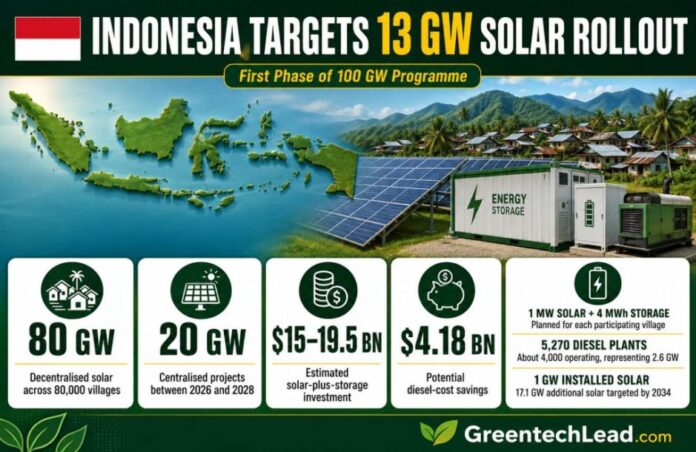
Indonesia is preparing to launch the first phase of its 100 GW solar power programme in Bali, accelerating plans to replace expensive diesel-based electricity generation with solar energy and battery storage.
The initial programme targets around 13 GW of solar and battery energy-storage capacity for regions dependent on diesel generation. However, the 13 GW figure refers to the planned solar-plus-storage rollout rather than Indonesia’s existing diesel-generation capacity.
Indonesia has approximately 5,270 diesel power plants with 3.48 GW of combined capacity, according to the Regulatory Assistance Project. Around 4,000 plants, or 76 percent, are estimated to be operational, representing approximately 2.6 GW.
Dinita Setyawati, Senior Energy Analyst – Asia at Ember, said: “By combining solar with smart grids, forecasting and storage systems, Indonesia can unlock far more of its solar potential while expanding reliable and affordable clean electricity to communities across the country.”
Leading Solar Companies in Indonesia
Indonesia’s solar industry is attracting investment across floating power plants, industrial rooftops, battery-backed projects and domestic manufacturing. State-owned PLN remains the principal utility-scale developer, while SUN Energy and Xurya lead the commercial and industrial rooftop segment. International companies including Masdar, ACWA Power, TotalEnergies, LONGi and SEG Solar are also expanding their presence.
PLN Group expands floating solar portfolio
PLN Group is central to Indonesia’s solar expansion through subsidiaries PLN Nusantara Power and PLN Indonesia Power.
PLN Nusantara Power operates the Cirata floating solar plant with UAE renewable-energy company Masdar. The West Java facility has installed capacity of 145 MWac or 192 MWp, generates electricity for approximately 50,000 homes and avoids around 214,000 tonnes of carbon emissions annually. The original project required approximately IDR 1.7 trillion, equivalent to about $109 million.
PLN and Masdar are evaluating an expansion that could add up to 500 MW, potentially making Cirata one of the world’s largest floating solar complexes. In April 2025, the companies also signed agreements to explore floating solar developments at the Jatigede, Gajah Mungkur and Jatigede reservoirs.
PLN Indonesia Power and ACWA Power are developing the 92 MWp Saguling floating solar plant in West Java. The project secured $60 million in financing from DEG, Proparco and Standard Chartered under Indonesia’s Just Energy Transition Partnership. Scheduled to begin commercial operations in November 2026, Saguling is expected to produce more than 130 GWh annually and reduce emissions by approximately 104,000 tonnes per year.
PLN Nusantara Renewables, another PLN affiliate, reports a development portfolio totalling 3,210 MW, including the 46 MWp Tembesi floating solar project.
SUN Energy crosses 200 MW operating capacity
SUN Energy is one of Indonesia’s largest commercial and industrial solar developers. By mid-2025, the company had achieved more than 200 MW of operating capacity, covering over 300 rooftop solar projects across 20 provinces and more than 50 industrial sectors.
Its customers include Unilever, Astra Group, Ajinomoto, Avian and LamiPak. SUN Energy said its installed Indonesian solar portfolio had surpassed 220 MWp by November 2025, including projects in the Karawang International Industrial City and Jababeka Industrial Estate.
SUN Energy secured a IDR 620 billion long-term facility from state-owned infrastructure financier PT Sarana Multi Infrastruktur. The financing has a tenure of 15 years and supports new solar installations for industrial and commercial customers.
Xurya expands beyond rooftop solar
Xurya Daya Indonesia has emerged as another leading distributed-solar company by offering rooftop solar installations without upfront capital expenditure from customers.
Xurya raised $55 million in 2024 from investors led by the Norwegian Climate Investment Fund, with participation from Swedfund, Clime Capital, British International Investment and AC Ventures. The transaction increased its cumulative funding to more than $88 million, or approximately IDR 1.5 trillion.
The company had built more than 100 MW across almost 200 projects by October 2024. Its secured portfolio subsequently exceeded 200 MWp, serving more than 100 companies. Xurya is now moving beyond on-grid commercial rooftops into off-grid systems, independent power projects and solar installations combined with battery storage.
TotalEnergies and RGE target 1 GW power exports
TotalEnergies and Singapore-based Royal Golden Eagle have formed the equally owned Singa Renewables joint venture to develop a large solar farm, battery energy-storage system and subsea transmission link in Riau Province.
Singapore granted the project a conditional licence to import 1 GW of firm renewable electricity from Indonesia. The development will also supply clean power to industries in Riau. Although the partners have not disclosed investment or generation-capacity figures, the project represents one of Indonesia’s largest planned solar-and-storage developments.
LONGi and SEG Solar invest in manufacturing
Chinese solar manufacturer LONGi is developing a module factory in Deltamas, West Java, with annual capacity of 1.6 GW. The facility will manufacture high-efficiency modules using the company’s HPBC 2.0 technology and strengthen Indonesia’s domestic solar supply chain.
SEG Solar is developing an integrated photovoltaic manufacturing complex in Batang, Central Java. The project targets 5 GW of annual production capacity covering silicon ingots, wafers, solar cells and modules. SEG describes it as Indonesia’s largest vertically integrated solar manufacturing park.
Bali Selected for First Solar Programme Phase
Energy and Mineral Resources Minister Bahlil Lahadalia said President Prabowo Subianto would inaugurate the first phase of the 100 GW solar initiative in Bali. The government is positioning the project as a major component of its energy-security and diesel-replacement strategy.
Indonesia has subsequently begun preparations for an initial 17 GW of solar photovoltaic capacity, indicating that the development pipeline may be expanding beyond the previously announced 13 GW first-phase target.
Bali has set an objective of achieving net-zero emissions by 2045, which is 15 years earlier than Indonesia’s national 2060 target. The province also plans to transform Nusa Penida into a fully renewable-powered “Green Island” by 2030, including a transition to battery-electric transport.
100 GW Solar Plan Includes 320 GWh of Battery Storage
Indonesia’s national programme is divided into two major components:
80 GW of decentralised solar installations distributed across approximately 80,000 villages
20 GW of centralised, grid-connected solar power projects
Each participating village could receive approximately 1 MW of solar capacity combined with around 4 MWh of battery energy storage. Delivering the complete village programme would therefore require as much as 320 GWh of battery-storage capacity.
The projects are expected to be managed partly through the Merah Putih Village Cooperatives, supporting rural electrification, local employment and community participation in electricity generation.
Indonesia aims to develop the 100 GW between 2026 and 2028, although the implementation schedule has varied between government announcements. Meeting a three-year schedule would require the country to install approximately 33 GW annually, or nearly 3 GW every month.
That represents a significant increase from Indonesia’s current installed solar capacity of approximately 1 GW.
Diesel Replacement May Require Up to $19.5 Billion
Replacing diesel generation with the planned 13 GW of solar and battery capacity could require an estimated investment of between $15 billion and $19.5 billion, according to the Institute for Energy Economics and Financial Analysis.
The estimate equals approximately $1.15 million to $1.5 million for every megawatt of solar-plus-storage capacity.
Indonesia launched the first phase of its diesel-replacement programme in 2022, but implementation has progressed slowly. Presidential Regulation 112 of 2022 established renewable-project procurement timelines of less than 180 days, yet power-purchase agreements for the initial programme faced delays.
The government expects solar generation to lower PLN’s fuel costs, reduce exposure to volatile oil prices and cut the electricity subsidies required to operate isolated diesel systems.
Government estimates indicate that completing the wider solar programme could generate savings of as much as $4.18 billion by reducing diesel consumption.
Indonesia Has 3,217 GW of Solar Potential
Indonesia possesses estimated technical solar potential of approximately 3,217 GW, but only a fraction has been developed. The proposed 100 GW programme would utilise just over 3 percent of that potential.
Indonesia’s 2025–2034 electricity supply plan provides for 17.1 GW of additional solar generation. Solar represents around 40 percent of the 42.6 GW of renewable capacity planned by 2034.
Renewables will account for nearly 61 percent of Indonesia’s planned additional generating capacity through 2034. The government aims to raise renewable energy’s share of the electricity mix from around 12 percent in 2024 to 35 percent by 2034.
However, only approximately 30.5 GWp, or about 30 percent of the headline 100 GW solar ambition, is currently included in the formal 2025–2034 electricity plan. Another 5.56 GWp could be developed by independent power producers outside PLN.
Approximately 27.8 GWp would require amendments to the electricity plan, while another 30.8 GWp depends on new demand from industrial projects, electric vehicles, induction cooking, mineral processing and green industrial parks.
Indonesia Needs Rapid Solar Manufacturing Expansion
The programme will create substantial demand for solar modules, inverters and battery systems. Indonesia reduced its minimum local-content requirement for solar plants from around 40 percent to 20 percent in 2024 to improve project bankability and attract international financing.
Indonesia’s launch in Bali marks an important step towards replacing costly diesel generation. The scale of the challenge remains considerable: the country must move from around 1 GW of installed solar capacity to 100 GW, deliver up to 320 GWh of battery storage and mobilise tens of billions of dollars within a compressed development period.
BABURAJAN KIZHAKEDATH
