
Yara International has accelerated its sustainability strategy in 2025 by reducing greenhouse gas intensity, expanding low-emission ammonia projects, strengthening renewable energy integration, and collaborating across its value chain to lower emissions.
Yara International, led by Bernhard Stormyr, Vice President of Sustainability Governance, combined operational improvements with strategic investments to advance its long-term climate ambitions.
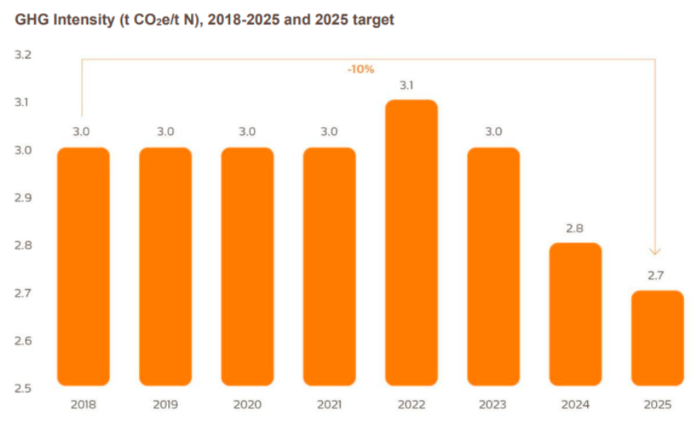
During the year, Yara achieved its target of reducing greenhouse gas intensity by 10 percent compared with the 2018 baseline, while progressing toward its commitment to reduce absolute Scope 1 and Scope 2 emissions by more than 30 percent by 2030 and achieve climate neutrality by 2050, Yara Sustainability Report 2025 indicated.
Yara advances net zero and climate targets
Yara continues to align its sustainability strategy with measurable emissions reduction targets. The company achieved its 2025 objective of lowering greenhouse gas intensity to 2.7 tonnes CO₂e per tonne of nitrogen, down from 3.0 tonnes in 2021 and 2.8 tonnes in 2024, representing a 10 percent reduction from 2018 levels.
The company reaffirmed its ambition to reduce absolute Scope 1 and Scope 2 greenhouse gas emissions by more than 30 percent by 2030 compared with the 2019 baseline while pursuing 11.1 percent absolute Scope 3 emissions reduction by 2030 against the 2021 baseline. Yara also reiterated its long-term goal of achieving climate neutrality by 2050.
Greenhouse gas emissions continue to decline
Yara reported total greenhouse gas emissions of approximately 62.7 billion kilograms of CO₂ equivalent across its operations and value chain during 2025.
The emissions profile included:
Scope 1: 14.8 billion kilograms CO₂e
Scope 2 (market-based): 0.7 billion kilograms CO₂e
Scope 3: 47.1 billion kilograms CO₂e
Within Scope 3 emissions:
33 billion kilograms CO₂e originated from the use of sold products.
11.6 billion kilograms CO₂e came from purchased goods and services.
For its 2030 climate KPI, Scope 1 and Scope 2 emissions declined to 15.3 million tonnes CO₂e in 2025 from 16.1 million tonnes in 2024. Overall, Scope 1 and Scope 2 emissions were 17 percent below the baseline, compared with 13 percent in 2024 and 4 percent in 2021.
Renewable energy and low-emission ammonia investments expand
Yara continued investing in renewable energy and low-emission ammonia to accelerate industrial decarbonization.
The company classifies:
Renewable ammonia as ammonia produced using hydrogen generated through electrolysis powered by renewable electricity or biomethane.
Low-carbon ammonia as ammonia produced using natural gas combined with carbon capture and storage (CCS).
Low-emission ammonia as the collective term for renewable and low-carbon ammonia.
Green hydrogen produced using wind, solar and hydropower is expected to reduce fertilizer carbon footprints by 70 percent to 90 percent compared with conventional production.
A major milestone is Yara’s Sluiskil CCS project in the Netherlands, scheduled to begin operation in Q3 2026, capturing approximately 800,000 tonnes of CO₂ annually, equivalent to around 0.5 percent of the Netherlands’ total emissions.
The company also announced advanced negotiations with Air Products to develop low-emission ammonia projects in the United States and Saudi Arabia, with a final investment decision targeted for mid-2026.
Sustainable agriculture reduces emissions
Yara continues to position agriculture at the center of climate action, noting that the sector accounts for approximately 30 percent of global greenhouse gas emissions.
Its Yara Climate Choice fertilizer portfolio can reduce the production carbon footprint of food products by 20 percent to 30 percent.
The company’s partnership with PepsiCo expanded into nine Latin American markets, with the potential to reach more than 20,000 hectares and supply over 30,000 tonnes of lower-carbon fertilizers.
Demand for Yara’s biological products has increased fivefold during the past two decades. The new Howden facility in the UK, expected to start operations in mid-2026, will more than double production capacity for YaraVita and YaraAmplix products.
Scope 3 collaboration strengthens value chains
With Scope 3 emissions totaling 47.1 billion kilograms CO₂e, Yara continues strengthening collaboration with suppliers, customers and strategic partners to reduce emissions throughout the agricultural value chain.
The company is expanding sustainable procurement, promoting lower-carbon crop nutrition solutions and encouraging suppliers to reduce emissions, supporting its target to cut absolute Scope 3 emissions by 11.1 percent by 2030.
Operational improvements fund sustainability investments
Operational efficiency continued generating resources for decarbonization.
Yara delivered:
More than USD 200 million in fixed-cost savings, exceeding the USD 180 million target.
USD 15.7 billion in revenue.
USD 2,803 million EBITDA excluding special items, up 37 percent from 2024.
USD 1,372 million net income, compared with USD 15 million in 2024.
10.7 percent return on invested capital.
USD 906 million invested in strategic projects supporting long-term growth and sustainability.
Sustainable production supports food security
Yara produced 7.073 million tonnes of ammonia during 2025, while finished fertilizer production reached 19.978 million tonnes.
Total fertilizer deliveries increased 4 percent year-on-year, supported by stronger demand across Europe and Brazil.
The company also remains the world’s second-largest ammonia producer and is developing Yara Eyde, the world’s first ammonia-powered container vessel, scheduled to enter service in early 2027, helping reduce Scope 3 emissions from fertilizer transportation.
Environmental performance improves
Yara improved energy efficiency to 33.0 GJ per tonne NH in 2025 from 33.1 GJ per tonne NH in 2024.
Digitized farmland with active users increased from 24 million hectares in 2024 to 25 million hectares in 2025, while the company continues targeting 150 million hectares over the longer term.
Safety remains an ESG priority
Employee safety remained a central focus throughout 2025.
Yara reported a Total Recordable Injury (TRI) rate of 1.2 per million hours worked, compared with 0.9 in 2024.
The company also recorded one workplace fatality, the first in six years, prompting further strengthening of its Safe by Choice program through enhanced safety leadership, training and operational risk management.
Yara employed approximately 15,700 people across operations in more than 60 countries, serving over 140 markets.
Sustainability governance
Bernhard Stormyr, Vice President of Sustainability Governance, continues to oversee Yara’s sustainability governance framework, ensuring climate strategy, emissions reduction, responsible value-chain management and sustainable innovation remain integrated into corporate decision-making.
Conclusion
Yara International’s Sustainability Report 2025 demonstrates measurable progress toward long-term climate objectives. The company achieved its 10 percent greenhouse gas intensity reduction target, reduced Scope 1 and Scope 2 emissions to 15.3 million tonnes CO₂e, reported total greenhouse gas emissions of 62.7 billion kilograms CO₂e, advanced an 800,000-tonne-per-year CCS project, expanded low-emission ammonia and green hydrogen initiatives capable of lowering fertilizer emissions by 70 percent to 90 percent, and strengthened sustainable agriculture through partnerships covering more than 20,000 hectares. Supported by USD 15.7 billion in revenue, USD 2,803 million EBITDA, USD 1,372 million net income, more than USD 200 million in cost savings and a 10.7 percent return on invested capital, Yara continues building the financial and operational foundation needed to achieve climate neutrality by 2050.
SHAFANA FAZAL
