
Sandvik has accelerated its sustainability transformation by delivering strong progress on climate action, digital innovation, circularity and workplace safety, according to its Sustainability Report 2025.
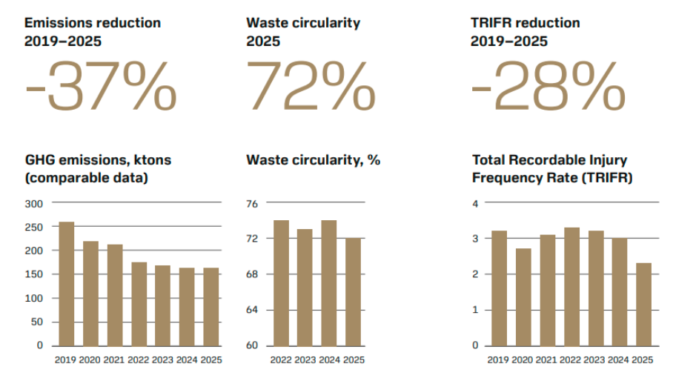
The engineering company exceeded its 2025 greenhouse gas emissions reduction target by cutting Scope 1 and Scope 2 emissions by 37 percent from the 2019 baseline, well ahead of its original goal of 25 percent. At the same time, Sandvik continued investing in battery-electric mining equipment, automation, digital technologies and circular business models to help customers lower emissions and improve resource efficiency.
Sandvik strengthens sustainability governance
Sandvik has embedded sustainability into its long-term business strategy under the leadership of Björn Roodzant, Executive Vice President and Head of Group Communications and Sustainability, together with Mats W. Lundberg, Head of Sustainability.
Sandvik advances toward net zero by 2050
Sandvik continues to align its climate strategy with the Science Based Targets initiative (SBTi) and remains committed to achieving net-zero greenhouse gas emissions across Scopes 1, 2 and 3 by 2050, Sandvik Sustainability Report 2025 indicated.
Its long-term climate targets include:
Reduce Scope 1 and Scope 2 emissions by 50 percent by 2030.
Reduce Scope 1 and Scope 2 emissions by 90 percent by 2040.
Reduce Scope 3 emissions by 30 percent by 2030, covering customers, suppliers and transportation.
Achieve net-zero greenhouse gas emissions across the value chain by 2050.
The company surpassed its previous objective of reducing Scope 1 and Scope 2 emissions by 25 percent by 2025, recording a 37 percent reduction compared with 2019.
Greenhouse gas emissions fall 37 percent
Sandvik reported Scope 1 and Scope 2 greenhouse gas emissions of 162.6 thousand tonnes CO₂e (162,558 tonnes) in 2025, compared with 162.4 thousand tonnes CO₂e in 2024.
The reduction from the 2019 baseline was achieved through improved energy efficiency, greater use of renewable fuels and wider adoption of fossil-free electricity across operations.
Scope 3 emissions remained broadly stable despite continued business expansion. Around 20 percent of Scope 3 emissions originate from suppliers, prompting Sandvik to strengthen supplier engagement and encourage adoption of science-based emissions reduction targets.
Product innovation tackles the largest source of emissions
Sandvik identified the use phase of its products as responsible for approximately 65 to 70 percent of its total carbon footprint, making product innovation its biggest opportunity to reduce customer emissions.
To address this, the company continued investing in:
Battery-electric mining equipment
Energy-efficient rock processing technologies
Mining automation systems
Digital software that reduces energy consumption
Resource-efficient machining solutions
The report also highlights Sandvik’s largest-ever order for battery-electric mining equipment, reinforcing electrification as a major growth area.
Renewable energy investments continue
While Sandvik did not disclose a company-wide renewable electricity percentage or installed renewable energy capacity, it continued investing in electrification, fossil-free electricity and energy-efficient technologies throughout its operations.
The company stated that renewable energy procurement figures were not disclosed in the 2025 report.
Digital business reaches SEK 5.5 billion
Digital transformation remained a key growth driver during 2025.
Sandvik generated SEK 5.5 billion in digital revenue and is targeting SEK 13 billion in digital revenue by 2030.
Its digital platforms help customers improve machine utilization, optimize production, reduce downtime, lower energy consumption and minimize resource usage across manufacturing and mining operations.
The company also maintained research and development investment at approximately 4 percent of annual revenue, while 25 percent of total revenue came from products introduced during the previous five years.
Circular economy initiatives expand
Circularity remained central to Sandvik’s sustainability strategy.
Waste circularity reached 72 percent in 2025 compared with 74 percent in 2024, while the previous target for 2025 was 80 percent.
The company is now working toward 90 percent waste circularity by 2030 through expanded recycling, material recovery and product life extension.
Major initiatives include:
Recovery of tungsten and carbide from used cutting tools
Buyback programs for used materials
Product reconditioning services
Battery-electric mining vehicles
Software that improves resource efficiency
These circular business models reduce dependence on virgin raw materials while lowering waste generation across the value chain.
Workplace safety reaches record performance
Sandvik achieved its strongest workplace safety performance to date.
The Total Recordable Injury Frequency Rate (TRIFR) improved to 2.3, an all-time low and 28 percent lower than the 2019 baseline.
The company had originally targeted a TRIFR of 2.7 for 2025 and has established a new 2030 target of 2.1 under its updated sustainability strategy.
Safety improvements were supported through leadership engagement, employee training, operational excellence and proactive risk management.
Sustainability commitments
Sandvik continues to strengthen its sustainability credentials through internationally recognized frameworks and reporting standards.
Key commitments include:
Science Based Targets initiative (SBTi)-validated climate targets
Net-zero greenhouse gas emissions by 2050
Signatory to the UN Global Compact since 2013
Environmental disclosure through CDP
Annual sustainability assessment through EcoVadis
Sustainability reporting aligned with ESRS and CSRD
Outlook
Sandvik’s Sustainability Report 2025 highlights measurable progress across climate action, digital transformation, circular economy and operational safety. The company exceeded its near-term emissions target with a 37 percent reduction in Scope 1 and Scope 2 emissions, generated SEK 5.5 billion in digital revenue, maintained 4 percent R&D investment, derived 25 percent of revenue from recently launched products, and continued advancing circular business models and electrification technologies. Supported by strong governance and SBTi-approved climate targets, Sandvik is positioning itself to achieve net-zero emissions by 2050 while delivering engineering solutions that improve productivity, resource efficiency and sustainability across the mining, manufacturing and infrastructure industries.
SHAFANA FAZAL
