
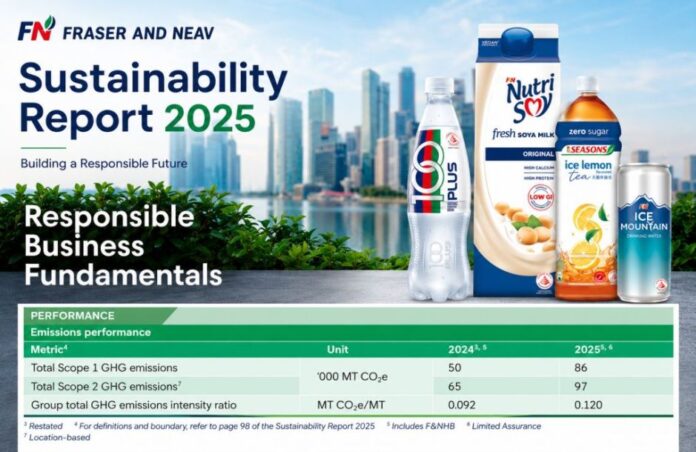
Fraser and Neave Holdings (F&N) has exceeded several of its sustainability goals ahead of launching a new FY2030 Sustainability Framework, delivering strong progress in climate action, renewable energy, circular economy initiatives, sustainable packaging, responsible sourcing, and ESG governance during FY2025.
The company’s sustainability agenda is overseen by the Sustainability Development Committee (SDC), chaired by Group CEO Lim Yew Hoe, ensuring ESG priorities remain integrated into corporate strategy and business operations. To strengthen accountability, F&N links sustainability performance indicators to executive remuneration, with ESG metrics contributing between 5 percent and 10 percent of annual performance assessments.
Climate action remained a major focus area throughout FY2025. F&N achieved a 17 percent reduction in greenhouse gas emissions intensity compared with its 2020 baseline, more than doubling its original target of 8 percent. The reduction was driven by renewable energy deployment, energy-efficiency improvements, and operational optimization projects across manufacturing facilities, Fraser and Neave Sustainability Report 2025 indicated.
The company also reduced logistics-related emissions through a digital raw milk collection routing platform that shortened transportation distances and eliminated more than 200,000 kilograms of carbon dioxide emissions annually. F&N continues to align its climate strategy with the SSP1-2.6 low-carbon pathway while supporting the broader net-zero by 2050 commitment of parent company Thai Beverage Public Company Limited.
Renewable energy investments delivered further environmental benefits. During FY2025, F&N added 6.38 MWp of rooftop solar photovoltaic capacity through installations at key manufacturing facilities. New solar systems were completed at two manufacturing plants in Shah Alam, while development work progressed at three facilities in Rawang.
The company reported that its solar energy projects prevented approximately 12,350 metric tonnes of carbon dioxide equivalent emissions during the year. Combined with energy-efficiency initiatives, these efforts contributed to a 3 percent reduction in energy intensity compared with the 2020 baseline.
F&N also continued integrating climate considerations into investment decisions through its Internal Carbon Pricing framework. The company applies a shadow carbon price of SGD 35 per metric tonne of carbon dioxide equivalent in its capital expenditure approval process, helping direct investments toward energy-efficient technologies and lower-carbon infrastructure.
The company achieved substantial progress in waste reduction and circular economy performance. Waste sent to landfill declined by 66 percent compared with the 2020 baseline, significantly outperforming its original target. Several operating facilities achieved waste diversion rates of up to 95 percent through recycling, recovery, and resource utilization programs.
Sustainable packaging initiatives also exceeded expectations. By the end of FY2025, 99 percent of packaging materials used across the business were recyclable. In addition, recycled content in beverage and dairy packaging increased to 29 percent, surpassing the company’s target of 25 percent and reducing reliance on virgin materials.
Responsible sourcing performance reached a major milestone with 100 percent compliance among active key suppliers with F&N’s Supplier Code of Conduct. The achievement strengthens environmental, social, and ethical standards throughout the company’s supply chain and supports broader sustainability objectives.
ESG transparency also improved as F&N began aligning its sustainability disclosures with IFRS Sustainability Disclosure Standards IFRS S1 and IFRS S2. The initiative enhances reporting on sustainability-related risks, opportunities, governance practices, and climate-related performance while preparing the company for future regulatory requirements.
On the social front, female representation in management positions reached 47 percent, reflecting continued progress in diversity and inclusion. The company also maintained 100 percent retention of FSSC 22000 and Halal certifications across all processing facilities in Malaysia, Singapore, and Thailand, reinforcing its commitment to food safety and product quality.
F&N’s sustainability achievements received external recognition. F&NHB improved its S&P Global Corporate Sustainability Assessment score to 77 out of 100, positioning the company among the leading performers in the global beverages industry. The company also received the Gold Award for Consumer Products at The Edge ESG Awards 2025 and saw F&N Foods Pte Ltd recognized among Singapore’s Best Employers 2025.
Following the successful completion of its FY2025 sustainability targets, F&N conducted a comprehensive double materiality assessment to evaluate sustainability impacts and climate-related financial risks. The findings will guide the company’s upcoming FY2030 Sustainability Framework and future priorities in climate action, renewable energy, sustainable packaging, circular economy practices, responsible sourcing, and social impact.
F&N’s FY2025 sustainability performance highlights include a 17 percent reduction in greenhouse gas emissions intensity against a 2020 baseline, exceeding its original 8 percent target; elimination of more than 200,000 kilograms of carbon dioxide emissions annually through logistics optimization; installation of 6.38 MWp of rooftop solar capacity across two Shah Alam facilities and three Rawang sites; avoidance of approximately 12,350 metric tonnes of carbon dioxide equivalent emissions; a 3 percent reduction in energy intensity; application of an internal carbon price of SGD 35 per metric tonne of carbon dioxide equivalent; a 66 percent reduction in landfill waste; waste diversion rates of up to 95 percent; 99 percent recyclable packaging; 29 percent recycled content in packaging against a 25 percent target; 100 percent supplier compliance with the Supplier Code of Conduct; ESG-linked remuneration of 5 percent to 10 percent; 47 percent female representation in management; 100 percent retention of food safety and Halal certifications; and an S&P Global CSA score of 77 out of 100. These achievements provide a strong foundation for F&N’s next phase of sustainable growth under its FY2030 Sustainability Framework.
SHAFANA FAZAL
