
Constellium strengthened its position as a leader in sustainable aluminum production during 2025 through major advances in renewable energy adoption, emissions reduction, recycling expansion, and low-carbon manufacturing technologies. The company exceeded key sustainability-linked bond targets ahead of schedule while making significant progress toward its 2030 climate objectives.
“This year’s upgrade to a B rating from the Carbon Disclosure Project acknowledges our progress and strengthens our credibility with customers, partners, and stakeholders,” Ingrid Joerg, CEO of Constellium, said.
Under the leadership of Catherine Athènes, Vice President of Group Sustainability, Constellium continued to integrate environmental responsibility across its operations, supply chain, and product development activities. The company’s sustainability strategy focuses on decarbonization, circular economy initiatives, renewable energy procurement, and responsible sourcing to support growing demand for low-carbon aluminum solutions.
Carolina Specht, Sustainability and Life Cycle Assessment Engineer at Constellium, said: “Currently, we are developing foundational LCA models for all Constellium plants. These models, which also evaluate impacts beyond carbon footprint, become powerful decision-making tools.”
Constellium Surpasses Sustainability Targets Ahead of Schedule
One of the most significant achievements in 2025 was Constellium’s ability to outperform its sustainability-linked bond commitments. Constellium reported annual revenue of $8.4 billion and Capex of $310 million in 2025.
The company reduced its Scope 1 and Scope 2 greenhouse gas emissions intensity to 0.57 metric tons of CO2-equivalent per metric ton shipped, exceeding its target of 0.615 mt CO2eq/mt. This represented a 14 percent reduction compared with 2024 and a 19 percent reduction versus the 2021 baseline.
Recycled aluminum input increased to approximately 717,000 metric tons, surpassing the company’s 2026 recycling target one year early. Recycled material accounted for 47 percent of total metal input, up 13 percent from 2024, placing Constellium close to its goal of sourcing 50 percent of metal input from recycled content by 2030, Constellium Sustainability Report 2025 indicated.
Renewable Energy Procurement Drives Decarbonization
Renewable electricity became a major contributor to Constellium’s improved environmental performance in 2025.
The company procured nearly 400 GWh of renewable electricity, covering approximately 26 percent of its annual electricity consumption across global operations. This renewable energy strategy significantly reduced Scope 2 emissions and was identified by CEO Ingrid Joerg as the primary driver behind the company’s improved carbon performance.
The increased use of renewable electricity helped Constellium achieve substantial reductions in greenhouse gas emissions while strengthening the resilience of its manufacturing network against future energy market volatility.
Emissions Intensity Falls Across Scope 1, 2 and 3
Constellium reported strong progress across all major emissions categories.
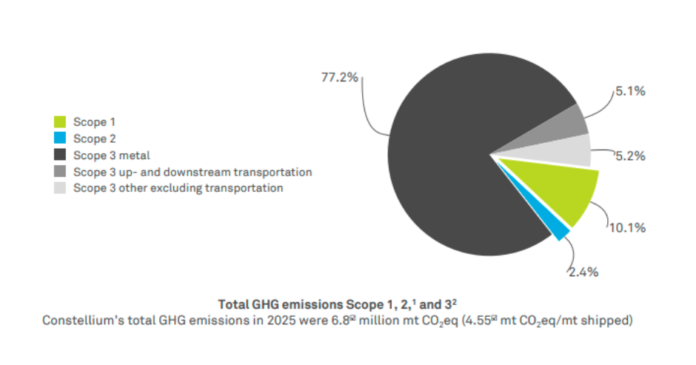
The company’s combined Scope 1, 2 and 3 emissions intensity declined by 16 percent year-over-year and was 10 percent below the 2021 baseline, reaching 4.55 mt CO2eq per metric ton of product shipped.
Scope 1 emissions intensity improved by 2.3 percent compared with 2024, supported by energy-efficiency projects and operational improvements. The company’s Muscle Shoals facility in Alabama reduced its Scope 1 emissions intensity by 14 percent, benefiting from record production levels combined with dedicated energy-saving measures.
Scope 3 emissions intensity also improved by 16 percent, largely driven by higher recycled content and reduced reliance on coal-based primary aluminum suppliers. These improvements helped lower upstream supply chain emissions, which remain the largest component of Constellium’s overall carbon footprint.
The company has maintained its goal of achieving a 30 percent reduction in Scope 1 and 2 emissions intensity and a 30 percent reduction in Scope 1, 2 and 3 emissions intensity by 2030 compared with 2021 levels.
Industrial Electrification Supports Low-Carbon Manufacturing
Constellium is investing in next-generation technologies to accelerate decarbonization of energy-intensive aluminum production.
The company is collaborating with PyroGenesis to evaluate plasma torch technology as a replacement for conventional natural gas burners. The technology can potentially reduce furnace emissions by up to two-thirds while being integrated into existing production infrastructure.
Constellium is also advancing hydrogen-oxygen combustion technology through the EU-funded HyInHeat project, which aims to replace natural gas with green hydrogen in industrial metal transformation processes. These initiatives support the company’s long-term vision of fossil fuel-free aluminum production.
Recycling Expansion Strengthens Circular Economy Leadership
Recycling remains central to Constellium’s sustainability strategy because recycled aluminum requires significantly less energy than primary aluminum production.
A key driver of growth in 2025 was the expansion of the company’s advanced recycling center in Neuf-Brisach, France. The facility helped increase recycled metal input by 13 percent year-over-year and supported record recycling volumes.
The company’s growing recycling capacity enables greater recovery of aluminum scrap while producing high-quality recycled products for demanding automotive, aerospace, packaging, and industrial applications.
Closed-Loop Recycling Partnerships Advance Sustainability
Constellium continued expanding closed-loop recycling programs across major industries.
In the automotive sector, the company completed the ISA3 research initiative alongside Renault Group, ESI Group, and the University of Lorraine. The project focused on lightweight aluminum design while increasing recovery and reuse of manufacturing scrap.
Within aerospace, Constellium partnered with TARMAC Aerosave to validate recycling of aluminum recovered from retired aircraft. The initiative demonstrated the potential to transform end-of-life aircraft materials into new flight-ready aluminum while reducing energy use and CO2 emissions by 95 percent compared with primary production methods.
Safety Performance Remains Strong
Employee safety remains a critical pillar of Constellium’s sustainability framework.
The company reported a Recordable Case Rate of 1.91 per million hours worked in 2025, significantly outperforming industry averages in North America and Europe. Several manufacturing sites operated for more than two years without recording a single reportable incident.
Constellium’s focus on employee well-being, operational risk management, and safety culture continues to support long-term business resilience and sustainability performance.
ESG Recognition Highlights Progress
Constellium’s sustainability achievements were recognized by several independent organizations during 2025.
The company improved its Carbon Disclosure Project (CDP) climate rating to B, reflecting stronger environmental performance and disclosure practices. Constellium also maintained independent verification of key sustainability indicators under the ISAE 3000 (Revised) framework and continued active participation in the Aluminium Stewardship Initiative to advance responsible aluminum production standards.
Outlook for 2030
Constellium enters the next phase of its sustainability journey with strong momentum. By combining renewable energy procurement, industrial electrification, advanced recycling infrastructure, and collaborative supply chain initiatives, the company is building a more circular and lower-carbon aluminum ecosystem.
With nearly 400 GWh of renewable electricity, 717,000 metric tons of recycled aluminum input, 47 percent recycled content, 0.57 mt CO2eq/mt Scope 1 and 2 emissions intensity, and 4.55 mt CO2eq/mt total emissions intensity, Constellium has established a strong foundation for achieving its 2030 climate and circular economy targets while helping customers reduce their own carbon footprints.
SHAFANA FAZAL
