
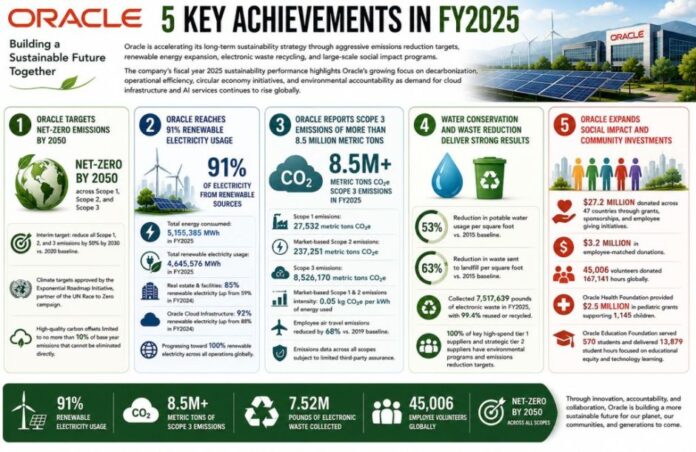
Oracle is accelerating its long-term sustainability strategy through aggressive emissions reduction targets, renewable energy expansion, electronic waste recycling, and large-scale social impact programs.
The company’s fiscal year 2025 sustainability performance highlights Oracle’s growing focus on decarbonization, operational efficiency, circular economy initiatives, and environmental accountability as demand for cloud infrastructure and AI services continues to rise globally.
Oracle Targets Net-Zero Emissions by 2050
Oracle has committed to achieving net-zero greenhouse gas emissions across Scope 1, Scope 2, and Scope 3 categories by 2050.
As part of its climate roadmap, the company established an interim target to reduce all Scope 1, 2, and 3 emissions by 50 percent by 2030 compared with its 2020 baseline.
Oracle said its climate targets are approved by the Exponential Roadmap Initiative, a partner of the UN Climate Change High-level Champions Race to Zero campaign.
The company also plans to limit the use of high-quality carbon offsets to no more than 10 percent of emissions from the base year that cannot be eliminated directly through operational improvements or renewable energy adoption.
Oracle Reaches 91 Percent Renewable Electricity Usage
Renewable energy expansion remains one of Oracle’s most significant sustainability achievements.
In fiscal year 2025, Oracle consumed 5,155,385 megawatt-hours of total energy, with 91 percent of electricity sourced from renewable energy.
Total renewable electricity usage reached 4,645,576 megawatt-hours during the year.
Oracle reported strong progress across both facilities and cloud operations. Renewable electricity usage across real estate and facilities increased to 85 percent in fiscal year 2025 from 59 percent in fiscal year 2024.
Renewable electricity usage within Oracle Cloud Infrastructure reached 92 percent, compared with 88 percent in fiscal year 2024.
The company continues progressing toward its long-term objective of sourcing 100 percent renewable electricity across all operations globally.
Oracle Reports Scope 3 Emissions of More Than 8.5 Million Metric Tons
Oracle’s emissions inventory follows the Greenhouse Gas Protocol Corporate Accounting methodology and includes both location-based and market-based reporting frameworks.
For fiscal year 2025, Oracle reported Scope 1 emissions of 27,532 metric tons of CO2 equivalent.
Market-based Scope 2 emissions totaled 237,251 metric tons of CO2 equivalent.
Total Scope 3 emissions reached 8,526,170 metric tons of CO2 equivalent. Oracle attributed the increase largely to improved reporting methodologies, more accurate emissions factors, and the addition of new Scope 3 categories.
The company reported a market-based Scope 1 and Scope 2 emissions intensity of 0.05 kilograms of CO2 equivalent per kilowatt-hour of energy used.
Oracle also reduced employee air travel emissions by 68 percent compared with its 2019 baseline.
To ensure reporting transparency, Oracle subjects emissions data across all scopes to limited third-party assurance.
Water Conservation and Waste Reduction Deliver Strong Results
Oracle continued improving operational resource efficiency across its facilities.
The company achieved a 53 percent reduction in potable water usage per square foot relative to its 2015 baseline.
Waste management initiatives also delivered strong results, with Oracle reducing waste sent to landfill per square foot by 63 percent compared with 2015 levels.
Electronic waste management remains another major focus area. Oracle collected 7,517,639 pounds of electronic waste during fiscal year 2025, with 99.4 percent of the material reused or recycled.
The company also confirmed that 100 percent of key high-spend tier 1 suppliers and strategic tier 2 suppliers have environmental programs and emissions reduction targets in place.
Oracle Expands Social Impact and Community Investments
Oracle increased investments in philanthropy, employee volunteering, healthcare support, and education programs during fiscal year 2025.
The company donated $27.2 million across 47 countries through grants, sponsorships, and employee giving initiatives.
Employee-matched donations reached $3.2 million during the year.
Oracle employees also contributed significant volunteer support, with 45,006 volunteers donating 167,141 hours globally.
The Oracle Health Foundation provided $2.5 million in pediatric grants supporting 1,145 children.
In education, the Oracle Education Foundation served 570 students and delivered 13,879 student hours focused on educational equity and technology learning opportunities.
Oracle Strengthens Sustainability Accountability
Oracle said its sustainability roadmap combines operational efficiency, renewable energy adoption, responsible supply chain management, and transparent climate reporting to support long-term environmental goals.
Although Oracle introduced updated Scope 3 methodologies and emissions factors in fiscal year 2025, the company has not yet adjusted its 2020 baseline but indicated it may evaluate future recalibration. With 91 percent renewable electricity usage, more than 8.5 million metric tons of Scope 3 emissions tracked, nearly 7.52 million pounds of electronic waste collected, and a long-term net-zero target for 2050, Oracle is positioning sustainability as a central component of its global cloud and enterprise technology strategy.
FASNA SHABEER
