
Germany has reduced liquefied natural gas (LNG) import costs by approximately €1.3 billion over the past three years, driven by the rapid deployment of residential heat pumps, according to the Institute for Energy Economics and Financial Analysis (IEEFA).
Between 2022 and 2025, nearly 1.1 million heat pumps were installed across German households, replacing conventional gas boilers and directly lowering gas demand. This large-scale electrification of heating has enabled Germany to avoid a projected 16 percent increase in LNG imports, highlighting how demand-side transformation can deliver immediate financial and strategic benefits.
Unlike temporary demand reductions driven by price shocks or mild winters, heat pump adoption represents a structural shift. Once installed, these systems permanently reduce fossil fuel consumption, ensuring long-term savings on LNG imports while supporting decarbonization goals.
Structural Decline in Gas Demand Reshapes Energy Security
Germany’s energy system is undergoing a fundamental transformation as electrification reduces reliance on imported fuels. The residential heating sector, historically one of the largest consumers of natural gas, is now at the center of this transition, Ana Maria Jaller-Makarewicz said in the IEEFA report.
Lower gas demand is improving energy security by reducing exposure to global LNG price volatility and geopolitical risks. The country’s experience since the 2022 energy crisis has demonstrated that reducing consumption can be as impactful as securing new supply sources.
This shift also enhances system resilience. Electrified heating, when combined with renewable power generation, reduces dependence on global fuel supply chains and creates a more domestically controlled energy ecosystem.
LNG Companies Expand Presence Amid Changing Demand Outlook
Despite declining long-term gas demand, major energy companies continue to expand their LNG footprint in Germany, reflecting the need for short-term supply security.
Key players such as Uniper and RWE are actively investing in LNG infrastructure and securing long-term supply agreements. These companies have repositioned themselves after the disruption of Russian gas supplies, pivoting toward global LNG markets to ensure continuity of supply.
International suppliers, including Equinor, are strengthening their role in Europe’s gas supply chain, while industrial giants like BASF are locking in regasification capacity to safeguard energy-intensive operations.
At the same time, U.S.-based exporters such as Venture Global LNG are increasing shipments to Europe, capitalizing on strong demand and long-term contracts. This growing ecosystem of suppliers and buyers underscores the continued importance of LNG in the near term, even as structural demand declines.
Multi-Billion Euro LNG Infrastructure Investment Wave
Germany has undertaken one of the fastest LNG infrastructure build-outs in Europe. This includes both floating storage and regasification units (FSRUs) and permanent onshore terminals designed to handle large-scale imports.
Flagship projects such as the Wilhelmshaven LNG Terminal have already become operational, serving as critical entry points for global LNG supplies. Additional projects, including the Brunsbüttel LNG Terminal and the Hanseatic Energy Hub, are expected to further expand capacity over the next few years.
These investments, collectively worth billions of euros, are supported by public funding, private capital, and international partnerships. They are designed to replace lost pipeline gas imports and ensure supply diversification.
However, the scale and speed of these investments have also raised concerns about future utilization rates, particularly as demand continues to decline due to electrification and efficiency improvements.
US LNG Dominance and Emerging Supply Risks
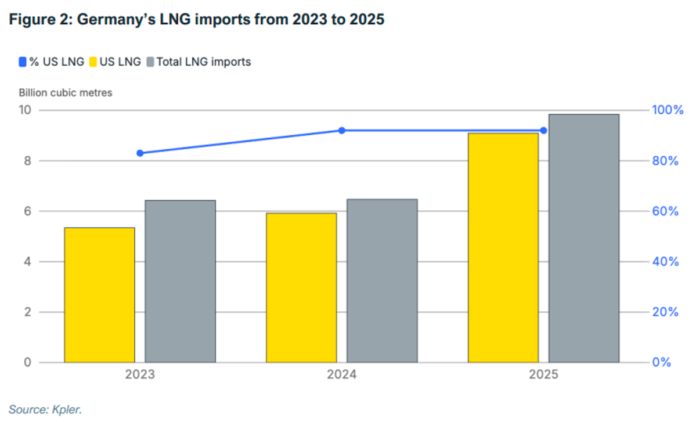
Germany’s LNG supply mix has shifted dramatically, with the United States emerging as the dominant supplier. This transformation reflects both geopolitical realignment and the flexibility of LNG markets.
While reliance on U.S. LNG has improved supply security in the short term, it also introduces new dependencies. Prices are increasingly linked to global LNG market dynamics, and competition for cargoes—especially from Asia—can drive volatility.
This evolving supply landscape highlights the trade-offs between diversification and dependency, as Germany replaces one dominant supplier with another, albeit within a more flexible global market structure.
Carbon Capture Faces Economic and Scalability Risks
While carbon capture and storage (CCS) is often promoted as a solution to reduce emissions from gas usage, the Institute for Energy Economics and Financial Analysis highlights significant economic and technical risks associated with its deployment in Germany.
CCS remains capital-intensive, requiring substantial investment in capture facilities, transport infrastructure, and long-term storage. These added costs increase the overall price of gas-based energy, making it less competitive compared to electrification technologies such as heat pumps.
In addition, CCS faces scalability challenges. Large-scale deployment depends on extensive pipeline networks and suitable geological storage sites, both of which are limited. Long development timelines further delay its contribution to emissions reduction, reducing its effectiveness in meeting near- and mid-term climate targets.
Another critical issue is efficiency loss. Capturing, transporting, and storing carbon dioxide consumes additional energy, creating an “energy penalty” that reduces system efficiency and increases operational costs.
From an investment perspective, CCS also risks locking in gas infrastructure. If deployment fails to scale or remains uneconomical, these investments could become stranded assets in a rapidly decarbonizing energy market.
External Industry Trend: Electrification Challenges LNG Growth
Germany’s experience is part of a broader European and global trend where electrification technologies are beginning to erode long-term demand for natural gas.
The International Energy Agency has identified heat pumps as a cornerstone of the clean energy transition, capable of significantly reducing fossil fuel consumption in buildings. As adoption accelerates, the role of LNG in residential heating is expected to decline steadily.
This trend is creating a structural tension in energy markets. On one hand, countries are investing heavily in LNG infrastructure to ensure short-term energy security. On the other, electrification and renewables are reducing long-term demand, raising the risk of overcapacity.
Investment Trends: Capital Rotation Toward Clean Energy Technologies
A notable shift is underway in global energy investment patterns. Capital is increasingly flowing into clean technologies such as heat pumps, renewable energy, battery storage, and grid infrastructure.
These investments are driven not only by climate goals but also by economic considerations. Electrification technologies offer predictable operating costs, lower exposure to fuel price volatility, and long-term savings for consumers.
Germany’s €1.3 billion LNG savings illustrate how demand-side investments can deliver immediate financial returns, strengthening the case for scaling clean energy solutions.
At the same time, LNG investments continue to attract funding due to their role in ensuring reliability during the transition. This dual investment strategy reflects the complexity of balancing short-term energy needs with long-term sustainability goals.
Competitive Landscape: Europe Accelerates Clean Heating Deployment
Germany is part of a wider competitive push across Europe to scale clean heating technologies. Countries such as France, Italy, and Netherlands are expanding subsidies, tightening building regulations, and promoting heat pump adoption.
This competition is accelerating market growth, driving innovation, and reducing technology costs. As a result, heat pumps are becoming increasingly accessible to households and businesses, further accelerating the decline in gas demand.
Utilities and energy companies across Europe are also adapting their strategies, diversifying into renewable energy, electrification solutions, and energy services to remain competitive in a rapidly evolving market.
Risk Outlook: Overcapacity and Stranded LNG Assets
One of the key risks emerging from Germany’s current strategy is the potential for LNG overcapacity. If gas demand declines faster than expected, newly built terminals and long-term contracts could become underutilized.
This raises the possibility of stranded assets—investments that fail to deliver expected returns due to structural market changes. For investors and policymakers, this underscores the importance of aligning infrastructure development with realistic demand projections.
The experience of underutilized terminals in parts of Europe already signals that this risk is not theoretical but increasingly tangible.
Outlook: Heat Pumps Signal a Long-Term Shift Away from LNG
Germany’s €1.3 billion savings from heat pump adoption mark more than a short-term cost reduction—they signal a long-term transformation in the energy system.
Electrification of heating, combined with renewable energy expansion, is emerging as a more sustainable and economically viable alternative to fossil fuel dependence. While LNG will remain important in the near term, its role is likely to diminish over time as clean technologies scale.
The key challenge for Germany will be managing this transition effectively—ensuring energy security through LNG in the short term while avoiding overinvestment that could hinder long-term decarbonization.
Ultimately, the balance between LNG infrastructure and electrification will determine the pace and success of Germany’s energy transition, with heat pumps already proving to be a critical catalyst for change.
FASNA SHABEER
