
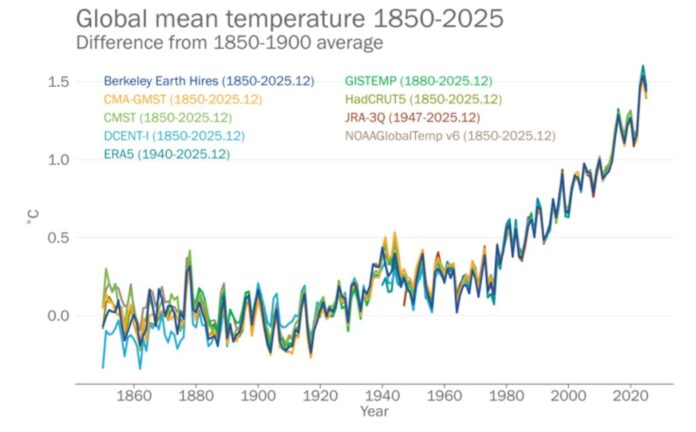
The latest State of the Global Climate 2025 report by the World Meteorological Organization (WMO) paints a stark picture of accelerating climate change, confirming that the period from 2015 to 2025 represents the 11 hottest years ever recorded. The year 2025 ranked as the second or third warmest, with global temperatures reaching approximately 1.43°C above pre-industrial levels (1850–1900).
Rising Temperatures and Intensifying Extreme Weather
The report highlights a steady and alarming rise in global temperatures driven by greenhouse gas emissions. Despite the temporary cooling influence of La Niña conditions, 2025 remained among the hottest years ever observed, while 2024 holds the record at about 1.55°C above pre-industrial levels.
Extreme weather events intensified worldwide in 2025, including:
Severe heatwaves and wildfires
Intense rainfall and flooding
Strong tropical cyclones and storms
These events caused thousands of deaths, displaced millions, and triggered billions in economic losses, exposing the vulnerability of interconnected global economies.
Ocean Warming and Energy Imbalance Reach Critical Levels
A key highlight of the 2025 report is the inclusion of Earth’s energy imbalance as a major climate indicator. This imbalance occurs when more energy from the sun is retained in the Earth system due to rising greenhouse gases.
Over 91 percent of excess heat is absorbed by oceans
Ocean heat content reached a new record high in 2025
The rate of ocean warming has more than doubled since 2005
The ocean has absorbed energy equivalent to around 18 times annual human energy consumption each year over the past two decades, acting as a buffer but also accelerating long-term climate risks.
Sea Level Rise, Ice Loss and Glacier Retreat Accelerate
The warming oceans and melting ice sheets are driving a continuous rise in global sea levels:
Sea levels are now about 11 cm higher than in 1993
Arctic sea ice reached its lowest or second lowest extent on record
Antarctic sea ice recorded its third lowest level
Glacier mass loss remains among the worst ever recorded
Ice sheets in Greenland and Antarctica continue to lose mass, contributing to long-term and largely irreversible sea-level rise.
Greenhouse Gas Concentrations Hit Historic Highs
The report confirms that atmospheric concentrations of key greenhouse gases – carbon dioxide, methane and nitrous oxide – have reached unprecedented levels:
CO2 levels are the highest in at least 2 million years
Methane and nitrous oxide are at their highest in 800,000 years
The annual increase in CO2 in 2024 was the largest since 1957
These gases are the primary drivers disrupting Earth’s natural energy balance, leading to sustained global warming.
Ocean Acidification and Ecosystem Risks Intensify
Oceans absorbed approximately 29 percent of human-generated CO2 emissions between 2015 and 2024, resulting in declining pH levels.
Ocean surface pH is at its lowest in at least 26,000 years
Acidification threatens marine biodiversity
Fisheries and shellfish production face growing risks
This chemical shift in oceans has long-term implications for food security and marine ecosystems.
Climate Impacts on Health, Food Security and Displacement
The report also highlights the growing human cost of climate change, linking environmental shifts to health and social impacts.
World Health Organization warns that dengue is now the fastest-growing mosquito-borne disease, with half the global population at risk
Around 1.2 billion workers face heat-related risks annually
Climate change is increasing food insecurity and displacement
Extreme weather events are creating cascading crises, particularly in vulnerable and conflict-affected regions.
Urgent Need for Climate Action and Early Warning Systems
According to Celeste Saulo, human activities are disrupting Earth’s equilibrium with consequences that will last for centuries. The report emphasizes the importance of:
Early warning systems for extreme weather and heat
Integration of climate data into health systems
Stronger global coordination on climate mitigation and adaptation
The findings align with assessments by the Intergovernmental Panel on Climate Change, which warn that many climate changes, particularly ocean warming and acidification, are irreversible on centennial to millennial timescales.
Climate Emergency Demands Immediate Global Response
The 2025 climate report delivers a clear message: climate change is accelerating, and delay in action will have severe consequences. With every major indicator worsening – from temperature and sea levels to ocean heat and greenhouse gases – the world faces a narrowing window to limit long-term damage.
As global leaders mark World Meteorological Day under the theme “Observing Today, Protecting Tomorrow,” the report serves as both a scientific assessment and a call to decisive action to safeguard future generations.
BABURAJAN KIZHAKEDATH
