
The 2025 sustainability report from Volvo Group outlines a decisive shift toward a low-carbon future, positioning the company as a key player in the decarbonization of heavy-duty transport and infrastructure.
As regulatory pressure and customer expectations intensify worldwide, Volvo is aligning its business strategy with climate goals by scaling electromobility, advancing circular manufacturing, and strengthening governance frameworks. The report reflects how industrial leaders can combine financial performance with sustainability priorities in the global energy transition.
Integrated Value Creation Across the Transport Ecosystem
Sustainability is embedded across Volvo’s value chain, starting with evolving customer demand for cleaner and more efficient transport solutions. This demand directly shapes product development, manufacturing processes, and service offerings.
The Group’s ecosystem includes retail services, maintenance, and financing through Volvo Financial Services, alongside a global network of suppliers and production facilities. This integrated approach enables Volvo to co-create value with customers by delivering reliable, high-performance vehicles that reduce environmental impact while improving uptime and operational efficiency.
Stakeholders across the ecosystem benefit from this model. Customers gain from improved vehicle lifecycle performance and lower emissions. Shareholders see stable returns supported by long-term investments in innovation. Employees are supported through inclusive workplace policies and competitive benefits, while society benefits from job creation, infrastructure development, and tax contributions. Continuous reinvestment in research, development, and industrial assets ensures sustained competitiveness.

Net-Zero Ambition and Carbon Reduction Strategy
Volvo Group remains committed to achieving net-zero value chain emissions by 2040, aligned with the Science Based Targets initiative and the 1.5 degree Celsius target.
A major focus in 2025 has been reducing Scope 3 emissions, which account for the majority of the company’s carbon footprint, primarily from the use of sold vehicles. Increased deployment of battery-electric trucks, including models like the FH Electric, has contributed to measurable reductions in fleet emissions.
The company is also accelerating development of hydrogen fuel cell technologies and promoting renewable fuels as transitional solutions for long-haul transport. Partnerships with infrastructure providers are expanding high-power charging networks, addressing one of the biggest barriers to large-scale electric vehicle adoption.
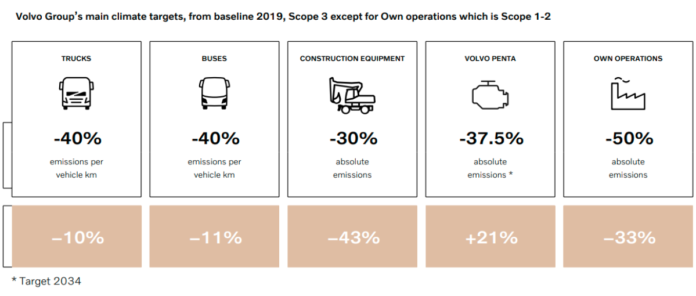
Volvo Group’s climate performance shows mixed progress when compared with its 2034 targets, with some areas advancing well while others lag behind.
In trucks and buses, the company has achieved emissions reductions of about 10 percent and 11 percent, respectively, against a target of 40 percent reduction per vehicle km. This indicates steady but still early-stage progress, with a significant gap remaining to meet long-term goals.
The construction equipment segment stands out as a strong performer. Volvo has already delivered a 43 percent reduction in absolute emissions, surpassing its 30 percent target, suggesting that decarbonization initiatives in this segment are ahead of schedule.
In contrast, Volvo Penta is moving in the opposite direction. Instead of reducing emissions, it has recorded a 21 percent increase, diverging substantially from its 37.5 percent reduction target, highlighting a key challenge area for the company.
For own operations, Volvo has achieved a 33 percent reduction in emissions, progressing toward its 50 percent reduction target. While this reflects meaningful improvement, additional efforts will be required to close the remaining gap.
Advancing Energy Efficiency in Manufacturing
Operational efficiency improved significantly across Volvo’s manufacturing footprint in 2025. Under its World Class Manufacturing program, a large share of production facilities now operate on fossil-free electricity, particularly in Europe and North America.
The company has implemented advanced energy-saving technologies, including AI-driven heating and cooling systems and heat recovery processes in energy-intensive operations such as foundries. Improvements in paint shop efficiency and compressed air systems have further reduced energy consumption per unit produced.
Volvo is also investing in on-site renewable energy generation, including solar installations at logistics and distribution centers. These initiatives not only reduce emissions but also enhance resilience against energy price volatility.
Circular Economy and Waste Reduction Initiatives
Circularity remains central to Volvo’s resource strategy. Through its remanufacturing business, Volvo Reman, the company restores used components such as engines and gearboxes to original standards. This process uses significantly less energy compared to producing new components and reduces industrial waste.
The Group has expanded its Zero Waste to Landfill initiatives across manufacturing sites, achieving high recycling rates through partnerships and advanced material sorting systems. Scrap materials including metals, plastics, and wood are increasingly reused as secondary raw materials.
In electromobility, Volvo is developing systems for second-life battery applications, particularly in stationary energy storage. Recycling programs are also being strengthened to recover critical materials such as lithium, cobalt, and nickel, supporting long-term supply chain sustainability.
Workforce Transformation and Social Responsibility
To support the transition to electric and digital technologies, Volvo is investing heavily in workforce development. Training programs focus on electric drivetrains, software capabilities, and safety protocols for high-voltage systems.
The company continues to promote diversity and inclusion, with initiatives aimed at increasing female representation in leadership and technical roles. At the same time, Volvo’s Zero Accidents vision is being advanced through the integration of advanced driver assistance systems and autonomous technologies.
Measurable Progress and ESG Reporting Standards
Volvo’s sustainability reporting aligns with global frameworks such as the Global Reporting Initiative and the Task Force on Climate-related Financial Disclosures, ensuring transparency and comparability.
Key performance indicators for 2025 show steady progress in reducing carbon emissions and increasing the share of renewable energy across business units, including construction equipment and marine solutions.
By integrating climate risks into financial planning and investment strategies, Volvo is building resilience against regulatory changes and market shifts expected in 2026 and beyond.
Conclusion: Scaling Sustainable Industrial Leadership
The 2025 report demonstrates how Volvo Group is transitioning from traditional manufacturing to a sustainable, innovation-driven industrial model. By combining electrification, circular economy practices, and strong governance, the company is not only reducing its environmental impact but also securing long-term growth in a rapidly evolving global transport landscape.
FASNA SHABEER
