
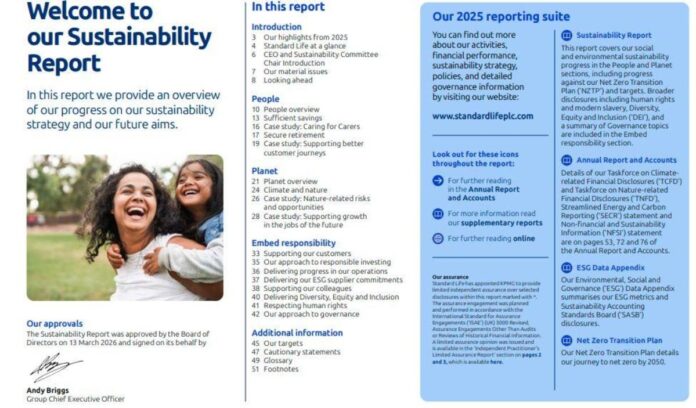
The Sustainability Report 2025 from Standard Life presents a comprehensive strategy focused on long-term financial security while addressing climate change and nature-related risks. Built around the pillars of People, Planet, and Embed Responsibility, the company integrates ESG principles into its pension and savings offerings, aligning customer outcomes with environmental sustainability.
Net Zero Strategy and Investment Scale
Standard Life, as part of its sustainability goals, is targeting net zero emissions across investments, operations, and supply chain by 2050, supported by a 2030 goal to reduce investment portfolio carbon intensity by 50 percent from a 2019 baseline. The company aims to deliver around 7 percent annual reductions in portfolio emissions intensity.
The scale of this strategy is significant. The firm manages about $39 billion in its Sustainable Multi Asset default workplace solution, serving around 2 million customers. Additionally, $74 billion in assets are aligned with climate-focused benchmarks and decarbonisation strategies.
The company confirmed that it met its 2025 interim targets for both investment portfolios and operational emissions, indicating steady progress toward its long-term goals.
Strong Portfolio Decarbonisation Performance
One of the standout achievements is in investment portfolio emissions. Standard Life targeted a 25 percent reduction in emissions intensity for listed equity and credit investments by 2025 but delivered a 58 percent reduction, more than double the target.
This performance reflects the company’s use of climate transition strategies and increased allocation toward businesses aligned with Science Based Targets.
Operational Emissions and Renewable Energy Achievements
Operational sustainability also shows strong results. Scope 1 and Scope 2 emissions declined by 12 percent year-on-year in 2025, while emissions intensity per employee improved from 0.34 tCO2e to 0.28 tCO2e.
Since 2019, overall emissions intensity has dropped by 84 percent, placing the company within its target reduction range of 75 percent to 85 percent. Absolute operational emissions have been reduced by 81 percent, with the business now effectively carbon neutral in its direct operations.
A key driver has been the adoption of 100 percent renewable electricity for all directly procured power, resulting in zero market-based Scope 2 emissions.
Scope 3 Emissions and Value Chain Challenges
Despite strong operational performance, Scope 3 emissions remain more complex. Certain categories increased, with Category 13 emissions rising by 1.4 percent and Category 8 emissions increasing by 11 percent due to business changes.
However, targeted initiatives are delivering results in specific areas, such as a 19.7 percent reduction in business travel emissions. The company is also strengthening supplier requirements, with 100 percent of strategic suppliers now required to report Scope 1 and Scope 2 emissions and demonstrate formal inclusion policies.
Customer Engagement and Digital Performance
Customer engagement remains central to Standard Life’s sustainability strategy. Customers accessed the company’s mobile app more than 21 million times in 2025, while digital service satisfaction reached 93 percent.
Customer preferences are increasingly aligned with ESG priorities, with 88 percent focusing on pension growth, 83 percent seeking to avoid harm in investments, and 47 percent identifying climate change as the most important ESG issue.
Data Transparency and Reporting Improvements
The company has significantly enhanced its ESG data quality. Portfolio emissions data coverage increased to 95 percent in 2025 from 89 percent in 2024, improving transparency and enabling more accurate tracking of climate performance.
Technology and Energy Efficiency Initiatives
As a digital-first financial services provider, Standard Life is reducing its environmental footprint through technology optimisation. The company is migrating to energy-efficient cloud infrastructure and decommissioning legacy systems to reduce data centre energy consumption.
These initiatives complement its broader operational efficiency strategy, ensuring that digital services are delivered through a low-carbon infrastructure.
Overall Performance Against Targets
Standard Life has exceeded several key sustainability targets ahead of schedule. These include investment emissions reduction, operational emissions intensity, and renewable energy usage. The company is also on track to meet its 2030 portfolio decarbonisation target, supported by consistent annual reductions.
However, challenges remain in managing Scope 3 emissions and navigating external dependencies such as market conditions and policy frameworks.
Conclusion
Standard Life’s Sustainability Report 2025 demonstrates strong execution across investment decarbonisation and operational efficiency. The company has significantly outperformed several interim targets, particularly in reducing portfolio emissions and achieving near carbon-neutral operations.
With clear progress toward its 2030 milestones and a defined pathway to net zero by 2050, Standard Life is strengthening its position as a responsible asset manager. Future progress will depend on continued advancements in value chain emissions management and the scaling of sustainable investment strategies.
FASNA SHABEER
