
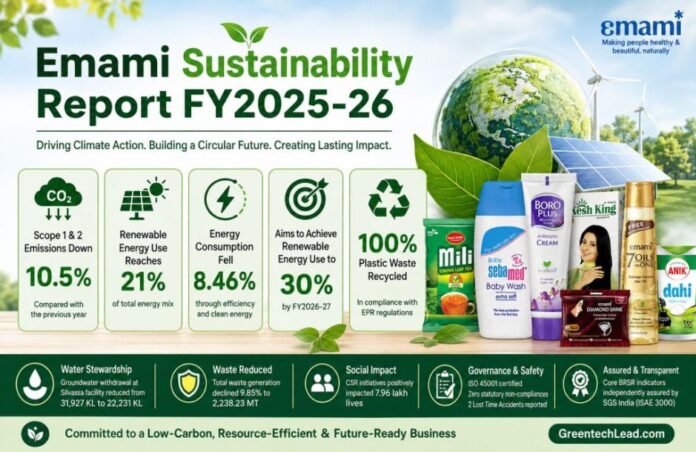
Emami has strengthened its sustainability performance in FY2025-26, delivering measurable progress across climate action, renewable energy, circular economy, resource efficiency, water conservation, workplace safety, and community development.
Climate action remained a major focus during the year. Emami reduced its combined Scope 1 and Scope 2 greenhouse gas emissions by 10.5 percent compared with the previous year by replacing furnace oil and light diesel oil with cleaner fuels such as Piped Natural Gas (PNG) and bio-briquettes. Scope 3 emissions increased to 210,713.42 metric tonnes of carbon dioxide equivalent from 178,152 metric tonnes in FY2024-25, reflecting broader supplier coverage, logistics expansion, increased business activity, and enhanced value chain reporting,
The company also improved its energy efficiency. Total energy consumption declined by 8.46 percent, while non-renewable energy consumption fell 10.71 percent through efficiency initiatives and cleaner energy adoption. Renewable energy now accounts for 21 percent of Emami’s total energy mix, supported by rooftop solar and on-site solar installations. The company has set a target of increasing renewable energy consumption to 30 percent across operations by FY2026-27.
Environmental performance improved further through lower air emissions and waste generation. Emami reported reductions in nitrogen oxides (NOx), sulphur oxides (SOx), and particulate matter emissions. Total waste generation declined 9.85 percent to 2,238.23 metric tonnes from 2,482.67 metric tonnes a year earlier, while waste intensity improved from 0.79 metric tonnes per ₹ crore of turnover to 0.73 metric tonnes per ₹ crore.
Circular economy initiatives also delivered strong results. The company achieved 100 percent recycling of plastic waste in accordance with Extended Producer Responsibility (EPR) regulations. Around 90 percent of packaging is now reusable, recyclable, or compostable, while 80 percent of targeted product portfolios have transitioned to compostable secondary packaging, supporting lower packaging waste and improved resource efficiency.
Water stewardship remained another priority. Through the expansion of Zero Liquid Discharge systems, groundwater withdrawal at the Silvassa manufacturing facility declined from 31,927 kilolitres to 22,231 kilolitres, reducing dependence on freshwater resources and improving water conservation.
On the social and governance front, all manufacturing facilities continued to operate under ISO 45001 occupational health and safety certification. The company reported two Lost Time Accidents during FY2025-26 caused by static electricity and procedural lapses, prompting the installation of automated discharge systems and enhanced employee safety training. Emami also maintained zero statutory non-compliances across operational facilities, while its core BRSR indicators received independent assurance from SGS India Private Limited under ISAE 3000 standards.
Corporate Social Responsibility initiatives positively impacted 7.96 lakh people through education, healthcare, sustainable livelihoods, and community development programmes. The company also continued promoting workforce diversity, inclusion, and gender representation as part of its broader ESG strategy.
Dr. Ankur Chaturvedi, ESG Lead and Associate Vice President – HSE, Excellence and Quality (Operations), said sustainability creates lasting value only when ESG principles become part of everyday business decisions rather than remaining limited to reporting. Guided by this approach, Emami continues to strengthen its transition toward a low-carbon, resource-efficient, and climate-resilient business with ambitious goals for renewable energy expansion, emissions reduction, and circular economy adoption.
SHAFANA FAZAL
